Why Do I Feel Responsible for Everyone’s Feelings?

You notice your mother sounds upset on the phone, and your whole mood changes. A friend messages, “Can we talk?” and before you even know what happened, you are already thinking about how to make them feel better. Your partner becomes quiet, and you start replaying the day in your head, wondering whether you did something wrong.
For some people, this happens so quickly that it barely feels like a choice. Someone else is uncomfortable, disappointed, worried, or angry — and your mind immediately turns their emotion into your responsibility.
That is often when the question appears: “Why do I feel responsible for everyone’s feelings?”
It can be confusing because caring about people is usually seen as a good thing. You may be the person everyone calls when something goes wrong. You may be dependable, thoughtful, emotionally aware, and good at noticing what other people need. None of those qualities are problems by themselves.
The difficulty begins when caring turns into carrying. You stop simply noticing another person’s feelings and start believing that you must change them. You feel guilty when someone is disappointed, anxious when a family member is upset, or uncomfortable saying no because you do not want anyone to feel bad because of you.
This article looks at why that pattern can develop, how childhood responsibilities may shape it, why it can be hard to ask for help yourself, and how to begin separating empathy from responsibility without becoming cold or uncaring.
Educational note: This article provides general mental-health information. It is not a diagnosis and does not replace personalised support from a qualified mental-health professional.
Quick Answer: Why Do I Feel Responsible for Everyone’s Feelings?
You may feel responsible for everyone’s feelings because you have become used to monitoring other people’s moods, preventing conflict, keeping the peace, or putting other people’s needs before your own. For some people, these habits begin in childhood or in relationships where another person’s mood strongly affected the atmosphere around them. Understanding someone’s feelings is healthy; believing you must always fix those feelings is a different pattern.
Why Do Other People’s Moods Affect Me So Much?
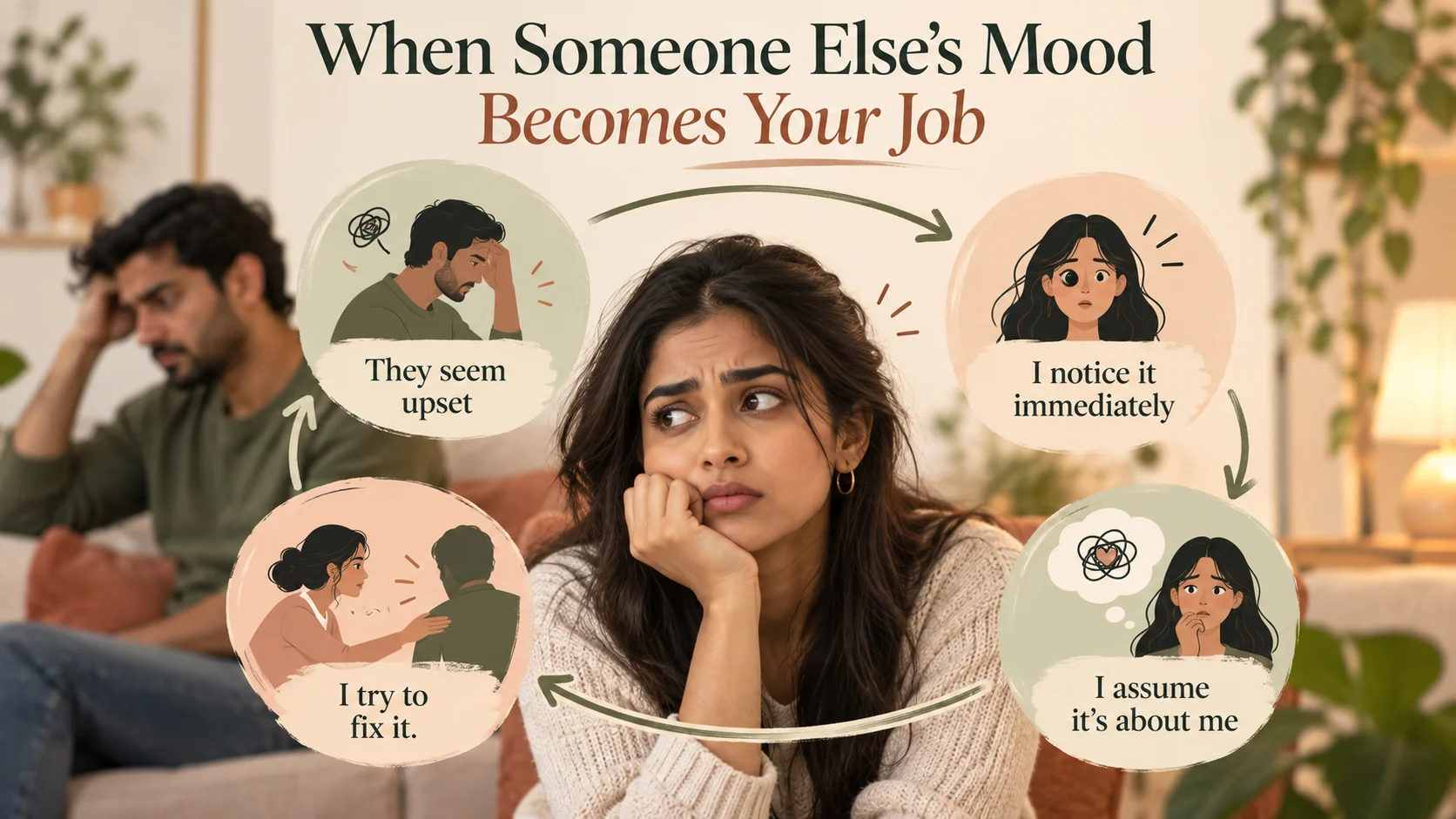
Imagine walking into a room and immediately noticing that someone is irritated. Nobody has said anything to you. You do not know what happened. Yet your body becomes tense and your mind starts searching for an explanation.
Did I say something wrong? Should I ask if they are okay? Maybe I should make tea. Maybe I should change the subject. Maybe I should apologise, just in case.
When other people’s moods affect you strongly, the problem is not necessarily that you are “too sensitive.” Being able to notice tone, body language, silence, or a change in someone’s behaviour can be a useful social skill. The issue is what happens after you notice it.
If another person’s mood automatically becomes something you need to solve, you may be carrying more emotional responsibility than actually belongs to you.
Some people learn to scan the emotional atmosphere because it once helped them feel prepared. If conflict at home was unpredictable, noticing a parent’s mood early may have helped you avoid an argument. If a family member was often overwhelmed, you may have learned to become helpful before anyone asked. If you were praised for being “mature” or “easy,” staying calm and useful may have become part of how you felt valued.
Years later, the same habit can continue even when the situation has changed. A partner has a bad day and you assume it is about you. A parent sounds disappointed and you immediately rethink your decision. A colleague seems annoyed and you spend the evening wondering whether you offended them.
The key distinction is this: noticing another person’s emotion is not the same as owning it.
Why Do I Feel Responsible for My Parents’ Emotions?

This pattern can feel especially strong with parents because family relationships are tied to belonging, loyalty, gratitude, and long histories that began before we had adult language for what was happening.
You might feel responsible for a parent’s emotions if you grew up hearing things such as, “Don’t upset your father,” “Your mother already has enough to worry about,” or “Be the sensible one.” Sometimes nobody says these things directly. You simply learn that home feels calmer when you are cooperative, helpful, successful, or emotionally undemanding.
In some families, children also become the person who listens to adult worries, manages younger siblings, mediates conflict, or tries to keep everyone together. None of these experiences automatically mean something harmful happened. Families go through illness, financial pressure, loss, work stress, separation, and many other difficult periods. Children often help in healthy ways.
The concern is when a child repeatedly takes on emotional or practical responsibilities that are too heavy for their age and feels that the family’s stability depends on them.
Research uses the term parentification for some forms of role reversal in which a child takes on developmentally inappropriate adult-like responsibilities. A 2023 systematic review found that parentification can be associated with both difficult and adaptive outcomes, depending on factors such as the type of responsibility, support available, and the wider context. In other words, it should not be treated as a simple label that automatically predicts how someone will feel as an adult.
For an adult today, the more practical question may be: Do I still feel as though my parents’ disappointment is something I must prevent?
You can love your parents and care about their feelings while also making choices they would not make for you. Disagreement is not automatically disrespect. A parent feeling sad or worried about your decision does not always mean the decision is wrong.
What Happens When You Had to Grow Up Too Fast?

People who had a lot of responsibility early in life often describe themselves as “the mature one,” “the strong one,” or “the person who never caused trouble.” Those identities can be useful. They can build competence, empathy, independence, and resilience.
But there can also be a hidden cost when maturity meant there was very little space for your own needs.
You may have learned to solve problems instead of expressing fear. You may have comforted others without expecting comfort back. You may have become good at reading people because it helped you know what version of yourself was safest to bring into the room.
As an adult, this can sometimes show up as difficulty resting, asking for help, receiving care, or allowing another person to struggle without immediately stepping in.
You may also feel uncomfortable when someone takes care of you. Helping feels normal; receiving help feels strange. Being needed feels familiar; having needs of your own can feel embarrassing.
This is one reason “growing up too fast” is not only about having chores or responsibilities. It can also mean learning, very early, that your role is to be steady while everyone else is allowed to be messy.
Why Do I Always Have to Be the Strong One?
Being the strong one can become part of your identity. Other people may reinforce it too. Friends tell you, “You always know what to do.” Family members call you first during a crisis. Coworkers trust you because you rarely complain.
At first, that can feel good. Being dependable creates connection and purpose.
The problem is when strength stops being something you can offer and becomes something you are never allowed to put down.
You may think, “If I fall apart, who will handle everything?” Or, “My problems are not serious enough compared with what everyone else is dealing with.”
Over time, this can create a one-way emotional life: you listen, organise, reassure, and help, while very few people know when you are struggling. Related reading: Stress Disorders and Burnout: How Counselling Supports Recovery.
Healthy strength includes flexibility. Sometimes you cope well. Sometimes you need support. Sometimes you have the answer. Sometimes you do not. Letting someone help you does not cancel out everything you have done for others.
Why Do I Always Take Care of Everyone Before Myself?

Taking care of people can come from genuine love. The goal is not to turn kindness into a problem.
A useful way to think about it is to separate empathy, support, responsibility, and over-responsibility.
Empathy means: “I can understand that you are hurting.”
Support means: “I can be here with you, listen, or help within my limits.”
Responsibility means: “If my actions caused harm, I will own my part and try to repair it.”
Emotional over-responsibility sounds more like: “You are upset, therefore I must make you feel better.”
Those statements may look similar on the surface, but they lead to very different relationships.
If you are supporting someone, you can still recognise your limits. If you are carrying them, their emotional state begins to control yours.
You may cancel plans because someone sounds lonely, give advice long after you are exhausted, agree to things you resent, or keep trying to solve a problem the other person is not ready to change.
Sometimes the most supportive thing you can do is stay present without taking over.
Why Do I Feel Guilty Putting Myself First?
Guilt can be one of the strongest reasons this pattern continues.
You might understand logically that you deserve rest, privacy, or time for yourself, but the moment someone is disappointed, the old feeling returns: I am being selfish.
It helps to ask what the guilt is actually telling you.
Sometimes guilt is useful. If you behaved unfairly or hurt someone, guilt may encourage you to repair the situation.
But sometimes guilt appears simply because you did something unfamiliar. Saying no may feel wrong because you are used to saying yes. Letting someone solve their own problem may feel uncaring because you are used to stepping in.
An uncomfortable feeling is not always proof that you made a bad decision.
Try replacing “I feel guilty, so I must have done something wrong” with “I feel guilty. Let me check whether I actually did something wrong.”
That small pause can change the entire conversation in your head.
Why Is It So Hard for Me to Ask for Help?
People who automatically care for others often find asking for help surprisingly difficult.
You may worry that you are becoming a burden. You may assume other people are already dealing with enough. You may prefer to solve things privately and tell people only after the problem is over.
There may also be another fear underneath: if you are no longer the capable one, will people still value you in the same way?
Learning to ask for help does not require suddenly sharing everything with everyone. Start small.
Ask someone to listen instead of solving the problem. Let a colleague help with one task. Tell a friend you have had a difficult day instead of automatically saying, “I’m fine.”
Receiving support is a relationship skill too. For healthy communication guidance, read How to Build Stronger Connections in the Age of Digital Communication.
How Do I Stop Feeling Responsible for Everyone?
You do not need to become detached or stop caring about people. The goal is to create a healthier line between compassion and responsibility.
1. Pause before you fix
When someone looks upset, notice the urge to immediately act. Give yourself a moment before offering a solution.
2. Ask instead of assuming
You can say, “Do you want advice, practical help, or just someone to listen?” This gives the other person ownership of what they need.
3. Check what is actually yours
If you made a mistake, take responsibility. If another adult is disappointed because you made a reasonable choice they do not prefer, that emotion may belong to them.
4. Let people have feelings
Someone can be sad, frustrated, or disappointed without you having to remove that feeling. Supporting people does not mean guaranteeing that they never feel uncomfortable.
5. Practice small acts of not rescuing
You might wait before replying to a non-urgent message, let a sibling handle their own disagreement, or allow a friend to make a decision without giving them five solutions.
6. Notice guilt without obeying it immediately
You can feel guilty and still wait before changing your answer. Ask whether your choice was unfair, or simply unfamiliar.
7. Make room for your own needs
Add your needs to the conversation before you are already exhausted. Caring for yourself only after everyone else is completely satisfied usually means your turn never arrives.
A Simple Reflection: Is This Mine to Fix?
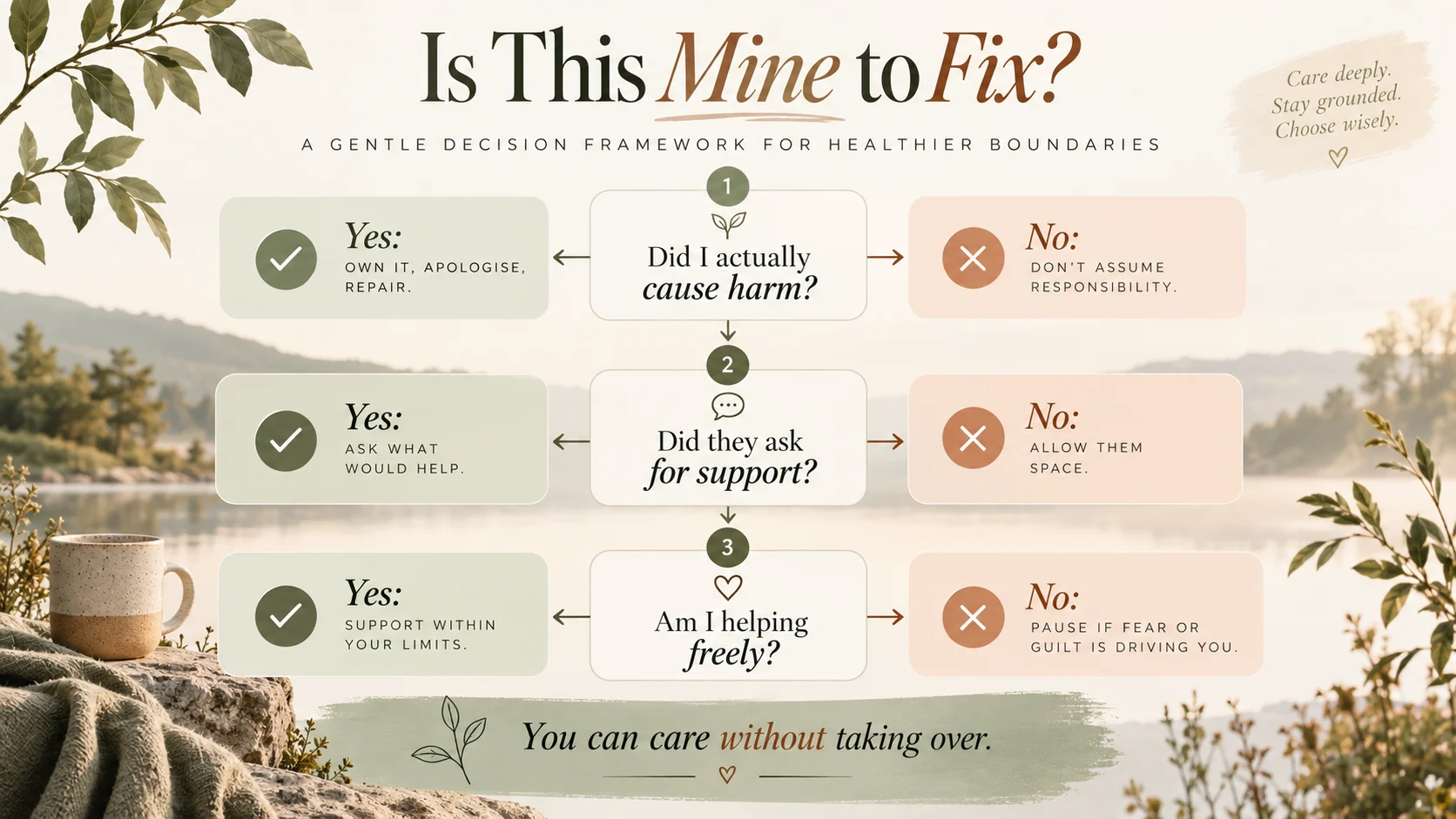
When you notice yourself taking responsibility for someone else’s feelings, ask these questions:
- Did I actually do something harmful?
- Has this person asked me for support?
- What part of this situation is within my control?
- What part belongs to them?
- Am I helping because I genuinely want to, or because their discomfort makes me anxious?
- Can I care about them without taking over the problem?
This is a reflection tool, not a psychological assessment. Its purpose is simply to slow down an automatic response and help you separate responsibility from anxiety.
When Can Therapy Help With Emotional Responsibility?

You do not need therapy because you are caring, responsible, or close to your family.
Therapy may be useful when the pattern starts affecting your wellbeing or relationships and feels difficult to change on your own.
For example, you may find that you cannot say no without intense guilt, you become anxious whenever someone is unhappy with you, you repeatedly take responsibility for family conflicts, or you understand the pattern intellectually but still feel compelled to fix everyone’s problems.
A therapist can help you explore where the pattern developed, notice what happens emotionally when you do not step in, and practise responses that allow you to remain caring without becoming responsible for every outcome. If you are ready to speak with a professional, you can book a therapy appointment with PsyQuench.
If this pattern feels familiar and exhausting, the goal is not to become less compassionate. It is to make sure compassion includes you too.
Frequently Asked Questions
Is it normal to feel responsible for other people’s feelings?
It is common to care about how other people feel and to consider how your behaviour affects them. The pattern becomes more difficult when you routinely assume that another person’s sadness, anger, disappointment, or stress is yours to solve, even when you did not cause it.
Why do I panic when someone is angry with me?
Anger can feel threatening for many reasons. You may dislike conflict, worry about rejection, or have learned to monitor other people’s moods closely. Feeling anxious does not automatically mean you did something wrong. It can help to separate the other person’s emotion from the facts of what happened.
Why do I always try to fix other people’s problems?
Fixing can feel useful and comforting, especially if helping has been part of your identity for a long time. It can also reduce your own anxiety because solving the problem makes the emotional tension disappear. Asking what kind of support the person actually wants can help interrupt that automatic role.
Can I care about someone without fixing their feelings?
Yes. You can listen, acknowledge what they are experiencing, offer practical help when appropriate, and still allow them to have their own emotional response. Caring does not require controlling the outcome.
Why do I feel guilty putting myself first?
If you are used to prioritising other people, making room for yourself can feel unfamiliar and therefore uncomfortable. Guilt does not always mean you have behaved selfishly. Check whether you have actually harmed someone or simply disappointed an expectation.
Can childhood family roles affect adult relationships?
They can influence how some people understand responsibility, closeness, conflict, and support, but childhood experiences do not determine adult behaviour in a simple or fixed way. Many other factors shape relationships, and patterns can change.
Final Thoughts
If you often wonder, “Why do I feel responsible for everyone’s feelings?”, try not to turn that question into another responsibility you need to solve perfectly.
Start by noticing the moments when the pattern appears.
Someone is disappointed. What happens inside you?
Someone is quiet. Do you immediately assume you caused it?
A family member has a problem. Do you offer support, or do you automatically make solving it your job?
Change often begins in those small moments.
You can care without controlling how someone feels. You can support people without carrying every problem. You can apologise when you genuinely caused harm without apologising simply because somebody is unhappy.
Most importantly, you can remain a thoughtful, loving person while allowing other adults to have emotions that you do not need to fix.