Career Options After MA Applied Psychology in India: Roles, Requirements & NCAHP

Career options after MA Applied Psychology include research, education support, workplace roles, community programmes and some mental-health-related work—but the degree alone does not qualify you for every job title in those fields. The most useful next step is to match what you studied and can do with the requirements of a specific role. This PsyQuench guide compares the main directions, where extra qualifications matter and how to test a career choice before spending more time or money on another course. It does not treat a list of possible titles as a list of current vacancies, and it does not assume that a general master’s degree confers clinical registration.
What Can You Do After MA Applied Psychology?
Applied psychology is broad by design. Graduates may be interested in how people learn, work, make decisions, manage difficulties or interact with services. That can lead toward research teams, student support, workplace learning, community programmes or further professional education. The word “may” is important. An individual role can have requirements that your degree does not meet, and the same job title can mean different work in different organisations.

Before reading any career list, decide what kind of work you want to spend most of your week doing. Do you enjoy analysing data, working directly with people, designing programmes or teaching? Do you prefer a university, school, nonprofit, organisation or healthcare setting? Your answers do not determine a permanent identity; they make the next search more focused.
PsyQuench’s broader guide to psychology career paths can help if you are comparing the whole field. This article stays with the narrower question of what an MA Applied Psychology graduate can explore and what each direction asks of them. A promising role is one for which you can identify the work, the entry requirements and a realistic next action.
The Skills You Already Bring From Your MA
Your degree may have given you practice in reading research, designing a study, interpreting data, understanding behaviour, writing reports and applying psychological ideas to real settings. The exact mix depends on your university, specialisation, dissertation and practical work. Do not assume that all MA Applied Psychology programmes produce identical skills—or that an employer will know what yours included without evidence.
Make a one-page evidence inventory. Under “research,” name the methods you actually used. Under “communication,” include a report, presentation or training material you produced. Under “practical experience,” describe the setting, your supervised responsibilities and what you learned. Avoid turning observation into a claim of independent clinical competence. If you have not yet had a particular experience, write “to develop,” not a vague statement that you are “well versed.”
This exercise makes job advertisements easier to read. A research assistant role may ask for data handling and writing; a student-support role may value communication and referral judgment; an HR role may ask for training or evaluation experience. Your degree is the foundation, while concrete examples show how you can contribute. The next sections examine where those examples might be useful.
Research and Academic Career Routes
Research work can include recruiting participants, managing data, reviewing literature, assisting with surveys, preparing reports or supporting programme evaluation. A project role may be in a university, hospital, nonprofit or research organisation. The task and supervision matter more than an impressive title. When you see an opening, read the essential qualifications, methods required, contract length and reporting line before deciding whether to apply.
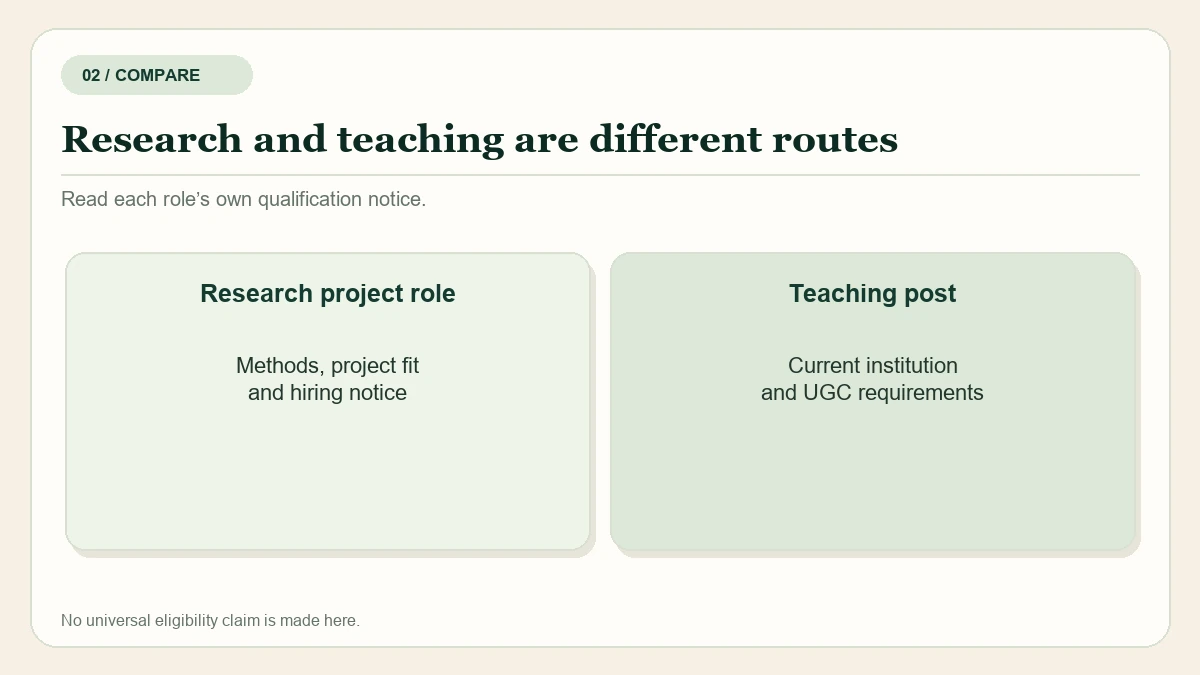
Academic teaching is a separate question. The UGC teaching eligibility notice sets conditions for relevant higher-education posts, including master’s marks and NET/SET/SLET or applicable PhD-related exemptions. This does not mean every education-related job requires NET, nor does it mean a master’s degree automatically qualifies you for a faculty post. The current recruitment advertisement and applicable UGC rules are the documents to check.
If research appeals to you, a dissertation can become a useful portfolio example—provided you can explain its question, method, limitations and what you would improve. A PhD may be appropriate for some academic goals, but it is not the automatic next degree for everyone who enjoys a research project. Talk to supervisors and inspect current postings to see what level of training your preferred role actually requires.
Workplace and Organizational Opportunities
Applied psychology can be relevant to learning and development, people research, employee experience, organisational assessment and related workplace functions. In these settings, the work is usually defined by the employer’s needs rather than by the degree title alone. A people-analytics role may require statistical tools; a training role may require facilitation and material design; an HR position may place greater weight on employment law or operations experience.
This is an area where generic career lists often overpromise. “Organisational psychologist” on a list does not tell you whether a particular employer is hiring, what experience it expects or whether that title carries a particular professional condition. Compare five or ten real advertisements instead. Note the tasks that recur and the requirements that appear as mandatory rather than preferred.

If you have an academic project about motivation or workplace behaviour, translate it into language an employer can use. Explain the problem you investigated, the evidence you considered and the limits of your conclusion. Avoid promising that psychological insight alone solves a company’s people problems. Good workplace practice also involves data protection, fair processes and collaboration with colleagues whose expertise differs from yours.
Education and Student-Support Roles
Schools and colleges may employ staff for student wellbeing, guidance, learning support or programme coordination. These roles can be meaningful for a psychology graduate, but their qualifications and duties vary widely. A school counsellor role is not identical to a university teaching post, and neither should be inferred from a generic “education careers” list.
Read a school or college job notice for the age group, direct-contact responsibilities, supervision, safeguarding requirements and qualifications. Ask whether the role is preventive support, individual counselling, academic guidance or a mix. A title that sounds familiar can hide a very different day-to-day job. For higher-education teaching, return to the UGC conditions and the particular institution’s advertisement.
Student work requires care with boundaries. A graduate who is good at listening should still know when a concern needs referral, what information must be documented and which decisions belong to a qualified specialist. If your interests lie with younger people, experience in an appropriately supervised setting can help you decide whether this is the work you want, without treating the experience as a substitute for required credentials.
What About Counselling and Mental-Health Careers?
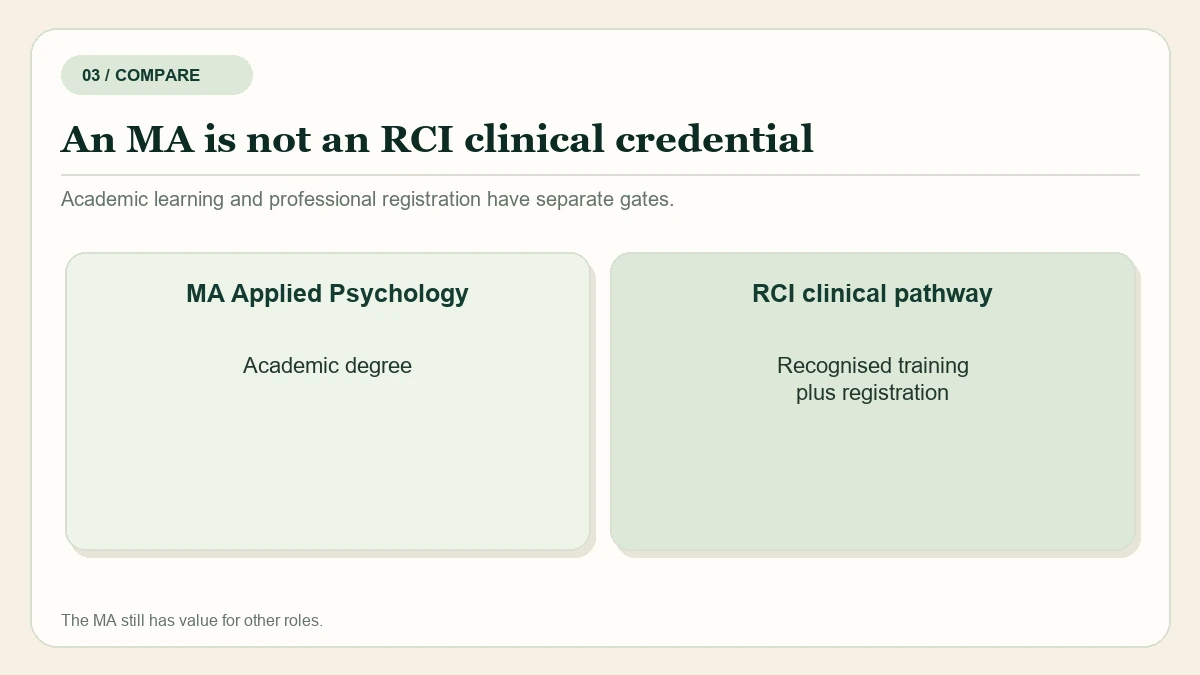
Mental-health work is the category where imprecise career advice can cause the most trouble. An MA Applied Psychology may be relevant background for some supervised or support roles, but it does not by itself make someone an RCI-registered clinical psychologist. The RCI lists specific professional programmes, and its registration framework is separate from the fact that a university has awarded a master’s degree. PsyQuench’s guide to RCI versus non-RCI psychology courses explains the distinction in depth.

If a job advert asks for a clinical psychologist, check the recognised qualification and CRR requirement. If it asks for a counsellor, read what the employer expects in education, supervision and scope. Do not assume that the absence of a regulated title means no training or ethical responsibility is needed. Equally, avoid assuming that every people-facing role is clinical practice. Community outreach, case coordination and research interviews may involve direct contact without authorising diagnosis or treatment.
The RCI programme list is a primary source for the regulated clinical route. The NCAHP framework is another, distinct professional context, with category-specific qualification and experience requirements. It should not be reduced to “an MA means registration.” Any statement about an individual’s eligibility needs their exact course, mode, experience and the current official rules.
Which Roles Need Extra Qualifications or Registration?
Instead of asking whether your MA is “enough” for the whole field, ask what the specific role requires. A higher-education post may require NET or an applicable exemption. RCI clinical practice requires a recognised professional route and registration. Another post may be open to graduates with project skills, while still preferring experience. A state or employer may add requirements of its own.
Create three columns for a target role: legal or regulatory requirement, employer requirement, and useful skill. This prevents a common error—spending money on a course because it sounds relevant while missing a mandatory credential. It also prevents the opposite error of thinking you need another degree when the actual gap is a demonstrable skill or supervised experience.
The NCAHP 2026 registration regulations illustrate why category-specific reading matters. A broad statement such as “psychology master’s graduates can register” leaves out degree mode, exact category and experience conditions. Use the official schedule and seek an authoritative determination for your own documents. RCI and NCAHP should not be treated as two names for one licence.
Choosing a Career That Fits Your Background
Put your preferences beside your current evidence. Suppose you like research but have little interest in long-term direct client work. A project assistant role might be a better experiment than enrolling immediately in a clinical programme. Suppose you value one-to-one support and are willing to complete a regulated training route. Then eligibility and supervised learning need to be examined before you commit to a course. Neither example establishes a universal “best” career.

Your bachelor’s subject and degree duration may matter for some further programmes. Your current location and finances may determine whether a full-time route is feasible. Caring responsibilities and a need for income are not minor details to ignore in a career plan. Compare time, cost and likely day-to-day work alongside the attraction of a title.
A useful choice is specific enough to test: “I want to try student-support work in a supervised setting this year,” or “I will verify eligibility for an RCI professional programme.” “I want a good psychology career” is understandable, but too broad to guide the next application. Write a direction that can be checked against real notices and conversations.
Gaining Practical Experience in Your Preferred Area
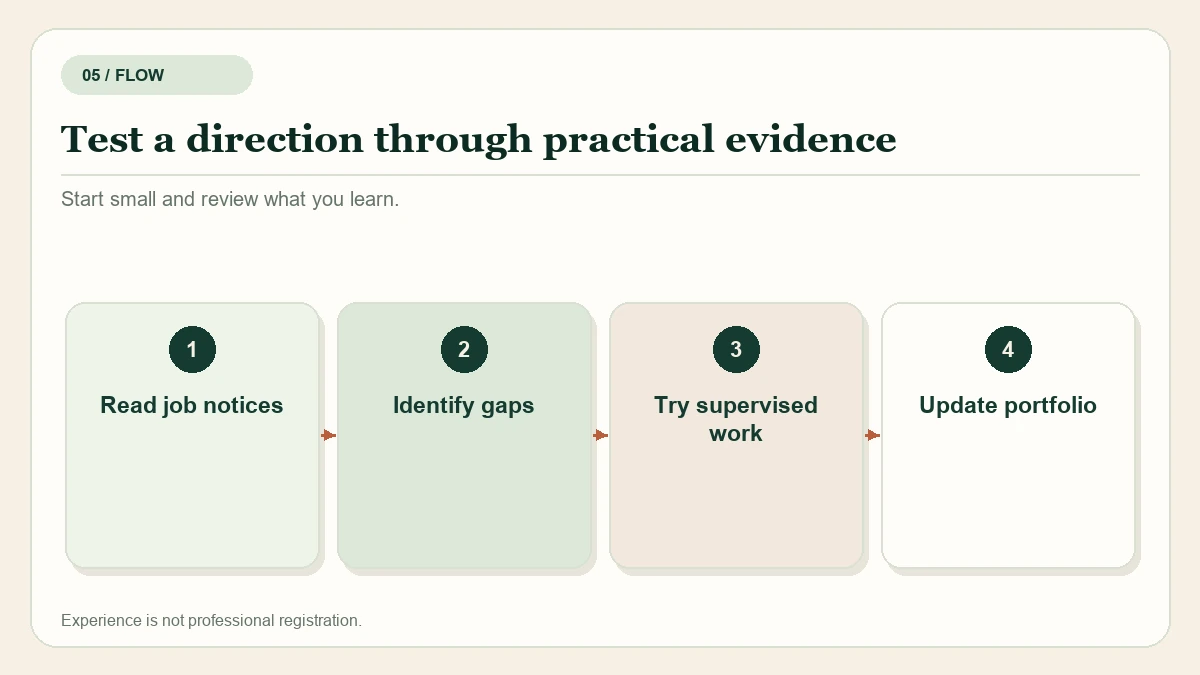
An internship can help you see what a role involves, practise appropriate tasks and learn where your skills are thin. It is most useful when the setting, supervision and responsibilities match your goal. PsyQuench’s article on psychology internships that actually build skills offers a more detailed way to judge opportunities.
For research, look for experience with a clear question, method and feedback on your work. For organisational work, seek a project that produces an interpretable output rather than an impressive title alone. For people-facing settings, be especially clear about supervision, confidentiality and what you may not do independently. A certificate confirming attendance is not the same as evidence of competence, and neither is a professional registration.
Keep a record of what you actually did, the tools used and what you learned. Remove confidential details from any portfolio example. When you speak to an employer, precise accounts are more persuasive than a list of short programmes with unclear outcomes. Practical experience should sharpen the career decision as well as your application.
Planning Your Next Career Step
Choose two role families rather than ten. Collect current advertisements for each and mark every requirement as mandatory, preferred or unclear. Compare the roles’ daily work, qualification pathway and expected experience. If a regulated credential appears, verify it with the regulator. If the gap is skill-based, identify a project or supervised opportunity that could show progress.
Set a short review period. Over the next month, you might prepare a portfolio example, contact an appropriate professional for an informational conversation, apply to suitable roles and investigate one training route. Track what you learn, not only whether you receive an offer. A rejection may reflect a competitive opening or an eligibility gap; the two call for different responses.
Avoid salary promises from undated career blogs. Pay varies by role, employer, city, contract and experience. If salary is a deciding factor, use current job advertisements and direct employer information. The most dependable plan joins your interest to evidence: what the role actually requires, what you can already demonstrate and what the next gap is worth closing.
Frequently Asked Questions
Can I become an RCI clinical psychologist with MA Applied Psychology alone?
Do not assume so. The RCI professional qualification and CRR registration route must be checked separately. An academic MA is not automatic proof of that status.
Is UGC NET required for every education job?
No. Teaching posts governed by UGC conditions and school or student-support roles can have different requirements. Read the current advertisement and applicable rules.
Does an internship count as professional registration?
No. It may build skills and experience, but it does not replace a recognised qualification or a regulator’s registration process.
Which career pays the most?
There is no reliable single answer across roles and cities without current, comparable job data. Check live advertisements and total working conditions rather than relying on an unsourced ranking.
Choose the Role, Then Check the Route
Your MA Applied Psychology gives you a foundation, not one prescribed future. You can explore research, education, workplace and community roles while being precise about regulated clinical work. Pick a role whose work interests you, verify what it requires and decide whether your next move is an application, a supervised experience or further qualification. That order makes the decision more useful than collecting another course name first.
Publication and visual brief
Article word count: 2238 | Source check: 15 November 2026 | Status: editorial review before publication
SEO and publishing details
SEO title: Career Options After MA Applied Psychology in India
Slug: career-options-after-ma-applied-psychology
Meta description: Compare research, education, workplace and mental-health directions after MA Applied Psychology, with role requirements and realistic next steps.
Primary keyword: career options after MA applied psychology
Category: Psychology Courses and Careers
Intent: Comparative career planning
Schema: Article; FAQPage only if applicable
Canonical: Self-referencing; differentiate from broad psychology-careers page
Reviewer: Psychology academic/career specialist and regulatory reviewer for title claims, names only after verification
Incoming links: General psychology career paths; RCI-vs-non-RCI courses; psychology internships
Final editorial checks
Check 2,000-plus words, ten H2 order, no fabricated jobs or pay, three existing blog links, and qualification/registration distinctions.
Image production plan
Image 1
Featured after title. Purpose: show multiple paths without implying all are immediately open. Concept: MA graduate at a crossroads with four workplace settings, labelled research, education, workplace, community. Premium editorial illustration, navy/teal/sand. Text: “After MA Applied Psychology”. Prompt: Indian psychology postgraduate comparing four realistic career environments, balanced editorial illustration, no salary claims or clinical title guarantee, clear headline area. Landscape 16:9. Filename: ma-applied-psychology-careers-featured.png. Alt: Graduate considering several applied psychology career directions. Accuracy: conceptual paths only.

Image 2
Under H2 02. Purpose: connect degree to evidence. Concept: skills inventory with research, communication, data and practical experience, blank proof boxes. Prompt: Clean editable-style skills inventory diagram for a postgraduate, four categories with blank evidence fields, readable labels. Portrait 4:5. Filename: ma-applied-psychology-skills-inventory.png. Alt: Worksheet for documenting skills gained during a psychology master’s. Accuracy: no assumption all degrees include every skill.
Image 3
Under H2 03. Purpose: distinguish research and teaching. Concept: two routes, project role and faculty post, with different requirements. Prompt: Two-track academic career diagram, generic requirements area, no unverified eligibility figures. Landscape 3:2. Filename: research-vs-teaching-routes.png. Alt: Comparison of research project and higher-education teaching paths. Accuracy: refer to current UGC and job notices.
Image 4
Under H2 06. Purpose: clarify clinical boundary. Concept: academic MA card separated from RCI recognised training and CRR card, with no automatic arrow. Prompt: Accurate credential comparison infographic showing academic degree, professional training and registration as distinct, no official seals. Square 1:1. Filename: ma-vs-clinical-qualification.png. Alt: Diagram distinguishing an MA degree from RCI clinical qualification and registration. Accuracy: not individual eligibility advice.
Image 5
Under H2 08. Purpose: support choice. Concept: matrix axes direct people work versus research/organisation and immediate application versus further qualification. Prompt: Clear two-axis career decision map with illustrative role groups and caveat “Check role requirements”, no salary statistics. Landscape 16:9. Filename: applied-psychology-career-map.png. Alt: Decision map for comparing career directions. Accuracy: editorial framework.
Image 6
Under H2 10. Purpose: guide a 30-day test. Concept: week-by-week checklist for ads, requirements, portfolio, applications. Prompt: Four-week practical career planning checklist, readable labels, neutral editorial design. Portrait 4:5. Filename: psychology-career-30-day-plan.png. Alt: Four-week plan to test a career direction. Accuracy: no promise of employment.
Advance Your Applied Psychology Career
Prepare for high-impact roles in clinics, schools, and corporate wellbeing through supervised internships and advanced psychological test masterclasses. You can Explore All Skill Courses or get started directly below: