Does My Child Need Counselling Even If They Have Good Grades & Seem Fine?

Does my child need school counselling if they get good grades, have friends and seem happy? Perhaps not—but those positive signs do not tell you everything about how a child feels or copes. Counselling can mean brief, practical school support, while some children need no individual sessions and others may need assessment outside school. At PsyQuench, the useful starting point is the reason support has been suggested: what has the child noticed, what has the school observed and what would a conversation with a counsellor aim to help? Those questions let you make a decision without treating ordinary childhood difficulty as illness.
Why Do Parents Assume a Happy Child Doesn’t Need Counselling?
Parents usually see grades and friendships as signs that a child is doing well because they often are. A child who goes to school willingly, keeps up with work and has people to spend time with has important strengths. It is reasonable to hesitate if the school recommends counselling without explaining why. The hesitation becomes less useful only when “doing well” is treated as proof that there can be no private concern.

Children can manage public tasks while still finding particular situations hard. One child may enjoy friends yet feel anxious before presentations. Another may get good marks but fear disappointing adults. A third may simply want to talk through a change at home. These are illustrations, not reasons to presume that your child has a problem. The CDC’s overview of children’s mental health notes the importance of looking at symptoms and functioning; it does not make grades a diagnostic test.
When a suggestion comes from school, ask what prompted it. Was there a specific event, a change in behaviour, a request from the child, or an ordinary school-wide support programme? Those are very different situations. A parent should be able to understand the proposed purpose before deciding whether individual counselling is appropriate.
Emotional Wellbeing Goes Beyond School Performance
School performance tells you how a child is meeting certain demands. Emotional wellbeing also includes whether they feel safe enough to ask for help, recover from setbacks, maintain friendships that feel supportive and have some room to be themselves. None of these can be read directly from a report card. Equally, a lower mark does not by itself reveal a mental-health condition.

It can help to look at change rather than a checklist of ideal behaviour. Is your child still enjoying ordinary activities? Have they become unusually withdrawn, irritable or worried compared with their own pattern? Are they sleeping and eating as they usually do? These observations are reasons for a conversation, not a diagnosis. Ask the child what school feels like at the moment before interpreting what a mark or teacher comment means.
The aim of support need not be to “fix” a child. Sometimes a school counsellor helps a student name a concern, practise a coping or communication skill, or find the right adult to approach. The WHO, UNESCO and UNICEF guidance on school mental-health support treats wellbeing as part of the school environment, with early support and appropriate referral. The child’s experience should remain central, not a measure of whether the school or parent has succeeded.
Why Children May Not Talk About What Bothers Them
Adults sometimes ask, “If something is wrong, why didn’t my child tell me?” A child may not have clear words for what they feel. They may assume a worry is too small to mention, fear a parent will be upset, or wait until they understand it better. Some prefer talking while doing an activity rather than sitting down for a formal conversation. Others are already speaking to a trusted adult or friend, but not about every detail.
These possibilities are not evidence that your child is hiding a serious problem. They simply show why repeated “Are you okay?” questions can get a short “fine” even in a caring home. UNICEF’s parent guidance on stress, anxiety and depression encourages listening and support. In practice, that can mean asking an open question—“What has felt easiest and hardest at school this week?”—and allowing an ordinary answer.
If the school has raised a concern, tell your child what you know without making it sound like a charge. “Your teacher mentioned you seemed quieter after lunch recently. I wanted to check how things have been for you” gives a specific observation and room to correct it. “Why haven’t you told me what’s wrong?” assumes a hidden problem and may close the conversation before it begins.
The Everyday Challenges Children Face at School
Children navigate more than lessons. Friend groups shift. A new class can change where they feel comfortable. Exams, performances, sports teams, online interactions and disagreements can all matter even when marks remain steady. A challenge can be ordinary and still deserve a conversation. Support is often most useful when it helps a child handle a real situation rather than making them feel that their feelings are abnormal.
Consider a child who has friends but worries about being excluded when two of them argue. A parent may see a healthy social life; the child may be spending a lot of attention on what happens during break time. The right response could be an open talk at home, a conversation with a teacher, a brief school counselling session or nothing formal if the situation is resolving. The example does not show that every friendship problem requires therapy.
Ask the school what challenge it is trying to address and how it knows. A specific observation is more useful than a broad label such as “needs counselling.” It also gives your child a fairer chance to describe their side of the situation.
How Unspoken Worries Can Affect a Child Over Time
Some worries pass as children adapt. Others persist and begin to affect concentration, sleep, attendance, enjoyment or relationships. What matters is not whether a child has ever been upset; all children are. What matters is the pattern, intensity and effect on daily life. A parent and school may each see only part of that pattern, so sharing concrete observations can help.
Avoid making every change into a warning sign. A quieter week after a tiring term is different from a sustained withdrawal that the child finds distressing. A child may also be functioning well while asking for a safe place to talk about something important. Both possibilities deserve curiosity rather than an instant label.
If a child describes feeling unsafe, is at risk of harm or has a marked change in functioning, the response needs to be more direct than a routine counselling appointment. Seek appropriate qualified help promptly and follow the school’s safeguarding process. The point of early attention is not to predict a disorder; it is to respond proportionately to what is actually happening.
What School Counsellors Actually Do
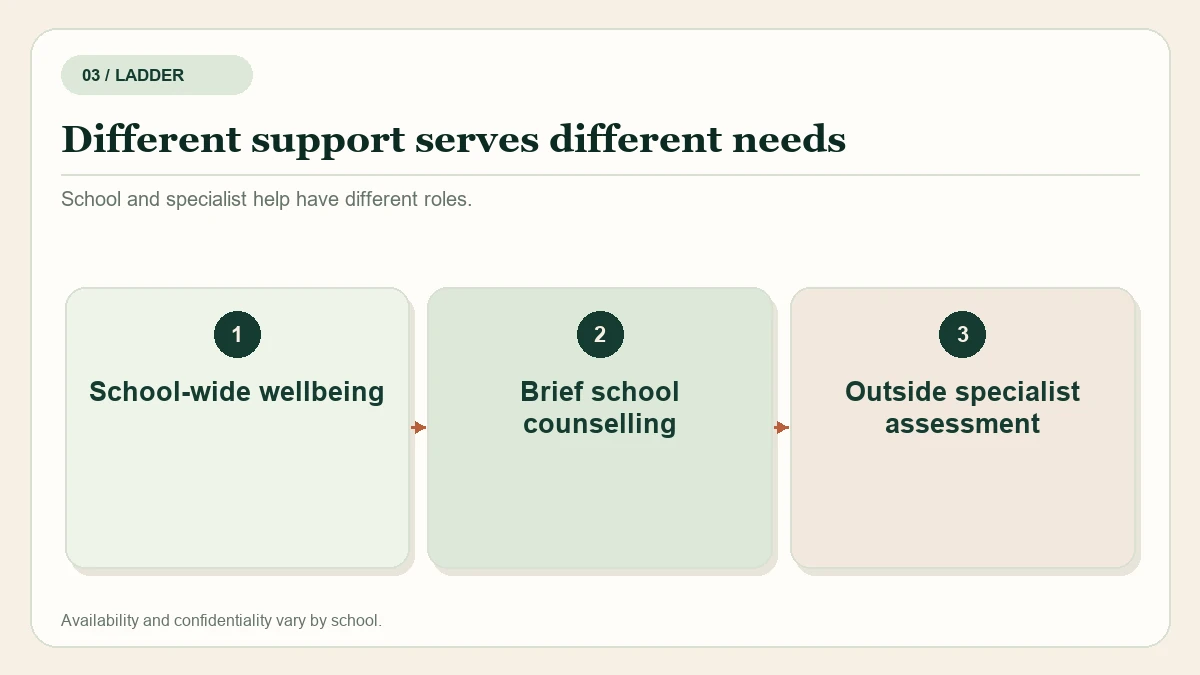
The phrase “school counselling” covers more than one activity. A school may offer lessons or activities that help all students with wellbeing. A counsellor may meet a student briefly about a particular issue. A child with more complex or persistent needs may be referred for specialist assessment or longer-term care. These are different levels of support, and a parent should ask which one is being proposed.

The American School Counselor Association’s position statement describes brief school-based support and referral when needs exceed that scope. It is a helpful explanation of professional roles, not a rule that applies unchanged to every Indian school. Schools differ in staffing, consent procedures, record-keeping and what a counsellor can provide.
PsyQuench’s article on child and adolescent mental-health counselling approaches gives more background on support methods. For the decision in front of you, ask who will meet your child, what the goal is, whether the meeting is one-off or ongoing, and how the child’s own wishes will be heard.
How Counselling Can Help Before Problems Become Serious
Support need not wait for a diagnosis. A child might use a short conversation to practise handling a friendship disagreement, talk through a school transition, or learn how to approach a trusted adult. The goal should be clear enough that the child and school can tell whether the support is useful. “A counsellor can help with everything” is too vague to guide a parent’s consent.

Preventive support is not the same as recommending individual counselling to every child. A school-wide wellbeing activity may be available to all students, while individual sessions should have an understandable reason and an appropriate process. If your child is content and no one can identify a concern or goal, asking for more information is a reasonable response.
Counselling also has limits. A school counsellor may help identify when a child needs an outside clinician, especially if there is persistent distress or a concern beyond the school’s scope. Seeing a counsellor should not be presented as a punishment, a secret investigation or proof that the child has failed. It is one possible form of support among several.
When Parents Should Pay Closer Attention
Notice changes that last or interfere with ordinary life: repeated school avoidance, persistent worry or sadness, a marked change in sleep, loss of interest, or a child’s own request for help. These are examples to discuss with a qualified professional, not a checklist that diagnoses a condition. A concern about immediate safety deserves prompt action regardless of grades.
Ask about the child’s baseline. A naturally quiet child is not automatically in trouble because they are quiet. A normally talkative child who suddenly withdraws may be signalling a change worth exploring. Look at what the child says, what adults observe across settings and whether a particular event helps explain the change.
Parents can also notice their own reaction. Fear of stigma may make a school suggestion feel more threatening than it is. PsyQuench’s article on why therapy is not only for people with mental illness can help separate support from diagnosis. At the same time, rejecting stigma does not mean agreeing to an unclear intervention. You can ask careful questions and still be open to help.
Working Together With the School Counsellor
Begin with specific questions: What has the school noticed? When did it start? Has the child asked to speak to someone? What is the proposed goal? How will the school know whether the support is helping? Who will contact parents if the concern changes? These questions turn an alarming phrase into a practical conversation.
Ask about consent, confidentiality and its limits under that school’s policy. A child needs some confidence that speaking honestly will not turn every sentence into a report at home. Parents also need to know how the school handles safeguarding concerns and when they will be informed. There is no single rule to assume for every institution; request the actual policy or explanation from the staff member involved.
Try not to make the child carry messages between adults. A parent–school conversation can clarify the plan while leaving the child free to describe their own experience. If there are stresses at home affecting the discussion, PsyQuench’s guide to parenting stress in Indian households offers additional context. The aim is cooperation around the child, not a search for which adult caused the issue.
Choosing the Right Kind of Support for Your Child
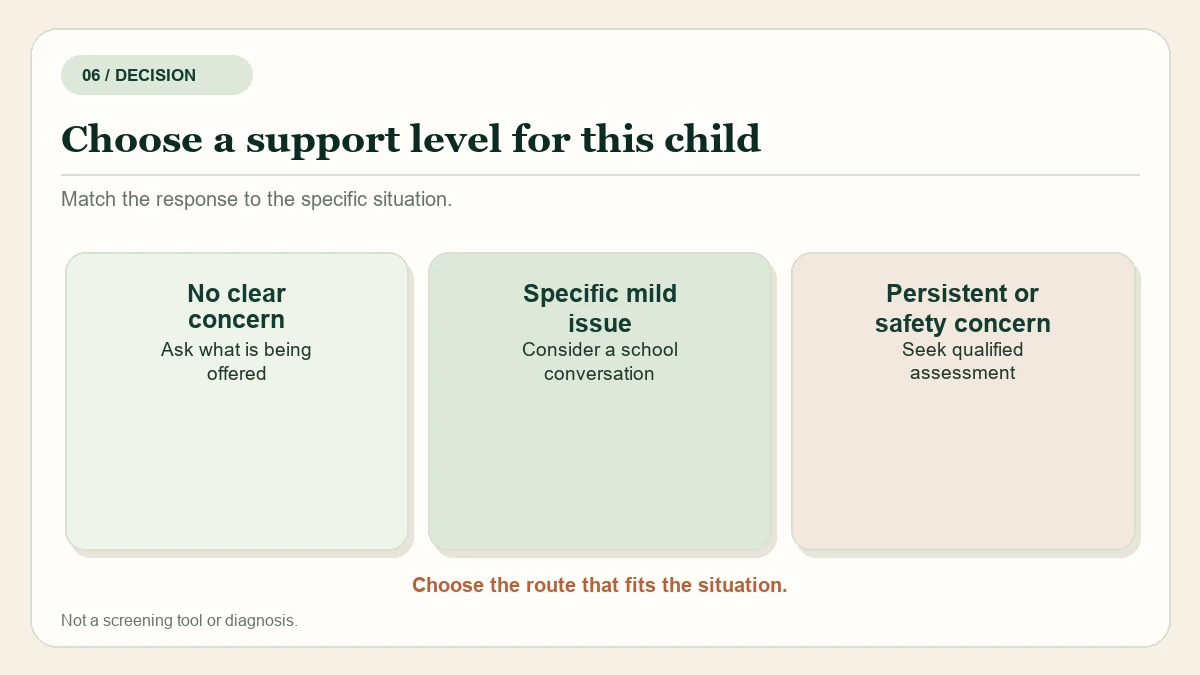
Put the information together before deciding. If there is no individual concern and the school is offering a general wellbeing activity, you may simply want to understand what it includes. If there is a specific, mild issue, a brief school conversation may be appropriate. If distress is persistent, functioning is changing substantially, or safety is at issue, ask a qualified specialist for assessment rather than expecting a school counsellor to do everything.
The child’s view matters at every level. Explain what is being proposed in age-appropriate language and ask what they think would help. A child may not get to make every decision alone, especially where safety is involved, but their account can change what adults understand. Avoid promising absolute secrecy or insisting that they tell you every detail after a session.
Set a time to review. What does the child say after a few weeks? What has the school observed? Is the original goal still relevant? You can change course if the support is not useful. The question is not whether “good children” need counselling. It is which support, if any, fits this child’s situation now.
Frequently Asked Questions
Does my child need a diagnosis to see a school counsellor?
No diagnosis is required for many forms of school support, though the services offered vary by institution. Ask what the counsellor will do and what goal is being proposed.
What if my child says everything is fine?
Take the answer seriously, then remain available. You can also share the school’s specific observation calmly and revisit the conversation later rather than pressing for a confession.
Will the counsellor tell me everything my child says?
Confidentiality and safeguarding rules depend on the school and the situation. Ask the counsellor to explain the policy and its limits before sessions begin.
When is an outside evaluation more appropriate?
Consider one when distress persists, daily functioning changes significantly, the child asks for help beyond school, or there is a safety concern. A qualified professional can assess the individual situation.
Start With the Child, Not the Label
Good grades and friendships are worth celebrating. They are not a complete measure of how a child feels, and they do not automatically create a need for therapy either. Ask what prompted the suggestion, listen to your child, understand the support being offered and agree on a way to review it. That is a more reliable decision than accepting or rejecting counselling because of a report card alone.
Publication and visual brief
Article word count: 2292 | Source check: 15 November 2026 | Status: editorial review before publication
SEO and publishing details
SEO title: Does My Child Need School Counselling If They Seem Happy?
Slug: does-my-child-need-school-counselling
Meta description: Good grades and friends are positive signs, but what if school suggests counselling? Learn what to ask, what support means and when evaluation helps.
Primary keyword: does my child need school counselling
Category: Child and Adolescent Mental Wellness
Intent: Parenting decision and informational
Schema: Article; FAQPage only if current policy supports it
Canonical: Self-referencing; distinct from general child counselling approaches
Reviewer: Qualified child/adolescent psychologist or school counsellor, name only after verification
Incoming links: Child and adolescent counselling approaches; parenting stress; therapy stigma
Final editorial checks
Check ten H2 order, 2,000-plus article words, three internal links, no universal school confidentiality claim, and no suggestion that every high-performing child needs counselling.
Image production plan
Image 1
Featured after title. Purpose: show parent’s genuine question without alarm. Concept: parent and child at a table with report card and school note, relaxed but attentive, generous headline space. Premium editorial illustration in cream/teal/navy. Text: “Does My Child Need School Counselling?” Prompt: Thoughtful Indian parent and school-age child discussing a school note beside a good report card, warm realistic editorial illustration, no distressed stereotype, readable headline space. Landscape 16:9. Filename: child-good-grades-school-counselling-featured.png. Alt: Parent and child discussing school support despite good grades. Accuracy: illustrative scene.

Image 2
Under H2 02. Purpose: distinguish external success and private experience. Concept: two panels “What adults see” and “What a child may feel,” with neutral non-diagnostic icons. Prompt: Balanced two-panel educational visual comparing school performance with subjective feelings, no claim of hidden disorder. Landscape 3:2. Filename: grades-and-emotional-wellbeing.png. Alt: Comparison of visible school performance and a child’s private experience. Accuracy: possible, not inevitable.
Image 3
Under H2 06. Purpose: clarify support levels. Concept: continuum from school-wide support to brief school counselling to specialist care. Text: those three labels. Prompt: Clear support continuum with distinct levels and no diagnostic symbols, accessible color contrast. Square 1:1. Filename: child-school-support-continuum.png. Alt: Three levels of school and specialist mental-health support. Accuracy: local school role varies.
Image 4
Under H2 07. Purpose: make preventive support concrete. Concept: small storyboard of a child discussing friendship change with counsellor and practising a conversation. Prompt: Respectful two-panel educational scene of brief school support for an ordinary friendship difficulty, no promise of outcome. Landscape 3:2. Filename: preventive-school-counselling-example.png. Alt: Illustrative example of a child receiving brief support for a friendship concern. Accuracy: no identifiable client.
Image 5
Under H2 09. Purpose: help parent ask the school. Concept: five-question card with observation, goal, consent, privacy, review. Text: those labels only. Prompt: Printable parent question card with five clear prompts for a school counsellor conversation, minimal editorial design. Portrait 4:5. Filename: questions-for-school-counsellor.png. Alt: Five areas for parents to ask about school counselling. Accuracy: policy must be checked locally.
Image 6
Under H2 10. Purpose: guide suitable support. Concept: three-lane decision tree: check-in, school conversation, specialist assessment, with safety route highlighted separately. Prompt: Clear non-diagnostic decision tree for parent support options, no numeric thresholds, calm readable design. Landscape 16:9. Filename: choose-child-support-level.png. Alt: Decision tree for choosing a level of support for a child. Accuracy: editorial aid, not screening tool.
Support Your Child’s Emotional Health Beyond Grades
Academic success shouldn’t hide emotional strain. Connect with a caring child and adolescent counsellor to support your child’s resilience and confidence. You can Explore Counselling Approaches or get started directly below: