Why Do You Become a Completely Different Person Around Your Family?

You may feel relaxed and articulate with friends, then become quiet, defensive or overly agreeable at home. If you wonder, “Why can’t I be myself around family?” one possible answer is that familiar roles and expectations change what feels safe or worthwhile to say. Acting differently with different people is normal; feeling trapped in a version of yourself you did not choose is worth exploring. This PsyQuench article looks at that difference without assuming your family is “toxic” or that you need to tell them everything. The goal is to find a little more choice in how you relate to them, within the circumstances you actually live in.
Why You Feel Different With Family Than With Friends
With friends, you may speak as the adult you are today. At home, one question about your work, clothing or plans can bring back an older tone of conversation. You answer briefly or make a joke instead of saying what you think. Later you wonder why you could not respond the way you would elsewhere. The contrast can be unsettling because both versions feel like yours, yet only one feels comfortable.

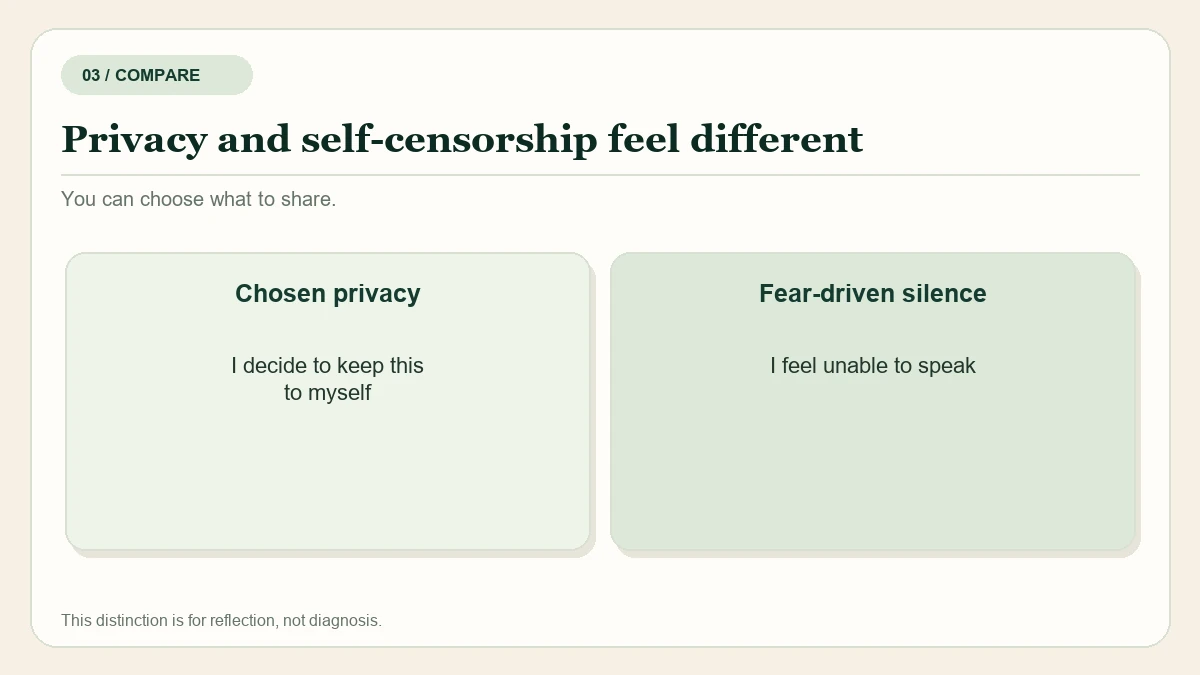
People naturally adjust across settings. You might be more playful with friends, formal with colleagues and private with relatives. That does not make you dishonest. The more important question is whether the change feels chosen. Deciding not to discuss a topic at dinner can be a healthy preference. Feeling unable to express any disagreement because you expect a punishing reaction is a different experience.
Notice what actually changes. Do you speak less, apologise more, become irritated, or agree before you have considered your own view? Does it happen with everyone in the family or only one person? The answer may show a pattern, but it is not a diagnosis. It helps you move from “I turn into a different person” to a more precise description of the situations where you lose room to choose.
The Roles Families Expect Us to Play
Families remember us across many years. They may still describe an adult as “the quiet one,” “the responsible one” or “the child who always argues.” A role can begin as a family shorthand and become hard to move beyond. You may not need to say anything for others to expect you to organise a gathering, keep the peace or accept advice. Sometimes you step into that role before anyone asks.

These labels are examples, not fixed types or a theory that explains every family. A role can be affectionate and useful in one setting, limiting in another. Being known as dependable may feel good until you are assumed to be available for everyone’s needs. Being protected may feel caring until your independent decisions are treated as mistakes. The same behaviour can mean different things depending on whether you have a real choice.
Research has explored the relationship between family context and authenticity, though an individual study cannot tell us why your family operates as it does. The useful practical idea is to compare the old role with the person you are now. What expectations still fit? Which ones are uncomfortable? Where can you respond in a new way without asking everyone to recognise a dramatic “new you” overnight?
Why Sharing Honest Opinions Can Feel Difficult
You may have a clear opinion and still choose silence because you anticipate a long argument, disappointment or an attempt to change your mind. If the person controls housing, finances or important family decisions, the consequences may be more than emotional. If you rely on them, a small disagreement can feel costly. The difficulty is not necessarily a lack of confidence; it can be an assessment of what may happen next.
Sometimes the expected consequence is based on a repeated experience. At other times, the family member may respond more openly now than they did years ago, but you have not had a safe chance to test that. Avoid assuming either explanation in advance. Ask what happened the last few times you expressed a view, not what you imagine a perfect family would do.
Honesty also does not require full disclosure. You can say, “I am still thinking about that,” or “I would rather not discuss it tonight,” without explaining every feeling underneath. A person who has often been pressed to justify themselves may need to learn that a short, truthful answer counts as an opinion. The next question is which expectations make those short answers difficult.
Living With Expectations You Didn’t Choose
Family expectations may concern career, marriage, where you live, how often you visit or how you spend money. These are possible examples in Indian households, not claims that every family holds the same values. Some expectations are openly stated; others are conveyed through jokes, comparisons or the way relatives react when someone chooses differently.
An expectation can carry genuine care. A parent who worries about financial security may question a career choice because they want stability for you. Yet care does not make the decision theirs alone, especially when you are the person who will live with the outcome. The conversation becomes more productive when you can separate the underlying concern from the demand. “I understand you are worried about income” is different from “I will take the job you chose.”

If you depend on family for housing or money, independence may need to be built gradually. A boundary that is simple for someone living separately may be risky or impractical for you. Plans about work, savings and support can create more choice over time. This is not a reason to accept every expectation indefinitely; it is a reason to make advice fit your circumstances.
The Habit of Hiding Your Real Feelings
Keeping a thought private once is not a problem. A habit of hiding begins when you automatically edit ordinary preferences—what food you want, whether you are tired, which plan you favour—because disagreement feels too costly. You may say “anything is fine” before checking whether it is. Over time, it can become harder to know which choices are yours and which are attempts to prevent a reaction.
Try observing one week without forcing yourself to speak differently. When did you agree quickly? What did you actually want? What consequence did you expect if you said it? This is a reflection exercise, not a validated measure. An observational study of family cohesion, shame and emotional suppression shows that researchers examine these relationships, but its adolescent sample cannot establish the cause of an adult reader’s behaviour. Your own notes can show whether your silence feels like a deliberate boundary, a temporary compromise or an automatic way to avoid discomfort.
PsyQuench’s article on feeling responsible for everyone’s feelings explores the adjacent tendency to manage other people’s reactions. This article focuses on the family setting and the feeling of becoming a smaller version of yourself there. The two patterns may overlap, but they are not identical. You can respect another person’s feelings without treating their disappointment as proof that your preference was wrong.
When Keeping the Peace Creates Distance
Avoiding one unproductive argument may be wise. Avoiding every meaningful difference can make closeness feel thinner. Family members may believe they know what you want because you rarely correct them, while you feel unseen because your real views never enter the conversation. Resentment can grow quietly, and the family may be surprised when you finally say no.

This does not mean the solution is to announce every disagreement at once. Ask which silence has a cost you are willing to address. Perhaps a relative keeps making plans for your weekends. A small, clear response—“I cannot come this Sunday, but I can visit next week”—may tell them more than a long explanation you are not ready to give. If the family responds respectfully, that creates space for more honest conversation. If the response is threatening, the issue becomes safety and support, not communication technique alone.
The NHS guidance on healthy relationships discusses communication and boundaries as part of wellbeing. Its general advice needs adaptation to the actual power and dependence in your family. The goal is not “perfect openness.” It is a relationship where you can make more ordinary choices without losing connection or safety.
Understanding What You Actually Need
Before asking family members to change, decide what you are asking for. Do you need fewer comments on a topic, more time to make a decision, privacy about a relationship, or a chance to finish speaking? “I want to be myself” is real, but a specific request gives you a place to begin. It also helps you distinguish what another person can provide from what you need to develop for yourself.

Consider your own preference even when nobody else is present. If you could decide without anticipating a reaction, what would you choose? What parts of that choice are negotiable, and what parts matter deeply to you? If you cannot answer immediately, that is information, too. Years of adapting to others can make preference feel unfamiliar. Give yourself room to find it without turning every decision into a test of independence.
A boundary can protect a need without demanding a dramatic confrontation. You might postpone a conversation, limit how long you discuss a subject or choose what information you share. PsyQuench’s practical guide to setting boundaries without guilt offers more on wording them. Here the key is to know what the boundary is for, not to collect assertive sentences that do not fit your life.
Starting Honest Conversations in Small Steps
Choose a topic and person where the risk is manageable. Start with a preference rather than the most painful family conflict. “I would like to go on Saturday instead” can be enough. If the person asks why, you can offer a short reason without defending your entire identity. Observe how they respond. A receptive conversation gives you evidence that more openness may be possible; a dismissive one tells you to reconsider the approach.

Speak about the current decision rather than trying to settle every past disagreement in one sitting. “I want time to decide about this course” is clearer than “You have never let me choose anything.” The broader feeling may be true and deserve discussion, but a first conversation can become overwhelming if it has to carry years of history. If you want to discuss that history, consider doing so when both people can listen or with appropriate professional support.
If you are afraid of retaliation or control, do not use a conversation script as a safety test. Seek trusted support and make choices with your circumstances in mind. PsyQuench’s article on relationship conflicts in Indian families offers related context, but no article can decide from a distance whether a particular conversation is safe for you.
Staying Connected Without Giving Up Boundaries
Closeness and independence can coexist when family members can tolerate differences. You can care about a parent’s worry while making your own career decision. You can enjoy family gatherings while declining a discussion about your private life. A boundary may be about time, tone, topic or decision-making authority; it need not be a declaration that the relationship is over.
The other person may need time to adjust, especially if you have long played a particular role. You do not control their reaction, but you can keep your message consistent and respectful. “I know this matters to you. I am still making this decision myself” names both care and autonomy. If each attempt leads to intimidation, threats or punishment, the situation requires more than patient repetition.
Notice whether your boundary gives you more room to be present. Some people feel closer when they stop pretending to agree; others need more distance to feel safe. There is no single correct amount of family contact. The meaningful measure is whether the relationship allows you to live with a reasonable degree of choice and dignity.
When Counselling Can Help With Family Pressure
Counselling may be useful if family interactions repeatedly leave you anxious, ashamed, angry or unsure of your own preferences, or if you avoid important decisions because of expected reactions. A qualified professional can help you describe the pattern, consider safety and practise choices that fit your life. They should not tell you from one story that your family is “toxic” or that cutting contact is the only healthy answer.
Support can also be practical when your situation involves dependence. You may need to plan for money, housing or allies before changing how openly you speak. The emotional part and the practical part are linked. A conversation in a safe room is useful only if the plan can survive outside that room.
It is also possible to begin without a label. You can say, “I feel like I disappear around my family, and I want to understand why.” That is a clear starting point. The work is not to become a different person; it is to have more choice about which parts of yourself you can bring home.
Frequently Asked Questions
Is it fake to act differently around family?
No. People adjust across settings. The concern is whether you feel unable to choose, especially when the pattern causes distress or limits important decisions.
Does this mean my family is toxic?
Not from this feeling alone. Look at specific behaviours, whether boundaries are respected and whether you feel safe. A label is less useful than a clear account of what happens.
What if I still depend on my family?
Choose changes that fit your safety and finances. A small topic boundary, trusted support or longer-term independence plan may be more realistic than a major confrontation.
Must I tell them everything I feel to be authentic?
No. Privacy is a choice. You can be honest about one decision while keeping other thoughts to yourself, especially where disclosure would be unhelpful or unsafe.
Make Room for More Choice
Feeling different around family can come from familiar roles, present expectations and the consequences you anticipate when you speak. You do not need to explain it with one label or force a dramatic conversation. Notice one situation where you edit yourself, identify what you would prefer, and choose a small response that is safe in your circumstances. More room for choice is a meaningful change even if the relationship takes time to adjust.
Publication and visual brief
Article word count: 2396 | Source check: 15 November 2026 | Status: editorial review before publication
SEO and publishing details
SEO title: Why Do I Feel Like a Different Person Around My Family?
Slug: different-person-around-family
Meta description: Explore why familiar roles can change how you speak and act around family, and how to make small, safe choices without losing your sense of self.
Primary keyword: why can’t I be myself around family
Category: Therapy and Mental Wellness
Intent: Explanation and practical self-expression
Schema: Article; FAQPage only if eligible
Canonical: Self-referencing; distinct from boundaries and responsibility-for-feelings pages
Reviewer: Qualified counselling or clinical psychologist, name only after verification
Incoming links: Responsibility for feelings; boundaries without guilt; family conflict
Final editorial checks
Check 2,000-plus words, ten H2 order, three internal links, no family diagnosis or universal cultural claims, and realistic safety caveat.
Image production plan
Image 1
Featured after title. Purpose: show context-dependent self without split-personality imagery. Concept: same adult relaxed with friends on one side and reserved at a family table on the other, continuous central figure. Premium editorial illustration, teal/sand/navy. Text: “Different Around Family?” Prompt: Respectful two-context illustration of the same Indian adult expressing themselves differently with friends and family, no pathologising split-face effect, readable headline space. Landscape 16:9. Filename: different-person-around-family-featured.png. Alt: Same person appearing more relaxed with friends than at a family gathering. Accuracy: illustrative, not diagnostic.
Image 2
Under H2 02. Purpose: show family roles. Concept: person surrounded by three generic expectation labels “reliable”, “quiet”, “peacemaker” as removable cards. Prompt: Conceptual editorial diagram of longstanding family roles as labels around an adult, not fixed identity types. Square 1:1. Filename: family-roles-and-expectations.png. Alt: Illustration of roles that family members may expect someone to play. Accuracy: examples only.
Image 3
Under H2 04. Purpose: show expectation/choice. Concept: fork between family expectation and personal preference, with shared concern in middle. Prompt: Balanced decision illustration showing a family expectation, underlying care and adult’s own choice, no cultural stereotype. Landscape 3:2. Filename: family-expectations-vs-choice.png. Alt: Diagram separating a family expectation from a person’s own preference. Accuracy: no claim all Indian families act alike.
Image 4
Under H2 05. Purpose: distinguish privacy and self-censorship. Concept: two cards chosen privacy and fear-driven silence, simple icons. Prompt: Clean conceptual comparison between choosing privacy and feeling unable to speak, restrained editorial colors. Square 1:1. Filename: privacy-vs-self-censorship.png. Alt: Comparison of chosen privacy and painful self-censorship. Accuracy: editorial distinction, not assessment.
Image 5
Under H2 08. Purpose: show a small conversation step. Concept: three-panel scene preference, short response, listener reaction, no promised outcome. Prompt: Realistic educational storyboard of an adult expressing a small preference at home, varied possible reaction, respectful Indian setting. Landscape 16:9. Filename: small-honest-family-conversation.png. Alt: Three-step example of expressing a preference in a family conversation. Accuracy: illustrative, not a universal script.
Image 6
Under H2 09. Purpose: show connection plus boundary. Concept: overlapping circles closeness and autonomy with shared area, no forced relationship ideal. Prompt: Minimal conceptual diagram of family connection and personal boundaries coexisting, legible labels, premium editorial style. Square 1:1. Filename: family-closeness-and-boundaries.png. Alt: Diagram showing that closeness and boundaries can coexist. Accuracy: possible goal, not guarantee.
Navigating Family Expectations & Finding Your Voice
Shifting back into childhood roles around family is exhausting. A therapist can help you establish compassionate boundaries without guilt or conflict. You can Explore Relationship Counselling or get started directly below: