Is Your IGNOU Psychology Degree Still Valid Under NCAHP?

If you are searching for “IGNOU psychology NCAHP registration 2026,” separate three questions before accepting a yes-or-no answer: Was your degree awarded by the university? Was the specific psychology programme permitted in your admission session and study mode? Do your qualifications meet the relevant professional registration rule? These are related, but they are not interchangeable. The PsyQuench guide below uses dated official sources to explain them. As checked on 15 November 2026, two published UGC texts give different start dates for the distance/online psychology restriction. That conflict cannot responsibly be solved by an “Apply Now” button or by declaring every IGNOU degree valid or invalid.
Why IGNOU Psychology Students Are Worried
The worry is understandable. A current student may have spent time and money on an MA Psychology programme. A graduate may be planning a career that requires registration. A prospective student may see an application page and wonder whether it is safe to enrol. Headlines about a “ban” can make all three readers think they face the same problem, when their admission dates, courses and professional goals may differ.

IGNOU’s MAPC programme page was still displaying “MA in Psychology (ODL)” and an “Apply Now” link when checked for this article. That is a fact about a webpage. It is not by itself proof of permission for every upcoming admission session, nor proof that a graduate will meet National Commission for Allied and Healthcare Professions (NCAHP) registration conditions. The current prospectus and regulatory documents need to be read alongside the page.
The most useful first move is to identify your exact situation: programme name, whether it is open and distance learning (ODL) or online, admission session, current status or graduation date, and the profession for which you seek registration. Once those are clear, the regulatory texts become questions you can put to the right authority rather than an argument about one vague word, “valid.”
What NCAHP Registration Means
NCAHP registration concerns an individual’s eligibility under the allied and healthcare professions framework. It is not the same event as admission to a university or the award of a degree. The Registration of Allied and Healthcare Professionals Regulations, 2026 set out categories and conditions that must be matched to a person’s qualification and experience. A general statement that “MA Psychology graduates can register” omits too much to be useful.

There is also a separate RCI route for regulated clinical psychology qualifications and Central Rehabilitation Register status. NCAHP and the Rehabilitation Council of India are different bodies with different questions to answer. A person should not use an NCAHP headline to infer RCI clinical psychologist eligibility, or the other way round. PsyQuench’s guide to RCI versus NCAHP licensing covers that boundary in more detail.
Registration eligibility depends on more than a degree’s name. The exact category, education mode, course, experience and current application rules may matter. This article cannot decide an individual application from the phrase “IGNOU MAPC” alone. It can show which documents to put together and what to ask before making a career or enrolment decision.
How UGC Distance-Learning Rules Relate to NCAHP
The University Grants Commission and its Distance Education Bureau (UGC-DEB) address whether higher-education institutions may offer particular programmes through ODL or online mode. NCAHP addresses registration under its professional framework. A university could award a degree, while a separate question remains about whether a particular cohort or mode satisfies professional registration conditions. Conversely, a professional regulation does not, by itself, rewrite every university transcript.
This is why the phrase “the degree is valid” is too broad. It may mean “the university issued it,” “the programme had the required recognition for that session,” or “the graduate qualifies for a professional register.” Those are three claims requiring different evidence. PsyQuench’s broader article on online psychology degree validity in India considers the general issue; here the concern is specifically IGNOU, the UGC distance-mode restriction and NCAHP registration.
The documents should be read in that order. First, identify what was offered and when. Second, check what UGC-DEB said about that mode and session. Third, assess the NCAHP category and requirements. Reversing the order can lead to an answer that is technically true about one question but misleading about the reader’s actual goal.
What the Rules Say About the Relevant 2026 Sessions
The UGC public notice dated 12 August 2025 says that higher-education institutions should not offer allied and healthcare programmes covered by the NCAHP Act, including Psychology as a specialisation, through ODL or online mode from the July–August 2025 academic session onward. It also discusses withdrawal of recognition already granted for that session and directions not to admit students under the covered programmes. That is the wording of the notice; it is not a sentence declaring every psychology degree awarded earlier to be void.
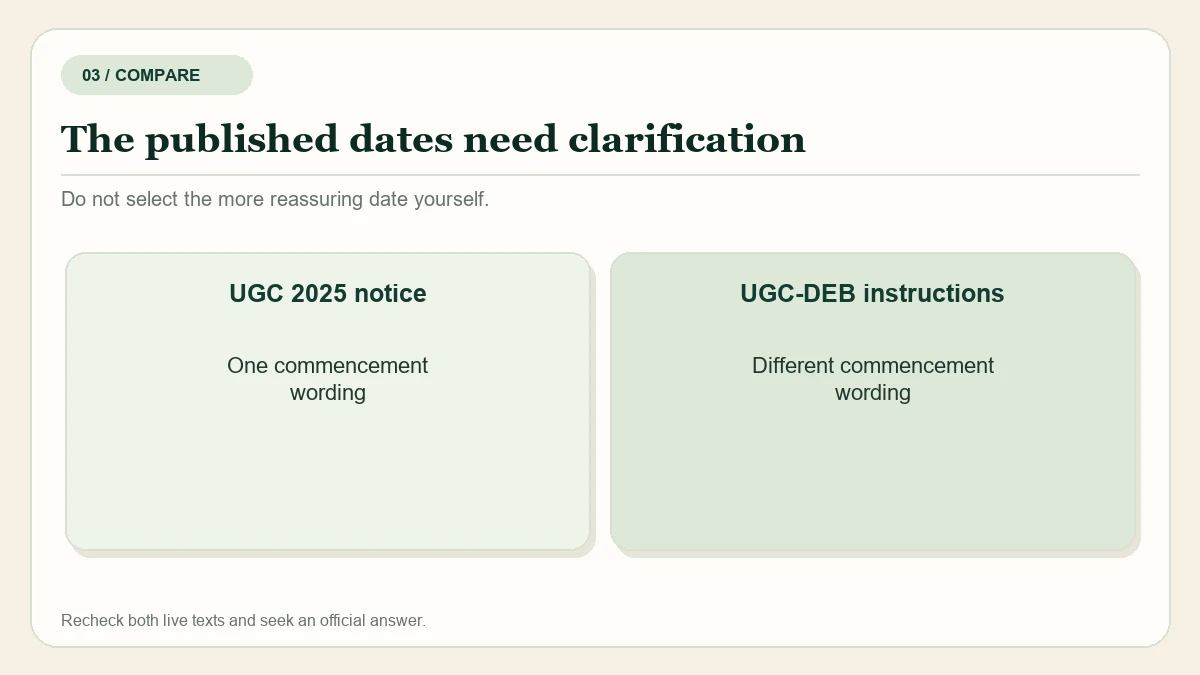
However, the current UGC-DEB instruction page, checked on 15 November 2026, describes the same commission decision while saying the restriction applies from August 2026 onward. The dates are materially different. A student admitted between those periods could be affected by how the discrepancy is officially resolved. This article cannot choose the more reassuring or more restrictive date on the reader’s behalf.

The correct presentation is a dated side-by-side comparison, followed by a request for written clarification from UGC-DEB and IGNOU for the exact programme and session. It is possible that a later correction, cohort-specific instruction or regulatory interpretation exists. Until one is identified and checked, the effective-date question remains unresolved. Any article or adviser who supplies one clean date without addressing the other official text leaves out a material fact.
What Prospective IGNOU Students Should Check
If you are considering a new admission, do not treat the live MAPC page as the whole permission record. Ask for the current prospectus for the specific admission session, the programme’s mode of delivery and the applicable UGC-DEB status. Check whether the university has issued a notice addressing the psychology restriction and whether that notice corresponds to the session in which you would enrol.
Before paying a fee, send a written question that can be answered precisely: “Is IGNOU admitting students to MAPC in ODL mode for [named session], and what current UGC-DEB recognition or clarification applies to this programme after the 2025 notice and 2026 DEB instructions?” Keep the reply with your admission documents. A general response that IGNOU is a recognised university does not answer a programme-and-session question.
If your reason for enrolling is NCAHP registration, add that goal explicitly. Ask the professional regulator or competent registration authority how the proposed degree mode and cohort would be assessed under the current regulations. A university can explain its programme, but it should not be asked to guarantee a separate regulator’s decision. Consider other study options only after the status and professional requirement are clear enough to compare.
What Existing Students Need to Verify
An existing student has a different evidence packet. Gather the admission letter, session and year of entry, programme title and mode, prospectus applicable at admission, subsequent university notices, mark sheets and any internship or experience records. The precise sequence matters: a person admitted before July 2025 is not in the same factual position as someone admitted during a disputed 2025–26 interval or after August 2026.

Do not assume that being able to continue classes answers the professional registration question. Equally, do not assume a social-media claim about a “ban” cancels work already completed. Ask the university what it says about your cohort and the UGC-DEB notice, then ask the relevant professional authority what that qualification and mode mean for the category you seek. Seek written answers you can retain.
If you are close to graduation, do not delay gathering documents. The exact course title and mode recorded by the university may be important when a regulator or employer reviews your qualification. If a document is unclear, request correction or clarification from the issuing institution. That is more useful than trying to make a broad argument about every distance psychology degree at once.
Does a Rule Change Automatically Invalidate an Earlier Degree?
The cited UGC 2025 notice is about programmes offered through ODL/online mode and admissions from a stated session. It does not, in its quoted direction, say that every earlier degree already awarded by IGNOU is retrospectively cancelled. That is an important limit. It is also not a basis to declare that every past, current or future cohort is unaffected. A reader needs a ruling tied to the programme, mode and dates that apply to them.

Academic recognition, institutional authority to offer a course and professional eligibility should remain in separate columns. A university-issued degree can be a real academic record while a professional registration authority applies a narrower criterion. A restriction on future admissions may have a different effect from a decision about a student already enrolled. These distinctions are why a blanket “valid” or “invalid” claim can be misleading even when one part sounds plausible.
Where the official texts conflict, the appropriate next step is not to invent a retrospective rule. Provide the documents and ask UGC-DEB/IGNOU for a cohort-specific position. If the answer has major financial or career consequences, obtain qualified regulatory or legal advice based on the documents rather than relying on a general blog post.
Does a Valid Degree Guarantee NCAHP Registration?
No. A degree’s academic status does not automatically satisfy the conditions for a particular professional registration category. The NCAHP’s final 2026 regulations need to be read for the exact category, qualification, mode and experience conditions. A person’s professional history and documents may matter. The outcome cannot be inferred solely from the university name or the word “psychology” on a transcript.
This distinction cuts both ways. Someone should not be promised registration because a university says its degree is recognised. Nor should a graduate be declared permanently ineligible because a search snippet mentions distance learning, without checking their admission date and the applicable category. The official registration authority should evaluate the individual case.
PsyQuench’s existing NCAHP psychologist registration questions guide discusses the broader framework. For an IGNOU reader, take that framework and add the missing cohort and mode information. Write down the category you seek before asking whether MAPC “counts”; a regulator can answer a specific category question more effectively than a vague one.
How MA Degrees, Certificates and Experience Fit In
An MA degree, a short certificate and professional experience are different kinds of evidence. The final NCAHP regulations set out which qualifications and experience are relevant for particular categories. A certificate of attendance cannot silently replace a required degree or experience condition. Conversely, genuine supervised experience should be described accurately rather than assumed to have no value because it is not another degree. Use the final schedule, not a marketing summary, to identify what counts.
Another source of confusion appeared in November 2026. A Press Information Bureau release on 11 November announced a draft provisional registration framework and invited comments until 4 December 2026. A draft proposal is not the same as the final 2026 registration regulations already notified. A proposed bridge or provisional route should not be sold as a current entitlement before it becomes final and applicable.
If someone recommends that you buy a course to “fix” eligibility, ask which exact final rule it satisfies and whether the authority has confirmed that interpretation. The question is especially important when the underlying UGC admission-date conflict is still open. A course purchase cannot clarify a regulatory ambiguity by itself.
How to Get Official Clarification and Plan Your Next Step
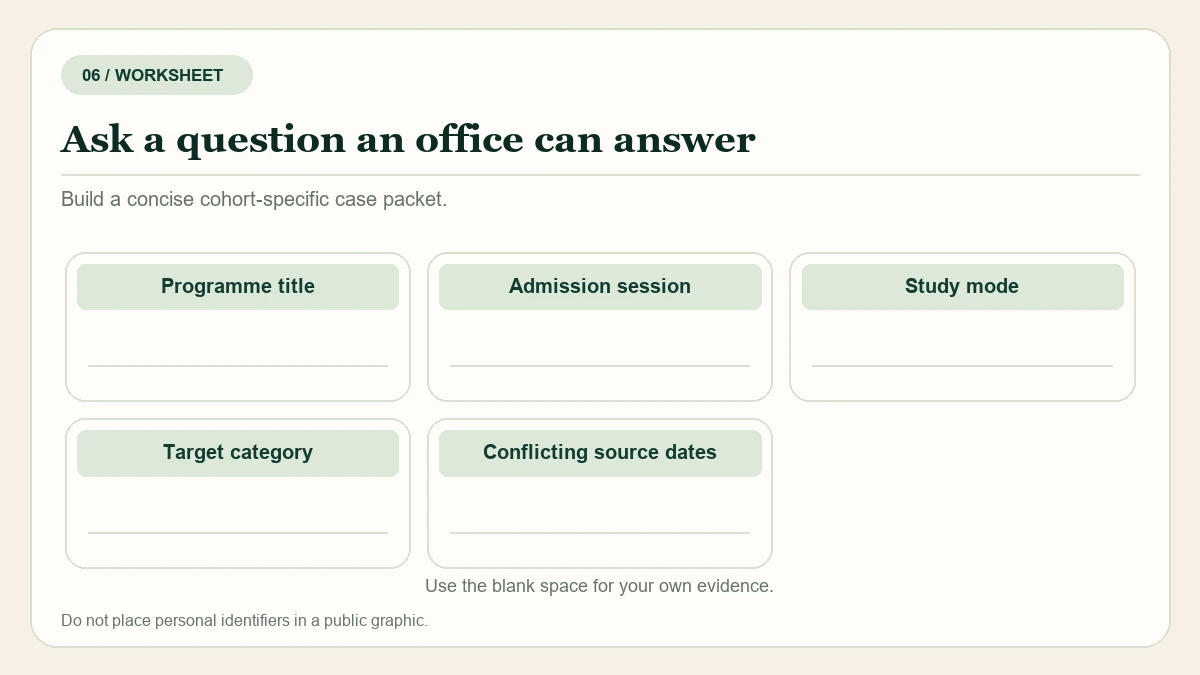
Build a one-page case summary: your exact IGNOU programme, mode, admission session, completion status, and intended NCAHP category. Attach or cite the applicable prospectus and your admission document. Quote both the UGC 2025 notice’s July–August 2025 date and the current DEB page’s August 2026 date, and ask which governs your cohort. Request a written response from IGNOU/UGC-DEB on offering status and from the professional authority on registration criteria. Keep the questions separate so each body can answer within its remit.
For a prospective student, the decision is whether to enrol before the status is clear. For an existing student, it is which documents and clarifications to obtain. For a graduate, it is how the current registration regulation applies to the actual qualification and experience. No cohort table in a blog can replace those answers, but it can prevent you from asking the wrong question.
This article’s regulatory check is dated 15 November 2026. Reopen the official pages before acting, because a clarification may appear later. Until then, the defensible conclusion is narrow: published UGC sources conflict on the effective date, IGNOU’s live MAPC page does not resolve that conflict, and NCAHP registration must be assessed separately.
Frequently Asked Questions
Does the UGC notice cancel an IGNOU degree awarded before 2025?
The cited notice addresses offering programmes and admitting students from a specified session; it does not state that every earlier awarded degree is void. A particular degree or professional use still requires a case-specific check.
Does IGNOU’s “Apply Now” button prove MAPC is currently permitted?
No. It shows that a page and link are live. Ask IGNOU and UGC-DEB for the programme-and-session status before relying on it for a new admission.
Can an IGNOU MAPC graduate register under NCAHP?
There is no safe blanket answer from the course name alone. Check the exact registration category, degree mode, admission cohort, experience and final regulation, then seek an official determination.
Are the November 2026 provisional registration proposals already final?
The 11 November PIB release describes a draft open for comments. Do not treat its proposed routes as a final registration entitlement.
Get an Answer for Your Cohort and Goal
The most useful question is not “Is IGNOU Psychology valid?” in the abstract. It is: what programme and mode did you enter, in which session, and what professional category do you seek? Put those facts beside both UGC texts and the final NCAHP regulation. Where the sources conflict, ask for written clarification rather than filling the gap with confidence. That is a slower answer, but it respects the real stakes of your degree and career.
Publication and visual brief
Article word count: 2360 | Source check: 15 November 2026 | Status: editorial review before publication
SEO and publishing details
SEO title: IGNOU Psychology, UGC Distance Rules and NCAHP Registration 2026
Slug: ignou-psychology-ncahp-registration-ugc-distance-rules
Meta description: Understand the conflicting UGC dates for ODL psychology, what IGNOU’s MAPC page means, and why NCAHP registration needs a separate cohort-specific check.
Primary keyword: IGNOU psychology NCAHP registration 2026
Category: Psychology Courses and Careers
Intent: Regulatory clarification and cohort decision
Schema: Article; FAQPage only if current policy warrants
Canonical: Self-referencing; distinct from general online-degree validity and NCAHP FAQs
Reviewer: UGC-DEB/NCAHP regulatory or academic compliance specialist; name only after verification
Update note: Prominent last-checked date, recheck before publication and after official clarification
Incoming links: Online psychology degree validity; NCAHP registration questions; RCI-vs-NCAHP licensing
Final editorial checks
Check 2,000-plus words, ten H2 order, both conflicting UGC dates, final-versus-draft distinction, all external source links and no blanket degree verdict.
Image production plan
Image 1
Featured after title. Purpose: frame the three-question distinction. Concept: student with three separate folders labelled degree, offering permission, registration, a question mark above the UGC date line. Premium editorial blue/teal/cream. Text: “IGNOU Psychology and NCAHP 2026”. Prompt: Accurate educational illustration of an Indian distance-learning student comparing three distinct regulatory folders, restrained editorial design, no official seals, readable headline space. Landscape 16:9. Filename: ignou-psychology-ncahp-2026-featured.png. Alt: Student comparing degree, programme permission and professional registration. Accuracy: no verdict on eligibility.
Image 2
Under H2 03. Purpose: distinguish authorities. Concept: UGC-DEB and NCAHP as two separate labeled columns with their questions, RCI as a small distinct note. Prompt: Clear regulator-role comparison diagram, text labels UGC-DEB and NCAHP and separate RCI note, no institutional logos. Landscape 3:2. Filename: ugc-vs-ncahp-roles.png. Alt: Diagram showing different questions handled by UGC-DEB and NCAHP. Accuracy: not a legal ruling.
Image 3
Under H2 04. Purpose: show official conflict. Concept: dated two-line timeline, 2025 notice → July–August 2025, current DEB page → August 2026, “Clarification needed”. Prompt: Minimal two-document date comparison infographic with those exact dates and unresolved label, no choice of winning date. Landscape 16:9. Filename: ugc-psychology-odl-date-conflict.png. Alt: Comparison of the different start dates shown by two UGC sources. Accuracy: verify dates again before publication.
Image 4
Under H2 05. Purpose: prospective-student check. Concept: document checklist mode, session, prospectus, written confirmation. Prompt: Printable four-document checklist for a prospective IGNOU MAPC applicant, clear labels, no approval promise. Portrait 4:5. Filename: ignou-mapc-before-enrolment-checklist.png. Alt: Checklist for verifying a MAPC admission session and mode. Accuracy: application link alone insufficient.
Image 5
Under H2 08. Purpose: distinguish degree from registration. Concept: two gates, university award and category-specific professional assessment, with separate evidence. Prompt: Two-gate credential diagram showing academic award and NCAHP registration as distinct decisions, no outcome guaranteed. Square 1:1. Filename: ignou-degree-vs-ncahp-registration.png. Alt: Diagram distinguishing degree award from professional registration. Accuracy: no cohort eligibility conclusion.
Image 6
Under H2 10. Purpose: guide written query. Concept: one-page case packet with programme, mode, admission session, target category, source dates. Prompt: Clean case-summary worksheet for an official regulatory clarification request, five legible fields, no personal data filled in. Portrait 4:5. Filename: ignou-regulatory-clarification-packet.png. Alt: Blank document packet for requesting cohort-specific clarification. Accuracy: no guarantee of reply or result.
Bridge Theory with Verified Practical Exposure
Complement your IGNOU or distance psychology degree with practical hours, diagnostic test training, and clinical case formulation under expert supervision. You can Explore Psychology Courses or get started directly below: