Why Does That One Comment Replay in Your Head All Day?

If you have wondered why criticism affects you so much, the answer is rarely that you are simply “too sensitive.” A remark can touch something you care about—competence, belonging, respect—and the hours spent replaying it can keep the hurt active. The comment might contain useful feedback, an awkward misunderstanding or genuine unkindness. At PsyQuench, we start by separating those possibilities before deciding what to do. You do not have to diagnose yourself from one painful afternoon. It helps first to understand how a brief sentence can become a much larger experience in your mind.
Why One Small Comment Can Hurt So Much
Imagine you have prepared carefully for a meeting and someone says, “This could have been clearer.” The words are short. Your reaction may be much bigger because the work matters to you, the comment came in public, or you hoped the person would recognise your effort. Another person might hear the same sentence and feel only mild irritation. Neither reaction proves that one of you is right about what the speaker intended.
The context changes the weight of a comment. A close friend’s offhand remark may feel like a judgment about the relationship. A manager’s brief feedback can raise worries about work. A relative’s familiar criticism may bring to mind many earlier conversations. We do not need a single hidden cause to explain why a sentence lands differently in different places.
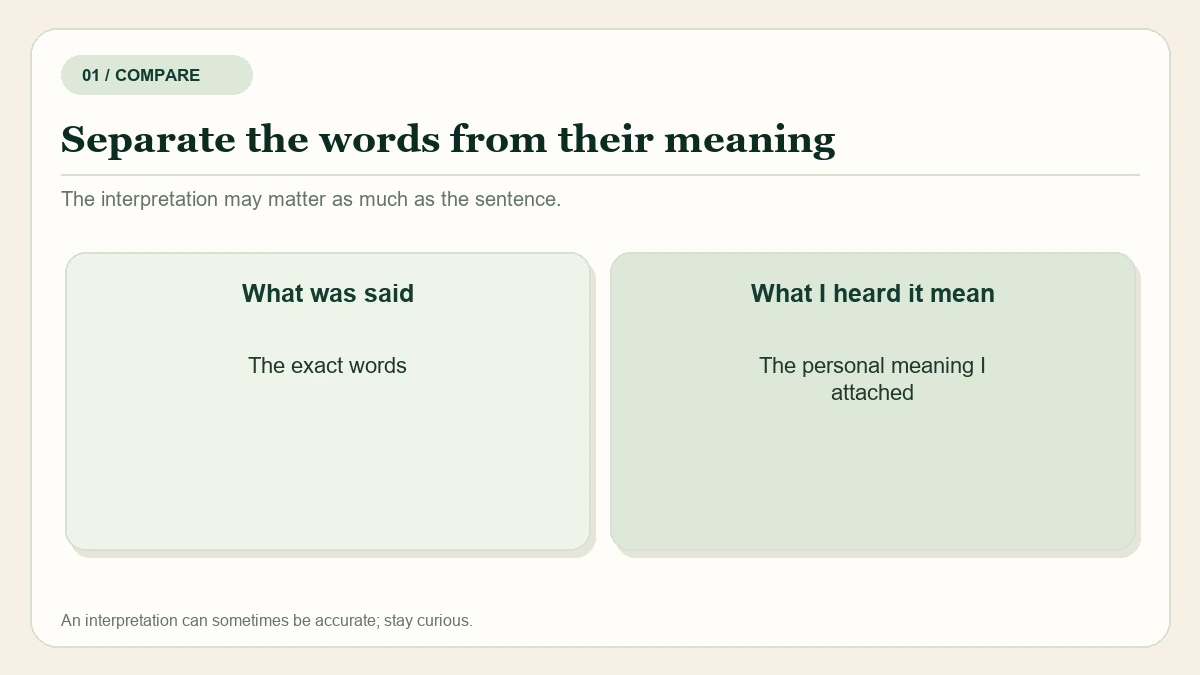
The useful first question is, “What exactly happened?” Write down the words if you can. Then ask what they seemed to mean to you. You may discover that the pain is partly about the remark and partly about the conclusion you drew from it. That distinction does not make the feeling false. It gives you a way to decide whether you need clarification, a boundary, or time to settle before responding.
When Feedback Starts Feeling Personal
Feedback is usually about an action, a piece of work or a decision. It begins to feel personal when it becomes a statement about who you are: “This slide was hard to follow” turns into “I am incompetent.” Sometimes the speaker really is attacking the person; sometimes the mind makes that leap because the topic is important. The task is not to force a positive interpretation, but to notice which part is observed and which part has been added.

Try placing the two sentences side by side. “My colleague said the introduction needs a clearer example” is a report. “My colleague thinks I should not have this job” is an interpretation unless they actually said it. Once you see the difference, you can ask for the concrete change needed without requiring an answer to the larger question of your worth.
The NHS guidance on low self-esteem describes how harsh self-evaluation can shape everyday experiences. That does not mean everyone upset by feedback has low self-esteem. It suggests one area to notice if the same global conclusion appears after many small comments. The first section identified the event; this one identifies the story attached to it.
Why Negative Words Stick More Than Praise
A critical remark may demand more attention than a pleasant one because it raises a question: Have I made a mistake? Is a relationship strained? Will something change because of this? Praise often asks for no immediate repair. This is a plausible way to understand why one comment can become the day’s main thought, but it is not a rule that negative words always outweigh positive ones or that every person’s brain reacts in the same way.
Consider how specific the comment was. “The report needs a source for this number” gives you a task. “You are always careless” gives little useful information and may be unfair. The second is more likely to leave you searching for what it meant, especially if it came from someone whose opinion matters. Ambiguity can keep a remark alive because there is no obvious action that resolves it.
It may help to resist the urge to gather five compliments as a counterweight. Reassurance can feel good, but it may not answer the real question. Was the feedback accurate? Was the delivery respectful? Is there something to change? When you address the question underneath the hurt, the remark has less reason to occupy the rest of the day.
The Emotional Reaction That Follows
Hurt is not the only possible response. You might feel embarrassed, angry, anxious, numb or suddenly defensive. A public correction can bring shame; a repeated joke can bring resentment; a vague message from a manager can bring uncertainty. The response may also show up physically, as tension or a rush of heat. These experiences are common enough to describe, but none of them identifies a disorder.
Try naming the emotion without arguing with it immediately. “I felt embarrassed because others heard that” is more informative than “I overreacted.” You can then ask whether the feeling points to something in the situation: a useful correction, a boundary that was crossed or a worry that needs a calmer look. Feelings are signals, but they are not transcripts of another person’s intention.
Timing matters. If you respond while trying to prove that you should not be hurt, the conversation can become about your reaction rather than the issue. A pause can give you room to separate what you feel from what you want to say. That pause does not mean you agree with the speaker. It means you are choosing how to engage.
Why You Keep Replaying the Same Comment
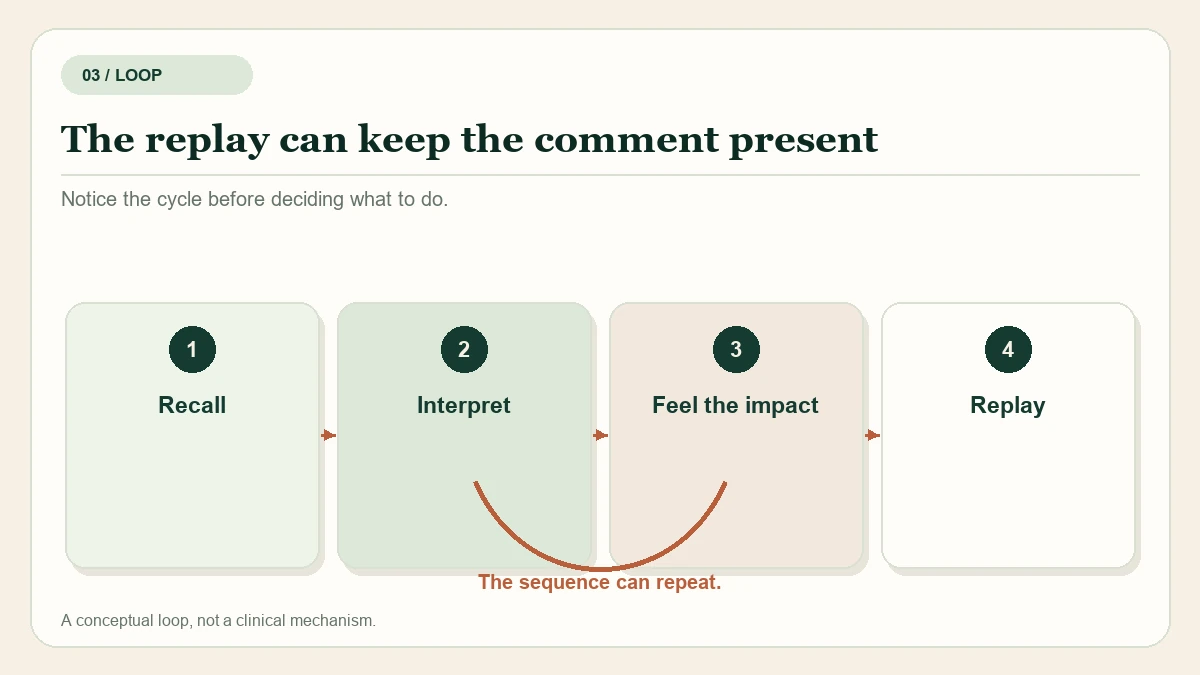
Reflection helps when it leads to a new understanding or a decision. Rumination is different: the same question returns without producing a useful answer. You revisit the tone, rewrite your reply and imagine what the speaker “really” meant, often becoming more certain while having no new information. PsyQuench’s article on anxiety versus overthinking offers more context for this repetitive-thinking pattern.
Research connects rumination with sensitivity to rejection. A 2026 meta-analysis found an association across studies, while research on post-event rumination has examined its relationship with social-anxiety symptoms. An association does not tell us that your particular afternoon was caused by rejection sensitivity, nor does it diagnose social anxiety. It supports the more modest observation that repeated thinking can be part of the distress pattern.
Ask yourself whether another ten minutes of replay is likely to give you new information. If the answer is no, choose a concrete next step: request clarification tomorrow, change one line of the report, or set the question aside until you can discuss it. You may still feel hurt. The aim is to stop making the feeling do the job of an investigation it cannot complete.
The Effect on Confidence and Everyday Choices
One comment may fade by the evening. Repeated experiences can have a wider effect if you begin avoiding meetings, withholding ideas or checking every message for signs of disapproval. The change is not simply that a remark hurt; it is that your choices become organised around preventing the next remark. That is worth noticing, especially if your work or relationships are narrowing.

Sometimes the pattern is strongest with one person. A colleague who gives vague or harsh feedback may create uncertainty that does not appear elsewhere. In another case, several ordinary comments may all become evidence of the same self-critical belief. The response should fit the pattern. You may need clearer communication from someone else, a boundary, or help with the way you evaluate yourself—not the same solution in every case.
Keep a record for a short period if the pattern is hard to see. What was said? Who said it? What did you do afterward? Did the impact last an hour or several days? This is a reflection aid, not a score or self-diagnosis. It helps identify whether the issue is one repeated relationship, a general response to feedback or a particularly stressful season.
Recognizing Feedback Versus Harmful Criticism
Useful feedback identifies something you can understand and potentially change: “The report needs a source for this claim.” It can still feel uncomfortable. Ambiguous feedback—“This isn’t good enough”—may require a follow-up question. Harmful criticism focuses on humiliation, insults or repeated personal attacks. The fact that it hurts does not by itself tell you which category a comment belongs to; look at its content and pattern.
If the remark is actionable, you can take the useful part without agreeing with every tone or assumption around it. If it is unclear, ask, “Which part would you like me to change?” If it is repeatedly belittling, a request for more detail may not solve the problem. You may need to set a limit or seek support within the relationship or workplace. PsyQuench’s guide to boundaries without guilt goes further into that decision.
Avoid telling yourself that every criticism is “just feedback” to seem resilient. Some remarks are poorly delivered, and some are genuinely unkind. Equally, avoid treating every uncomfortable suggestion as an attack. A fair assessment gives you more choices than either extreme.
What to Do When a Comment Upsets You
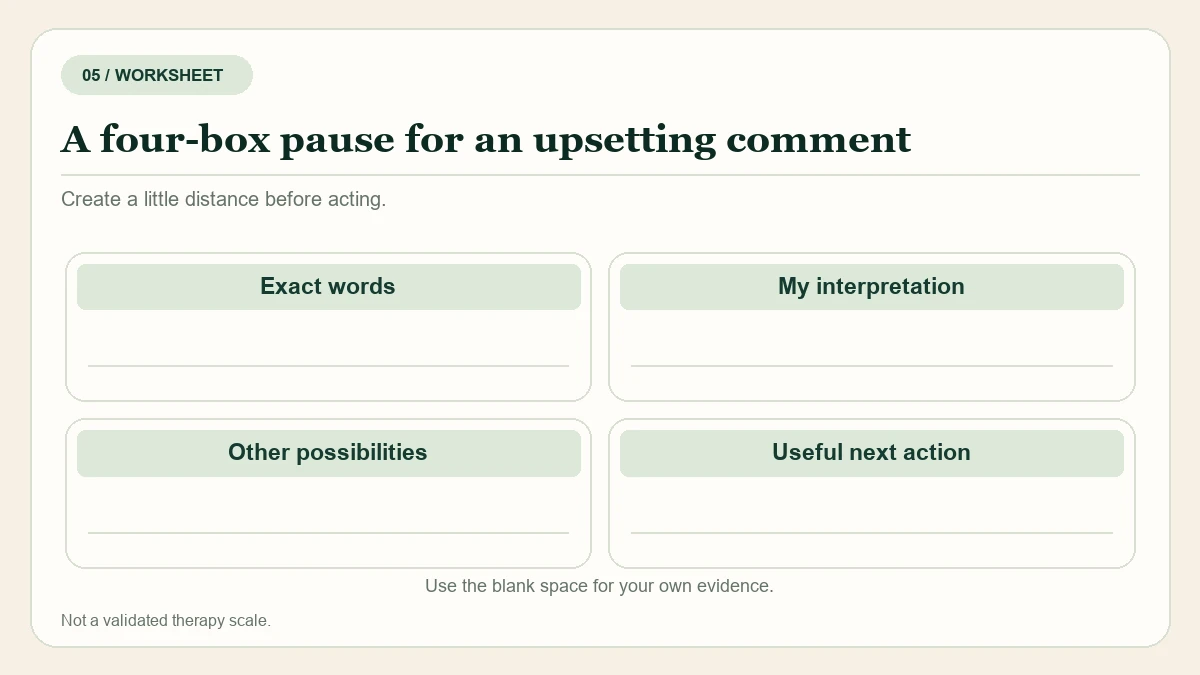
Start with a pause if one is available. You can say, “I want to think about that,” or simply wait before replying to a message. Then write four short lines: the exact words, the meaning you gave them, one other plausible interpretation, and one useful action. This is an editorial exercise, not a validated therapy technique or a requirement to talk yourself out of being hurt.
Suppose the words were, “Can you make this clearer?” You heard, “I never explain things well.” Another possibility is that one part of the work needs a better example. The useful action is to ask which part confused the reader and revise it. If the words were an insult, the alternative interpretation may not be kinder; the useful action might be a boundary or documentation of a repeated problem.
After choosing an action, give yourself permission to do something else. You may need a walk, a conversation with a trusted person or ordinary work that requires attention. Distraction is not the whole solution if a problem remains, but it can prevent endless replay while you wait for a time when you can act.
Learning Not to Define Yourself by One Remark
A comment can contain information without becoming a verdict. This is easier to believe when you have a fuller account of your work and relationships than the last sentence someone said. Keep specific evidence of what went well and what you are improving—not as a wall of praise, but as a realistic record. An honest assessment can include a mistake without reducing you to it.
If the same person’s reactions often decide how you feel about yourself, look at the relationship as well as your thoughts. Do you feel responsible for preventing their disappointment? Is approval unpredictable? PsyQuench’s piece on feeling responsible for everyone’s feelings explores that adjacent pattern. This article’s narrower point is that one remark deserves a proportionate place in your day, not authority over your whole identity.
You do not have to become unaffected by feedback. Being able to hear it, assess it and choose a response is a more realistic goal. Sometimes that response is “thank you, I’ll revise it.” Sometimes it is “please speak to me respectfully.” The difference depends on what was actually said.
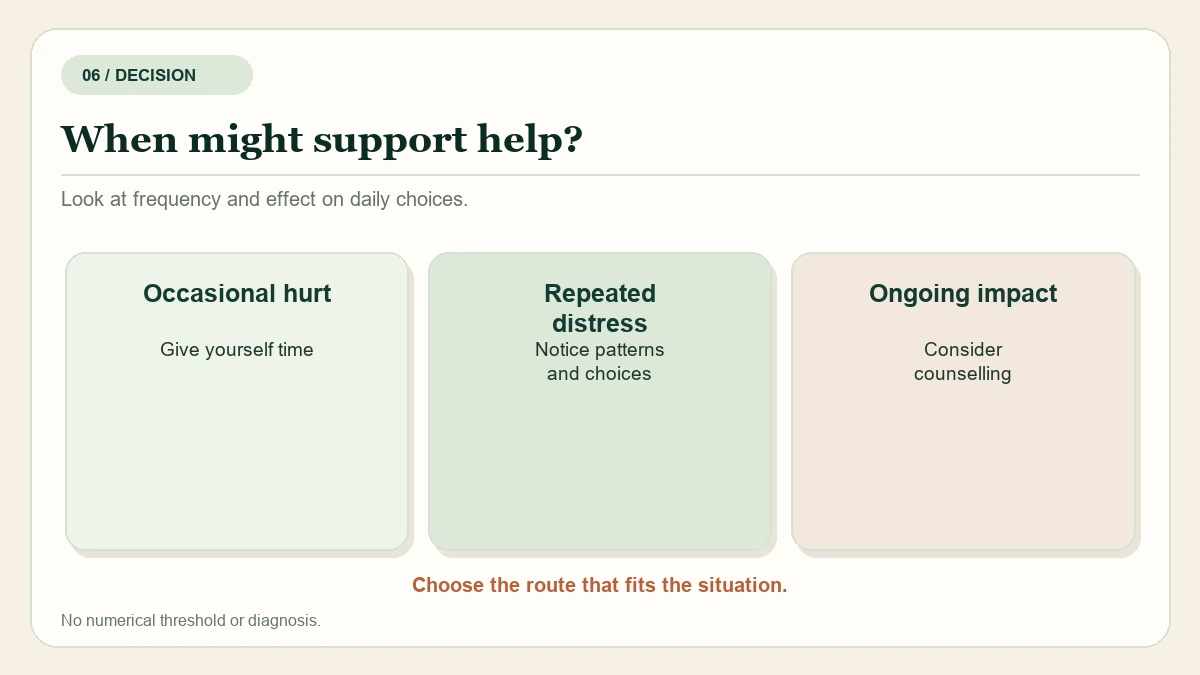
When Repeated Distress May Benefit From Counselling
Consider support if small remarks repeatedly lead to hours of distress, avoidance, conflict or strong self-criticism, especially if your own attempts to respond differently are not helping. A counsellor can explore the pattern with you in context. They do not need to label you from a single example, and this article cannot tell you whether ADHD, rejection sensitivity, social anxiety or another issue is involved.
Support can also help you distinguish an internal pattern from an environment where feedback is consistently harsh or unsafe. It would be unfair to teach someone only to tolerate belittling better. A useful conversation should take both your interpretation and the other person’s behaviour seriously.
If the reaction is occasional and passes, you may need only a practical pause and clearer information. If it is changing your choices, asking for help is reasonable. The goal is not to become “thick-skinned” at any cost. It is to regain room to think and act after a difficult sentence.
Frequently Asked Questions
Does a strong reaction mean I am too sensitive?
No single reaction tells you that. Look at the context, the content of the remark and whether the pattern is persistent or affecting daily life.
Could this be rejection-sensitive dysphoria or ADHD?
One painful comment cannot establish either. If you have broader concerns about attention, emotion or functioning, a qualified professional can consider them properly.
Should I confront the person immediately?
Not necessarily. A pause can improve clarity. Decide whether you need to accept useful feedback, ask a question, set a boundary or leave the remark alone.
What if the feedback is true?
Use the specific information to improve what you can. A true point about one action is still not a complete judgment of your abilities or worth.
Give the Comment Its Proper Size
One sentence can matter without owning the whole day. Notice the exact words, the meaning you added and whether there is an action worth taking. If the remark was harmful, take that seriously; if it was useful, use it. If replaying comments is repeatedly limiting your life, support can help you understand the pattern with more care than a label pulled from a search result.
Publication and visual brief
Article word count: 2262 | Source check: 15 November 2026 | Status: editorial review before publication
SEO and publishing details
SEO title: Why Does One Small Comment Ruin My Day?
Slug: why-does-one-small-comment-ruin-my-day
Meta description: Understand why criticism can hurt for hours, how rumination keeps it active, and how to tell useful feedback from harmful remarks.
Primary keyword: why does criticism affect me so much
Category: Therapy and Mental Wellness
Intent: Explanation and practical coping
Schema: Article; FAQPage only if eligible
Canonical: Self-referencing; separate from anxiety/overthinking and boundaries articles
Reviewer: Qualified counselling or clinical psychologist, name only after verification
Incoming links: Anxiety versus overthinking; boundaries without guilt; responsibility for feelings
Final editorial checks
Check 2,000-plus words, ten H2 order, three internal links, research association caveat and no ADHD/RSD diagnosis.
Image production plan
Image 1
Featured after title. Purpose: show one comment overwhelming a day without melodrama. Concept: adult at desk, small speech bubble casting a larger shadow on a calendar, soft editorial color. Text: “Why Does One Comment Stay With Me?” Prompt: Premium conceptual illustration of a small critical remark taking up disproportionate mental space during an ordinary day, dignified adult, clear headline area, muted navy and terracotta. Landscape 16:9. Filename: one-small-comment-ruins-day-featured.png. Alt: Small remark appearing large in a person’s thoughts. Accuracy: metaphor, not neurological depiction.
Image 2
Under H2 02. Purpose: separate fact and interpretation. Concept: two cards containing exact words versus inferred meaning. Text: “What was said” and “What I heard it mean”. Prompt: Clean comparison diagram with two distinct text cards and no fixed example, legible editorial style. Square 1:1. Filename: comment-vs-meaning.png. Alt: Diagram separating a comment from its interpreted meaning. Accuracy: interpretation may also be accurate; no forced positivity.
Image 3
Under H2 05. Purpose: show rumination loop. Concept: thought bubbles circling one sentence, with an exit arrow toward new information or action. Prompt: Minimal conceptual loop diagram showing repetitive replay and an optional decision point, no brain claims. Landscape 3:2. Filename: rumination-after-criticism.png. Alt: Illustration of repeated thinking after criticism. Accuracy: conceptual, not a clinical model.
Image 4
Under H2 07. Purpose: classify response. Concept: three columns useful feedback, unclear remark, harmful criticism, each with a different next action. Prompt: Precise three-column educational card with concise labels and neutral icons, no moralising. Landscape 16:9. Filename: feedback-vs-harmful-criticism.png. Alt: Comparison of actionable, ambiguous and harmful remarks. Accuracy: editorial classification.
Image 5
Under H2 08. Purpose: practical exercise. Concept: blank four-box worksheet exact words, interpretation, alternative, action. Prompt: Printable four-box reflection worksheet with those labels, generous writing room, navy linework. Portrait 4:5. Filename: four-box-comment-worksheet.png. Alt: Reflection worksheet for responding to an upsetting comment. Accuracy: not validated therapy scale.
Image 6
Under H2 10. Purpose: show support threshold. Concept: small branching path occasional reaction versus repeated distress affecting choices, with professional support as an option. Prompt: Calm decision aid about when repeated criticism distress may warrant support, no diagnostic labels or numeric cutoffs. Square 1:1. Filename: criticism-distress-support.png. Alt: Diagram distinguishing occasional hurt from persistent distress. Accuracy: no diagnosis.
Break the Mental Loop with Professional Support
When offhand remarks or past interactions replay relentlessly, cognitive therapy offers practical tools to regulate rumination and restore peace of mind. You can Learn About Our Counselling Services or get started directly below: