Why Do I Keep Choosing the Wrong Partners?
Understanding the Patterns Behind Your Relationships
There is a particular kind of frustration that comes from looking back at your relationships and realising that the people were different, but the emotional experience felt strangely similar.
Maybe one partner avoided serious conversations. Another became distant whenever things started becoming close. Someone else looked completely different at first but eventually left you feeling the same way: confused, uncertain, emotionally tired, or constantly wondering where you stood.
After this happens more than once, the question often changes. Instead of asking, “Why did that relationship not work?” you start asking, “Why do I keep choosing the wrong partners?”
That question can feel personal. It may even make you wonder whether your judgement is poor, whether you ignore obvious signs, or whether you are somehow responsible for every difficult relationship you have had. But repeated relationship problems are rarely that simple.
Sometimes the pattern is not only about the kind of person you choose. It can also be about what happens after the relationship begins. You may become emotionally invested very quickly. You may give someone more chances than you are comfortable with. You may keep hoping that inconsistency will become commitment. Or you may notice concerns early but convince yourself that things will improve with time.
Looking at these patterns is not about blaming yourself. It is about understanding what keeps repeating so that you can recognise it earlier next time.
Educational note: This article is for general information only. It does not diagnose you, your partner, or any past relationship.
Quick Answer: Why Do I Keep Choosing the Wrong Partners?
If you repeatedly find yourself in relationships that feel unhealthy, unclear, or emotionally exhausting, there may be several reasons. You might feel strongly drawn to familiar relationship dynamics, overlook early warning signs, become more interested when someone is inconsistent, or confuse emotional intensity with deeper compatibility. Past experiences can also shape what feels normal in love. The useful question is not only who you choose, but also what happens once you choose them.
Why Do I Keep Choosing the Wrong Partners Even When I Know What I Should Avoid?
Many people who repeat unhealthy relationship patterns already know, at least in theory, what they do not want. You may know that mixed signals make you anxious. You may know that you want honest communication. You may know that you do not want to be the only person making an effort. You may even have promised yourself after a previous breakup that you would not tolerate the same behaviour again.
And then, when you meet someone you genuinely like, those rules can become much harder to follow. This happens because knowledge and emotion do not always move at the same speed.
At the beginning of a relationship, you are working with limited information. You see someone’s charm, confidence, humour, appearance, kindness, interests, or the way they make you feel during the first few meetings. You do not yet know how they will behave during conflict. You do not know how they respond when you need reassurance. You do not know whether they remain consistent when the early excitement settles. You also do not know how they will behave when they are stressed, disappointed, angry, or asked to take responsibility.
That is why an unhealthy pattern often does not look unhealthy in the beginning. It may start with something small. They cancel a plan. The explanation sounds reasonable. Then replies become slower. You notice that you are starting most conversations. You want to ask what is going on, but you worry that asking too soon will make you look demanding. So you wait.
Then you spend a great weekend together, and the concern seems less important. A few days later, the uncertainty returns. None of these moments alone may feel serious enough to walk away from. The problem becomes visible only when you step back and look at the pattern as a whole.
This is why one of the most useful questions is not simply, “Why did I choose this person?” It may be, “At what point did I start ignoring information that made me uncomfortable?” That question gives you something practical to reflect on.
Why Do I Keep Attracting Emotionally Unavailable People?
A common thought is: “I always attract emotionally unavailable people.” It feels true when the same kind of disappointment happens repeatedly. But sometimes the pattern is slightly different from what it first appears to be.
You may not necessarily attract emotionally unavailable people more than anyone else. You may simply stay engaged with them longer. You may become more invested when someone becomes unpredictable. Or you may find uncertainty more emotionally gripping than consistency. That means the better question could be: “Am I attracting unavailable people, or am I staying when emotional availability is missing?”
Emotional unavailability can appear in different ways. A person may avoid serious conversations about feelings, become distant when the relationship becomes closer, keep the future unclear for a long time, show affection and then disappear emotionally, refuse to discuss conflict, give attention mainly when they sense you are pulling away, or expect emotional support while giving very little back.
At the same time, it is important not to label people too quickly. Someone being quiet does not automatically make them emotionally unavailable. Someone who needs time to trust you is not necessarily unhealthy. Stress, personality, previous experiences, and life circumstances can all affect how someone communicates.
What matters is the repeated pattern. A useful question is: “Do I feel like I am building this relationship with the other person, or do I feel like I am constantly trying to convince them to build it with me?” If the relationship only moves forward when you push, explain, chase, or wait, the problem may not be your ability to earn closeness. The problem may be that closeness is not being offered consistently in the first place.
Why Do I Repeat the Same Relationship Patterns With Different People?
One reason relationship patterns are difficult to identify is that the people involved may look completely different. One person may be outgoing. Another may be reserved. One may be focused on career. Another may be creative, spontaneous, and relaxed. Yet each relationship may leave you with almost the same emotional experience.
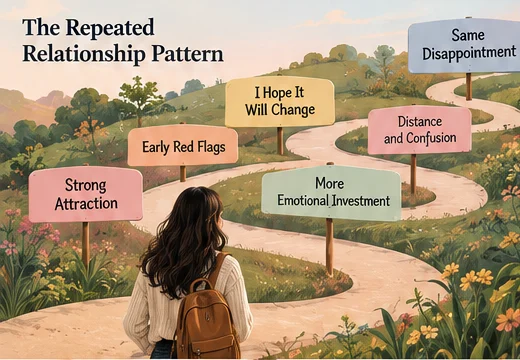
You feel unsure. You wait for reassurance. You hesitate to ask for clarity. You become more interested when they pull away. You keep hoping things will return to how they felt at the beginning.
This is where the pattern becomes easier to see. It may not be, “I always date the same kind of person.” It may be, “I repeatedly end up feeling the same way.”
A repeated relationship pattern can look something like this: strong attraction, then uncertainty, then extra effort, followed by temporary closeness, distance, confusion, and more effort. The faces change, but the emotional sequence stays similar.
Attachment theory is one psychological framework that can help explain how people respond to closeness, trust, and distance in relationships. But attachment is only one part of the picture. Timing, values, communication style, life circumstances, previous relationships, and compatibility also matter. The goal is not to find a label for yourself. The goal is to notice what happens often enough that it deserves your attention.
How Can Childhood Affect Romantic Relationships?
Childhood is often discussed in relationship psychology, but it is easy to oversimplify the idea. You may hear statements like, “You choose partners who remind you of your parents.” Real life is rarely that straightforward.
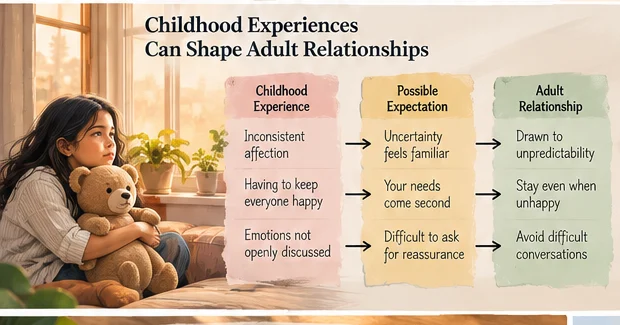
Earlier relationships can influence what you expect from closeness, how you respond to conflict, how safe it feels to ask for reassurance, and what you consider normal in a relationship.
For example, if you grew up in an environment where emotions were rarely discussed, you may find direct emotional conversations uncomfortable as an adult. If affection was inconsistent, unpredictability may feel more familiar than steadiness. If keeping everyone happy was important, you may become used to putting your own needs second.
None of this means your childhood controls your romantic future. It simply means that experiences can create expectations. Those expectations may show up later without you consciously deciding to carry them forward.
Someone who is consistently available may initially feel almost too easy to trust. Someone unpredictable may feel more exciting because you are constantly waiting for the next sign of closeness. That does not mean you are consciously choosing pain. It may simply mean that familiar emotional experiences can be easier to recognise than unfamiliar healthy ones.
The encouraging part is that familiar does not have to mean permanent. Patterns can be noticed, questioned, and changed.
Why Do I Ignore Red Flags in Relationships?
Most people do not deliberately choose to ignore warning signs. Usually, red flags are softened in our minds. You notice something that makes you uncomfortable, and then you explain it.
Maybe you tell yourself they are just stressed, they have been hurt before, nobody is perfect, you are expecting too much, they will open up with time, or you do not want to ruin something good by overthinking it. Some patience is reasonable in any relationship. The problem begins when patience requires you to repeatedly silence your own discomfort.
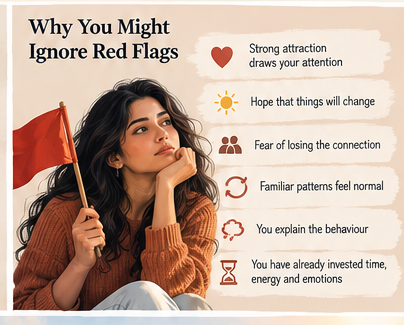
- Strong attraction can pull your attention toward the qualities you enjoy and away from what feels uncomfortable.
- Hope can keep you focused on who the person may become rather than how the relationship feels now.
- Fear of losing the connection can make honest conversations feel risky.
- Emotional investment can make it harder to step away after you have already given a lot of time and energy.
- Familiar behaviour can feel normal even when it does not meet your needs.
One useful practice is to stop judging the relationship only by its best moments. Ask, “What happens most often?” A partner can be affectionate after an argument. A partner can say beautiful things. A partner can make promises. The long-term pattern tells you more than a single good day.
Why Do Healthy Relationships Sometimes Feel Boring?
Some people feel embarrassed admitting this. They meet someone kind, consistent, and emotionally available, yet something feels flat. Meanwhile, the person who sends mixed signals occupies their thoughts all day.
One possibility is that unpredictability creates emotional stimulation. If you do not know when someone will call, whether they still like you, or where the relationship stands, your attention may become highly focused on them. When they finally show affection, the relief can feel powerful. That cycle can create intensity.
A more stable relationship may have less of that emotional rollercoaster. You know the person is interested. They respond consistently. You do not spend hours analysing messages. There is less uncertainty to solve. At first, that may feel less dramatic.
But less dramatic does not mean less meaningful. A healthy relationship can still include attraction, passion, spontaneity, playfulness, and excitement. The difference is that excitement is not constantly being created by fear.
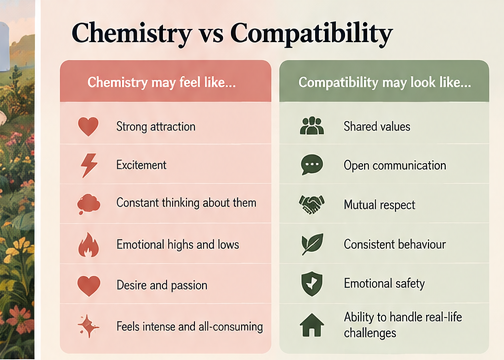
Chemistry and compatibility are not the same thing
| Chemistry may feel like | Compatibility may look like |
|---|---|
| Strong attraction | Shared values |
| Excitement | Mutual respect |
| Constant thinking | Consistent behaviour |
| Emotional intensity | Reliable communication |
| Desire | Ability to handle conflict |
| Spark | Emotional safety |
You do not have to choose one or the other. The strongest relationships often have both. But chemistry on its own cannot answer questions such as: Can we communicate honestly? Do our values fit? Do I feel respected? Can we solve problems together? Do their actions match their words?
Why Am I Attracted to People Who Are Bad for Me?
Attraction is not a carefully reasoned decision. You usually do not choose who catches your attention by comparing them against a spreadsheet. Attraction can come from appearance, humour, confidence, intelligence, energy, shared interests, mystery, emotional familiarity, or simply timing.
That is why the first feeling of attraction is not necessarily the place where change has to happen. The more useful question is: What happens once I have more information?
You may feel attracted to someone and later realise they do not communicate in a way that works for you, your values are very different, they do not want commitment, they repeatedly disrespect your boundaries, or their behaviour leaves you anxious and uncertain.
Attraction does not disappear just because you learn these things. But you can choose how much meaning you give that attraction. A simple idea can help: attraction is information. It is not an instruction.
You can like someone and still decide they are not a good match for your life. You can feel chemistry and still notice that the relationship does not meet your needs. You can miss someone and still know that going back would not be healthy for you. Those two truths can exist together.
How Do I Know If I Am Repeating an Unhealthy Relationship Pattern?
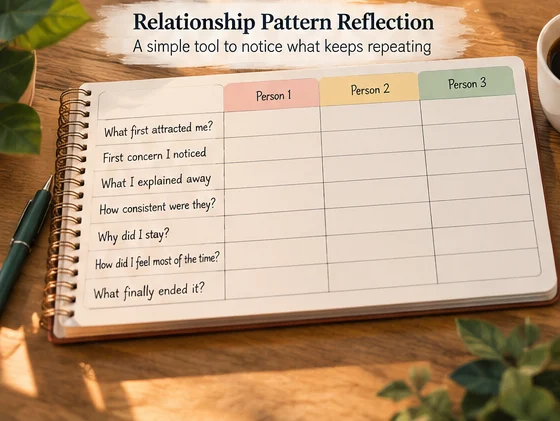
Memories can be unreliable when you look at past relationships one at a time. You may remember the happiest moments of one relationship and the worst moments of another. A better approach is to compare the same questions across several experiences.
Relationship Pattern Reflection
This is a reflection exercise, not a clinical assessment. Think about your last two or three meaningful romantic relationships or dating experiences.
| Reflection question | Person 1 | Person 2 | Person 3 |
|---|---|---|---|
| What first attracted me? | |||
| How quickly did I become invested? | |||
| What was the first concern I noticed? | |||
| What did I explain away? | |||
| Were their words and actions consistent? | |||
| What happened when they became distant? | |||
| What did I avoid asking for? | |||
| Why did I stay when I felt unhappy? | |||
| How did I feel most of the time? | |||
| What finally ended the relationship? |
Now read across each row. You may discover that your partners were very different, yet you repeatedly did similar things. Perhaps you became more attached when someone withdrew. Perhaps you kept hoping the relationship would return to how it felt in the beginning. Perhaps you stayed quiet about your needs because you feared being rejected. Or maybe you repeatedly chose people whose future plans never matched yours.
The purpose is not to criticise yourself. It is to identify the point where you may have more choice next time.
How Can I Stop Choosing the Wrong Partner?
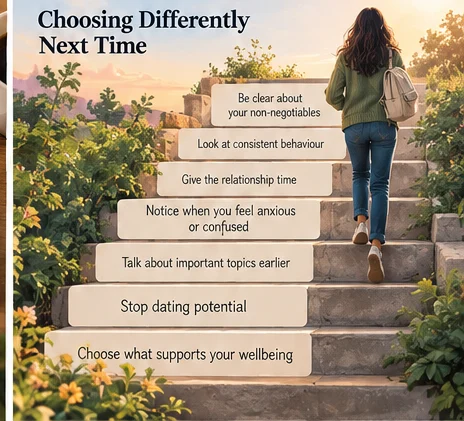
If you are trying to understand how to stop choosing the wrong partner, “make better decisions” is not very helpful advice. You need something more practical.
1. Look at the pattern, not just the breakup
Instead of asking only, “What was wrong with them?” also ask, “What did I repeatedly ignore, accept, chase, or hope would change?” That moves your attention toward your own decision-making.
2. Give the relationship time to reveal itself
Early attraction can make someone seem more compatible than they actually are. You do not need to become suspicious. Just avoid deciding too early that someone is exactly what you have been looking for. Let consistency build over time.
3. Pay attention to behaviour
Words can create hope. Behaviour shows you what the relationship actually feels like. Notice whether the person keeps commitments, communicates with reasonable consistency, takes responsibility for mistakes, respects your time, listens when you express a need, and handles disagreement without humiliation or threats.
4. Decide what matters before you are deeply invested
Think about your non-negotiables while you are calm. What values do you need in a partner? What kind of communication works for you? What behaviours would make the relationship unsuitable? What are you flexible about, and what are you not willing to compromise on?
5. Be careful with uncertainty
Uncertainty can feel like excitement. If someone keeps you guessing, you may spend more time thinking about them simply because your mind wants an answer. Ask yourself: “Am I enjoying the relationship, or am I mainly trying to secure it?”
6. Notice how you feel between meetings
A relationship is not only what happens when you are physically together. Pay attention to how you feel afterwards. Do you generally feel calm, respected, valued and understood, or confused, anxious, exhausted, unsure and constantly worried about losing them?
7. Talk about important issues earlier
Avoiding a difficult conversation does not remove incompatibility. If commitment, marriage, children, family involvement, finances, career goals, location, religion or lifestyle matter deeply to you, discuss them before the relationship becomes too serious.
8. Stop dating potential
Ask yourself: “If this person stayed exactly as they are now, would I still want this relationship?” Relationships happen in the present, not in the future version of someone you hope may eventually appear.
Related reading: Marriage Pressure in India: Mental Health & Emotional Stress can be helpful if family expectations or marriage timelines are influencing dating decisions.
What Does a Healthier Relationship Choice Look Like?
A healthy relationship does not mean finding someone who never disappoints you. It does not mean never arguing, and it does not mean perfect communication. Healthy relationships are still between imperfect people.
What matters is the pattern. Look for consistency more often than confusion, honesty, mutual effort, respect during disagreements, willingness to listen, accountability, room for both people to have individual needs, and an ability to repair after conflict.
The relationship should not require one person to constantly earn basic security. You should be able to ask questions without feeling as though the entire relationship will collapse. You should be able to have needs without automatically feeling guilty for having them. And both people should have some responsibility for keeping the relationship healthy.
For communication-focused guidance, read How to Build Stronger Connections in the Age of Digital Communication. If past hurt has made trust difficult, Love After Trauma: Healing & Opening Up Again explores rebuilding trust and emotional safety.
When Can Therapy Help With Repeated Relationship Patterns?
You do not need therapy because you dated the wrong person. Almost everyone makes relationship choices they later question.
Therapy may be useful when the same pattern keeps appearing and you feel unable to change it, even though you understand it logically. You may consider speaking with a therapist if you repeatedly choose unavailable partners, rejection deeply affects your sense of worth, you become highly anxious when someone pulls away, you struggle to leave relationships that consistently hurt you, you repeatedly ignore your own needs, or you recognise the pattern but feel unable to respond differently.
Therapy is not about having someone choose a partner for you. A therapist cannot tell you who you should date. What therapy can offer is a place to examine your emotional responses, expectations, fears and choices with more distance. Sometimes understanding the pattern while you are outside the relationship makes it easier to recognise when it appears again.
If you want personal support, you can explore PsyQuench counselling services or book a therapy appointment.
For Psychology Learners
If you are studying psychology or counselling, repeated relationship patterns are also useful to understand from a professional perspective. Emotional availability, attachment, communication, boundaries and conflict are common areas explored in relationship counselling.
PsyQuench also offers a Relationship Counselling workshop for learners who want structured exposure to listening skills, emotional intelligence, problem identification and relationship boundaries.
Frequently Asked Questions
Can I change the kind of people I am attracted to?
You may not control every initial feeling of attraction, but you can change how you respond to it. As you become clearer about your needs, values, boundaries and relationship patterns, you may begin investing differently. The goal is not to force yourself to like someone. It is to avoid allowing attraction to make every decision for you.
Why do I lose interest when someone treats me well?
There can be many reasons. Sometimes consistency feels unfamiliar if you are used to uncertainty. In other cases, the person may simply not be compatible with you. Losing interest in one kind person does not automatically mean you are attracted to unhealthy relationships. Look for a repeated pattern before making that conclusion.
Does choosing the wrong partner mean I have attachment issues?
No. A difficult relationship does not prove you have an attachment problem. Attachment is one framework that can help explain certain relationship behaviours, but it is not the only factor involved in romantic choices.
Is strong chemistry a bad sign?
Not at all. Healthy relationships can have strong chemistry. The important question is whether attraction exists alongside respect, reliability, communication and shared values.
How do I know if I keep repeating the same relationship pattern?
Compare several relationships using the same questions. Look at what attracted you, the first concern you noticed, what you ignored, how you reacted to distance, and why you stayed. Similar emotional experiences across different relationships may point to a repeating pattern.
Can therapy help me choose healthier relationships?
Therapy may help you understand what happens when you experience attraction, uncertainty, rejection, conflict or emotional distance. It cannot guarantee that every future relationship will work, but it can help you become more aware of your own patterns and choices.
Final Thoughts
If you keep wondering, “Why do I keep choosing the wrong partners?”, try not to use the question as evidence that you are failing at relationships. Use it as a starting point.
Maybe the repeated issue is not that you keep meeting the exact same person in a different body. Maybe the repetition happens in how quickly you invest, how long you tolerate uncertainty, what you explain away, or how strongly you react when someone becomes distant.
Once you begin noticing the pattern earlier, you have more room to make a different decision. You cannot guarantee that every person you date will be right for you, and you cannot remove every disappointment from relationships. But you can become clearer about what you need, what you are willing to accept, and what you want to do when familiar warning signs appear again.
That is where change becomes possible.