How Do You Make Sense of Everything a Client Tells You? Understanding Case Formulation in Psychology

You finish a practice interview with two pages of notes. There is a missed deadline, a tense conversation with a manager, three nights of poor sleep, an old memory of being criticised, and a dozen smaller details. Which one matters? At PsyQuench, we think this is one of the most useful questions a psychology learner can ask before reaching for a technique. A case formulation in psychology is a working explanation of how a particular difficulty may have developed and what might be keeping it going. It is a way to organise the story, not a verdict about the person.
This guide shows you how to move from a crowded page of information to a careful, revisable idea. We will use one clearly fictional example throughout, compare formulation with diagnosis and planning, and show what changes when a new fact no longer fits your first explanation.
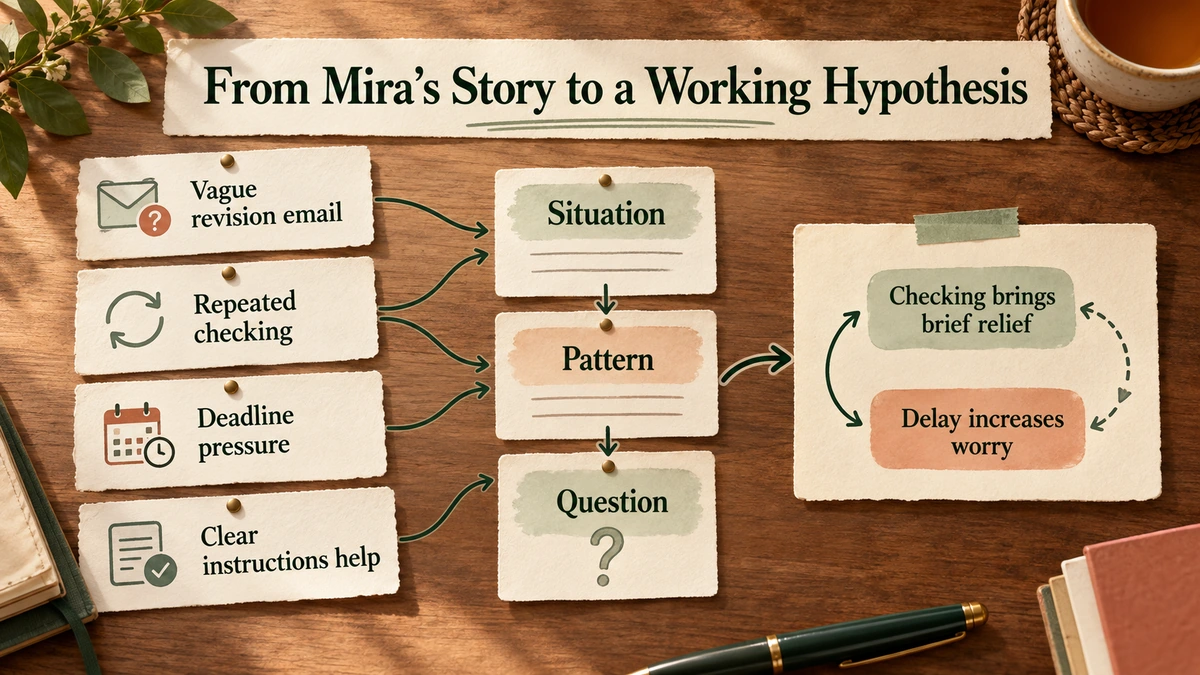
Table of Contents
- What Is a Case Formulation in Psychology?
- Case Formulation vs Diagnosis vs Treatment Planning: What Is the Difference?
- What Information Should Be Included in a First Case Formulation?
- What Does a Good Counselling Case Formulation Example Look Like?
- How Can Psychology Students Build a Case Formulation Step by Step?
- How Do You Revise a Case Formulation When New Information Does Not Fit?
- How Should Psychology Students Practise Case Formulation Safely?
- FAQs About Case Formulation in Psychology
What Is a Case Formulation in Psychology?
A case formulation is a reasoned account of a person’s difficulty, written as a hypothesis rather than a list of facts. It brings together the concern the person has described, the situations in which it appears, relevant context, and a possible pattern that maintains it. The explanation is individual. Two people may report the same symptom while needing very different questions asked of them.
For learners studying case formulation psychology, the skill is to explain a pattern without pretending that the first explanation is the final one.
How Does a Working Case Formulation Explain a Client’s Difficulty?
Imagine a learner writing, “Mira worries about work and sleeps badly.” That is a summary. It tells us what is happening, but it does not yet help us understand what links the two experiences. A formulation might ask whether a specific event starts the worry, what Mira predicts will happen, what she does next, and whether that response brings brief relief while creating another problem.
That does not mean every detail must be turned into a cause. A late night could reflect worry, a noisy home, a shift in work hours, or something else. The learner’s job is to keep these possibilities visible rather than filling gaps with certainty. If you are still building your toolkit, PsyQuench’s guide to practical tools interns use offers useful background. This article stays with one skill: making an explanation that can be questioned.
The Beck Institute’s overview of formulation-led CBT describes formulation as a guide to decisions during cognitive behavioural therapy, rather than a document completed once and filed away. That is the important shift for a beginner: write something useful enough to guide the next question, but light enough to change.
Why Should a Case Formulation Change When New Information Appears?
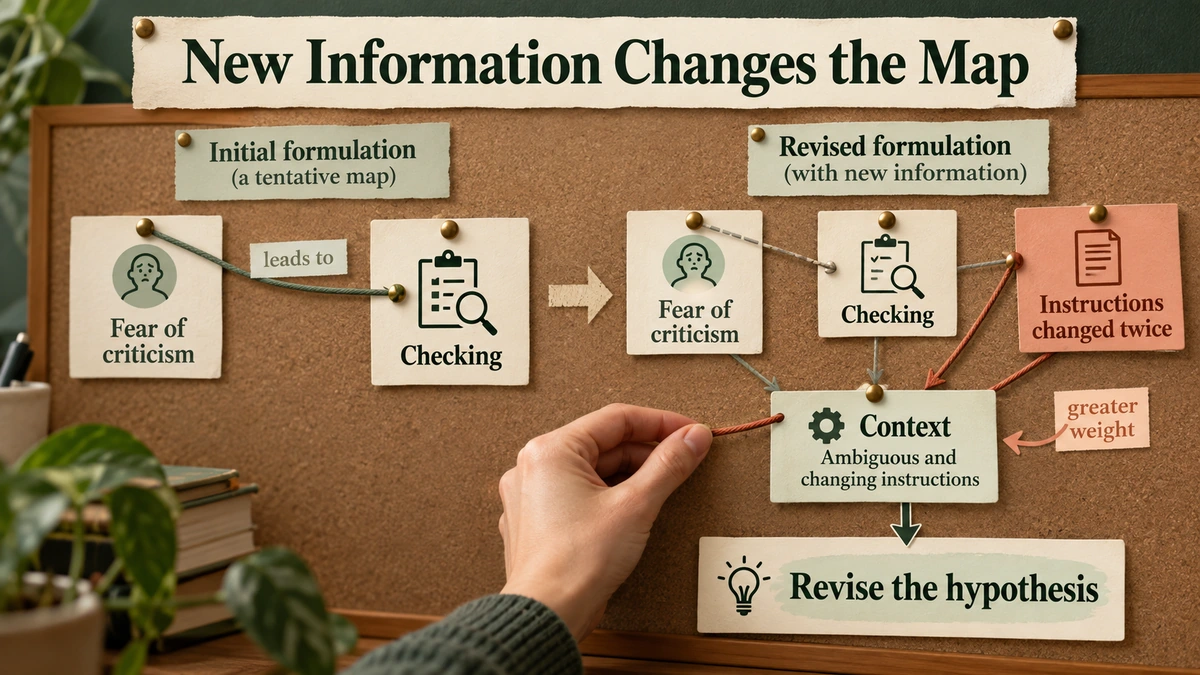
A working explanation should change when the person’s account, the context, or your understanding changes. Perhaps you initially thought Mira delayed sending a report because she feared criticism. Later you learn that the reporting requirements changed twice that week. Her delay may partly be a sensible response to unclear instructions. The new fact does not erase her worry; it changes how you understand it.
This is why “hypothesis” is a better word than “truth.” You can ask the person whether your summary feels fair, look for examples that do not fit it, and discuss uncertainty in supervision. A formulation that survives only because nobody questions it is not doing much work.
Case Formulation vs Diagnosis vs Treatment Planning: What Is the Difference?
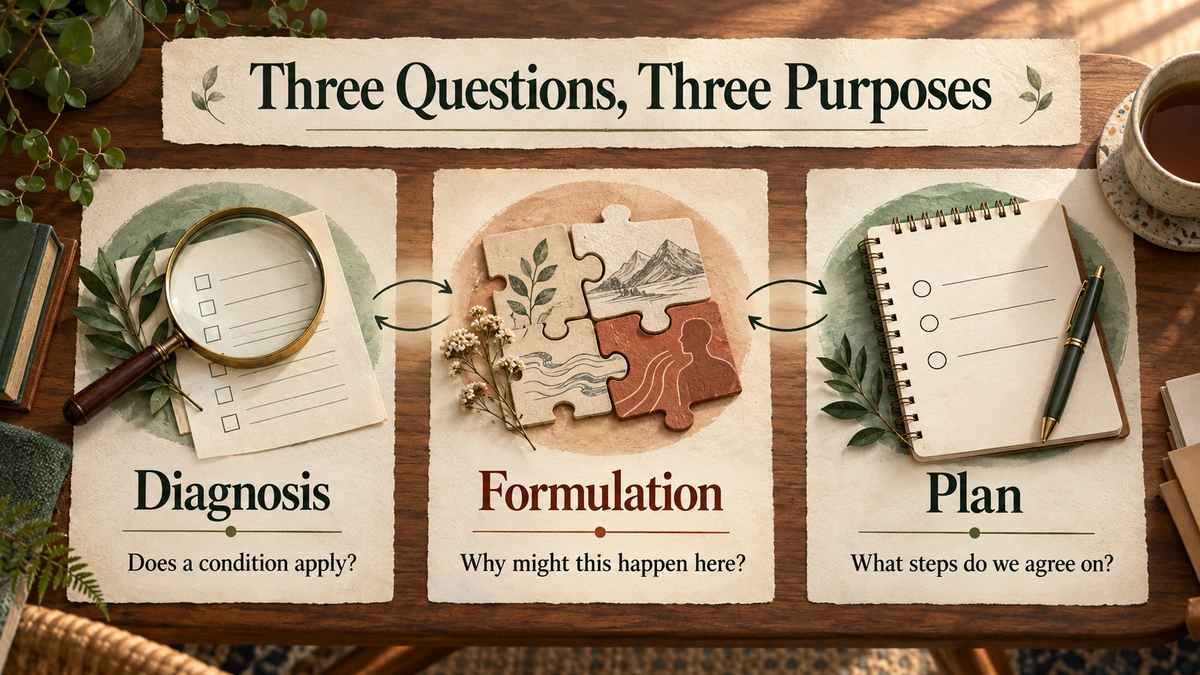
The three terms answer different questions. A diagnosis asks whether a pattern of experiences meets a recognised set of criteria. A formulation asks how the person’s difficulties might make sense in their own circumstances. A treatment plan sets out agreed goals and steps. They can inform one another, but they are not interchangeable.
What Question Does Each Answer: Diagnosis, Formulation or a Treatment Plan?
The table is deliberately modest. It does not diagnose Mira or prescribe treatment. It shows why a label alone cannot tell a practitioner how a difficulty works in a particular week of a particular person’s life.
How Do Diagnosis, Case Formulation and Treatment Planning Work Together?
A diagnosis can contribute relevant information about risk, likely course or evidence-based options. A formulation may help a practitioner understand how the person’s situation shapes the work. A plan should follow from a proper assessment and shared goals, then be reviewed. None of these steps gives a student permission to treat independently.
If you are studying treatment planning psychology, the temptation is to jump straight from a symptom to a technique: “The person worries, so teach a worry exercise.” The missing question is whether worry is the central problem, a response to a real external demand, or one part of a larger pattern. The American Psychological Association’s introduction to psychotherapy case formulation describes formulation as a way to understand an individual’s landscape while acknowledging that different therapeutic approaches use their own lenses. This guide uses a simple educational lens, not the only legitimate model.
What Information Should Be Included in a First Case Formulation?
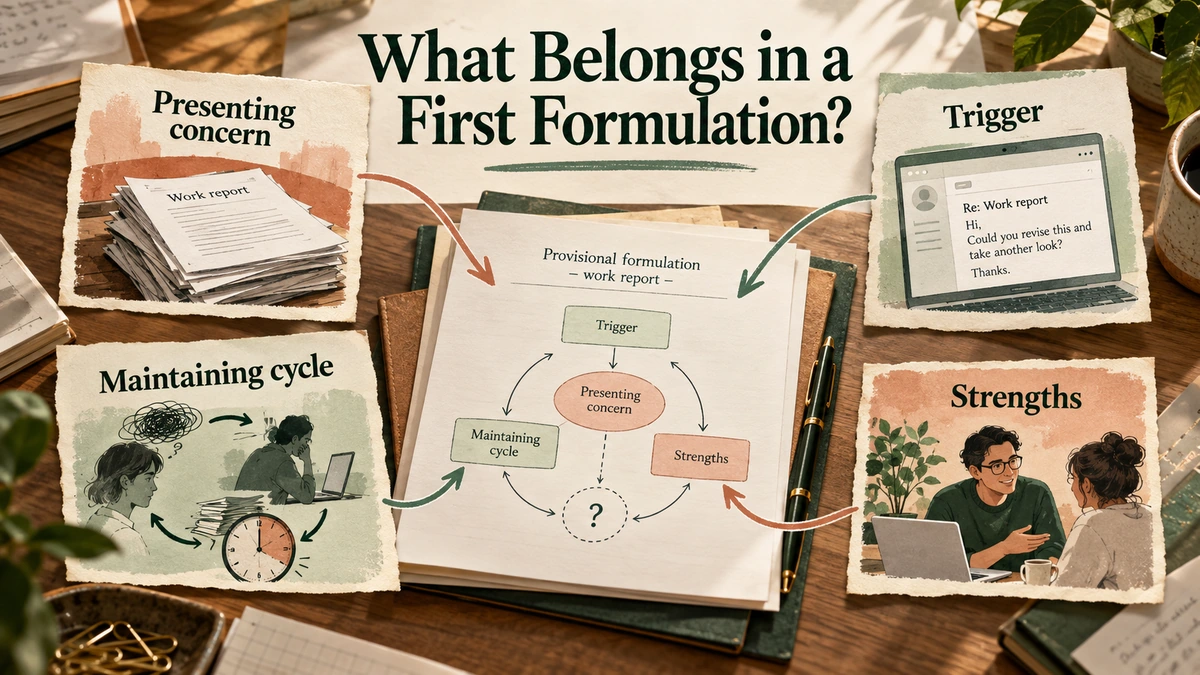
Start with the person’s stated concern and the events close to it. Then ask which details help explain the pattern or challenge your first idea. A biography is not automatically a formulation. Good selection is less about finding the one dramatic childhood event and more about deciding what is relevant now, what remains unknown, and what strengths the person already brings.

How Should You Describe the Presenting Problem?
Write the difficulty in words the person might recognise. For Mira, “I keep delaying a report because I cannot decide when it is good enough” is more useful than “work anxiety.” It tells us what she wants to change and gives us a situation we can explore. Ask what happens, how often, and what it costs her. Avoid turning a single difficult week into a permanent trait.
In CBT case conceptualization, a learner may organise thoughts, feelings, bodily sensations and actions around one recent event. That structure can be helpful, but the form should serve the story. Mira’s uncertainty about a manager’s instructions belongs in the picture alongside her self-critical thought; leaving it out would make the account falsely individual.
How Do You Identify Relevant Triggers?
A trigger is the situation that seems to start or intensify the difficulty. Mira receives an email asking for revisions. Before writing “emails trigger anxiety,” ask what is special about this email. Was it vague? Did it arrive late? Did it follow a previous criticism? A trigger is an observation to explore, not proof of an underlying cause.
How Do You Find a Maintaining Cycle in a Case Formulation?
Next, look at what keeps the difficulty going. Mira predicts that submitting an imperfect report will make her look unreliable. She rereads it repeatedly and postpones sending it. The checking brings a little relief for an hour, but the deadline gets closer; that pressure makes the next round of checking feel more necessary. This is a possible maintaining cycle, not a diagnosis of Mira’s personality.
The cycle also has a context. If the manager regularly changes the instructions without explaining the priority, Mira’s checking may be partly an attempt to manage genuine uncertainty. A careful formulation can hold both things: a response that has become costly and a work environment that makes the response understandable. The gap between tidy classroom models and real situations is one reason to read about what psychology students are not taught about practice.
Why Should Strengths and Protective Factors Be Included in a Case Formulation?
Do not make the map entirely about problems. Mira asks for clarification, cares about accuracy, has a colleague she trusts, and has completed difficult projects before. Those are not decorative “positive points.” They may show where the pattern is less powerful and which questions could help test your explanation. What changes on the days she receives clear instructions? What has helped her submit work despite uncertainty?

If you are learning to turn theory into a usable formulation, PsyQuench’s Cognitive Behavior Therapy training is one place to explore structured skills practice. The fictional worksheet below is for learning; a course does not replace supervision, role-specific qualifications or responsibility for real client care.
What Does a Good Counselling Case Formulation Example Look Like?
Yes. The most helpful example is one where the first draft is not very good. Mira is fictional, and the details below are invented for teaching. No actual client information is used. Read the sequence as a way of asking better questions, not as a template to paste into a real record.
What Makes a Weak Case Formulation Too Vague?
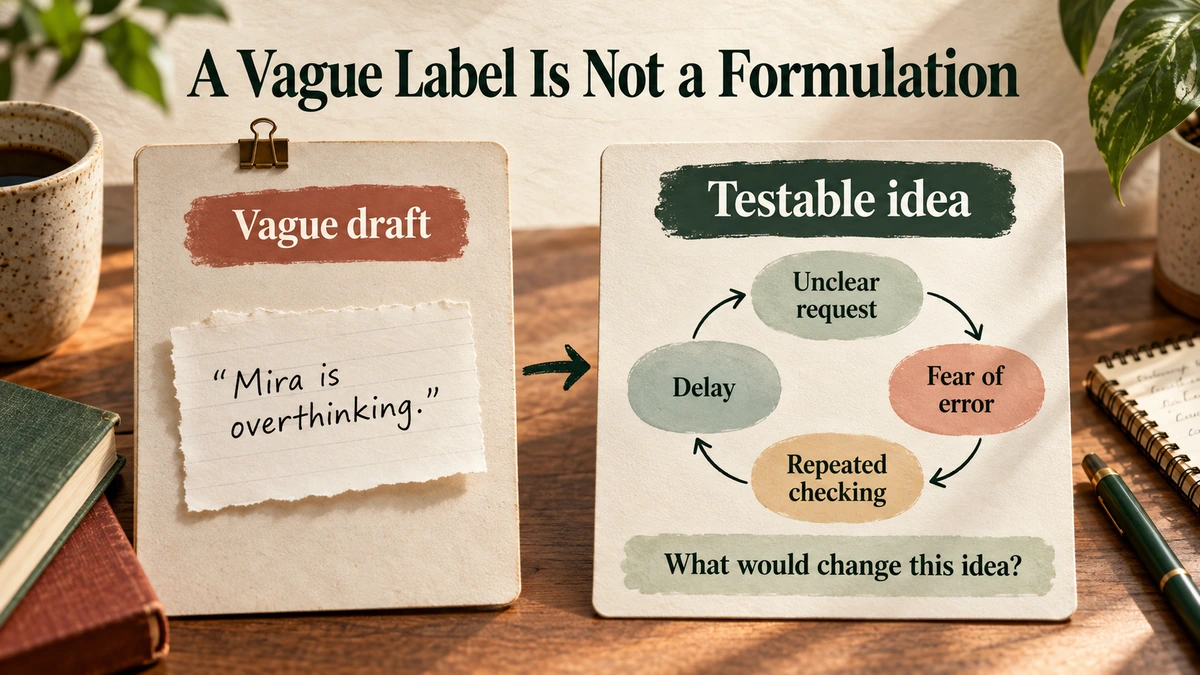
Suppose a trainee begins with: “Mira is anxious because she has low confidence. She needs to stop overthinking.” It is short, but it has three problems. “Low confidence” is treated as a cause without evidence. “Overthinking” does not explain when the problem appears or what Mira does. “Needs to stop” is advice, not an explanation. The draft would not help a supervisor know what to ask next.
Here are the fictional notes the trainee actually has. Mira, 29, works on reports that are reviewed by her manager. She delayed one report after receiving a vague revision request. She reread the email and checked the report several times. She worried that a mistake would make her seem unreliable. She slept poorly on the two nights before the deadline. She also mentioned that when project requirements are clear, she usually sends work on time. A colleague sometimes helps her identify which changes matter.
The trainee can now sort the notes instead of copying them all. The delayed report is the current problem. The unclear request is a possible trigger. The prediction about seeming unreliable, the repeated checking and the deadline pressure may form a cycle. Clear instructions and a helpful colleague are strengths or useful contrasts. Poor sleep matters because it shows cost, but the notes do not prove that worry is its only cause. There is still much we do not know.
How Do You Turn Client Notes Into a Testable Working Hypothesis?
An improved counselling case formulation example might say: “When Mira receives a revision request that does not specify what matters most, she worries that submitting the wrong version will make her look unreliable. She rereads the request and checks the report repeatedly before sending it. Checking briefly reduces uncertainty, but the delay brings the deadline closer and increases her worry. This seems less intense when requirements are clear or when she can ask a colleague for clarification. We should ask Mira whether this account fits and look for occasions when it does not.”
That paragraph is longer because it earns its length. It names a situation, a prediction, an action, short-term relief, a possible cost, and two ways to test the idea. It does not claim Mira has a disorder. It also leaves open whether the manager’s communication, Mira’s beliefs, or both should be given more weight.
How Can Psychology Students Build a Case Formulation Step by Step?
Use five short prompts to move from a client’s story to a working explanation you can check and revise. This is a PsyQuench teaching tool for fictional practice, not a clinical protocol.
Story → Pattern → Hypothesis → Test → Revise: A Practice Framework
Write one or two lines under each heading:
Story: What is the person’s concern in their own words? Which recent event shows it clearly?
Pattern: What seems to happen before, during and after that event? What helps, even briefly?
Hypothesis: What tentative link might explain why the difficulty continues? What context might you be missing?
Test: What question, contrasting example or client feedback could challenge this idea?
Revise: What changes after you learn more? What remains uncertain?
How Do You Test Whether a Formulation Fits the Client’s Story?
For Mira, the “test” is not an experiment imposed on her. It might simply be asking whether the checking happens when instructions are clear, or whether another worry matters more. This PsyQuench educational reflection tool is not a clinically validated model or a substitute for assessment. Its value is the habit of moving from a neat story to a question you are willing to revisit.
How Do You Revise a Case Formulation When New Information Does Not Fit?
You test a formulation by looking for information that could make it less convincing, not by finding only details that confirm it. Ask whether the person recognises the pattern, whether it appears in different contexts, and what happens when one condition changes. A supervisor can help a beginner see where a compelling explanation has outrun the evidence.
What Questions Can Challenge Your First Formulation Hypothesis?
Suppose the trainee asks Mira about a recent report sent without delay. Mira says the manager had provided a clear example and a firm priority order. That fits the uncertainty part of the hypothesis. But she also says she sometimes checks a simple personal message repeatedly, even when nobody has been critical. That complicates the idea that unclear work instructions explain everything.
Now imagine one more fact: the manager changed the report requirements after Mira had already completed a draft. Her extra checking may have been a reasonable response to an unstable task as well as a habit that costs her time. The trainee should not erase either possibility. A revised note might say that unclear demands and a strong fear of getting it wrong both appear relevant, while the role of sleep, workload and earlier experiences remains open.

Why Should a Case Formulation Be Collaborative With the Client?
Ask Mira whether the wording sounds like her experience. She may say, “I do worry about mistakes, but I am mostly trying to work out what my manager wants.” That correction is useful data. A formulation written about someone, without checking it with them where appropriate, can look coherent on paper and still miss the point.
For students, this is where hands-on training and feedback matter. In clinical psychology training, a fictional case can teach the reasoning process; supervised practice helps learners notice the questions they forgot to ask. Different therapeutic approaches may emphasise different kinds of information, so a formulation should remain tied to its method and the person’s goals. New information should change the map when the map no longer helps.
How Should Psychology Students Practise Case Formulation Safely?
Practise on invented material first, explain your uncertainty, and take real practice questions to the appropriate supervisor. A polished worksheet does not authorise independent assessment or treatment. Keep the boundary clear between learning to reason and making decisions for an actual person.
How Can Roleplay Help Students Practise Case Formulation?
In pairs, one learner can play Mira using only the fictional facts above while the other asks about one recent report. The observer notes three things: whether the learner asked about context, whether they checked an assumption, and whether they included a strength. Swap roles. Then write a two-sentence hypothesis and one question that could disconfirm it. The aim is not to “get Mira right”; it is to practise being specific and revisable.
What Should You Take to Clinical Supervision About a Formulation?
Bring the uncertainty to supervision in a form that invites discussion: “I linked the delay to fear of criticism, but I may have underweighted the changing task instructions. What would you ask next?” That question is more useful than “Is my formulation correct?” because it identifies the decision you need help making. Supervision also helps you examine how a formulation might affect care, not just whether a worksheet looks complete.
How Should Students Protect Client Privacy During Formulation Practice?
Do not put actual client notes into a class exercise, a public document or an unapproved digital tool. Follow your placement, employer and supervisor’s confidentiality process. The fictional Mira story needs no identifiers because there is no real person behind it. If you want to see how a client-facing service explains the other side of this work, PsyQuench describes how a counselling conversation starts. That service link offers perspective; it does not turn this educational article into treatment advice.
The point is not to produce an impressive diagram. It is to ask a better next question. When two pages of notes leave you uncertain, return to the person’s words, name a possible pattern, and look for what could change your mind. A formulation earns trust by staying useful, collaborative and open to correction.
Ready to practise the reasoning with guidance? Explore PsyQuench’s Cognitive Behavior Therapy course for structured learning about CBT concepts, including case thinking. Check the current variant, dates and eligibility on the course page before registering. Course completion does not by itself qualify someone for independent clinical practice.
FAQs About Case Formulation in Psychology
Is Case Formulation the Same as Case Conceptualisation?
The terms are often used very similarly. “Conceptualisation” is especially common in CBT discussions; “formulation” appears across several therapeutic approaches. The useful question is not which label wins, but what the document does: it should connect relevant information into a provisional explanation that guides questions and can be revised. A student may need to follow the terminology and model required by their course or supervisor.
Do I Have to Use the 5 Ps in a Case Formulation?
No single template is right for every learning task. The 5 Ps can help organise presenting, predisposing, precipitating, perpetuating and protective factors, but a filled template is not automatically a useful formulation. If your programme requires the 5 Ps, use them; then ask whether the resulting account actually explains a pattern, includes strengths and identifies uncertainty. Do not force a detail into a category merely to complete the page.
Can a Case Formulation Be Wrong?
Yes. A formulation is a hypothesis built from limited information, so it can miss context, give too much weight to one event or use an unsuitable model. That is why it should be checked against the person’s account and revised when new information appears. “Wrong” does not mean the learner has failed; refusing to reconsider an explanation is the more serious problem. In real work, discuss significant uncertainty with the appropriate supervisor.
How Long Should a Beginner Case Formulation Be?
Long enough to show the concern, the proposed links and the questions that remain. A brief paragraph can be more useful than several pages of unrelated notes. Your course or placement may have its own format, so follow that requirement. Before adding another detail, ask whether it changes the explanation, helps test it or identifies an important strength or safety issue. If it does none of those, it may belong in notes rather than the short formulation.
How Is a Case Formulation Different From a Treatment Plan?
A formulation proposes why a difficulty may be happening or continuing; a treatment plan records agreed goals and the steps to pursue them. The plan may draw on the formulation, but it should also reflect assessment, the person’s preferences, evidence and professional judgement. If the formulation changes, the plan may need review. Neither is a substitute for the other, and a student exercise should not be presented as a plan for a real client.
Can Psychology Students Practise Case Formulation With Fictional Cases?
Yes. Fictional cases are a useful way to practise noticing patterns, naming assumptions and asking what evidence would change your mind. Make the scenario clearly invented, include context and strengths, and review the work with a tutor or supervisor. A fictional case does not test whether you can make a clinical decision for a real person. Avoid using disguised details from an actual client unless your training setting has explicitly approved the material and its privacy safeguards.