Am I Using AI to Learn—or Just Letting It Think for Me? A Guide for Psychology Students
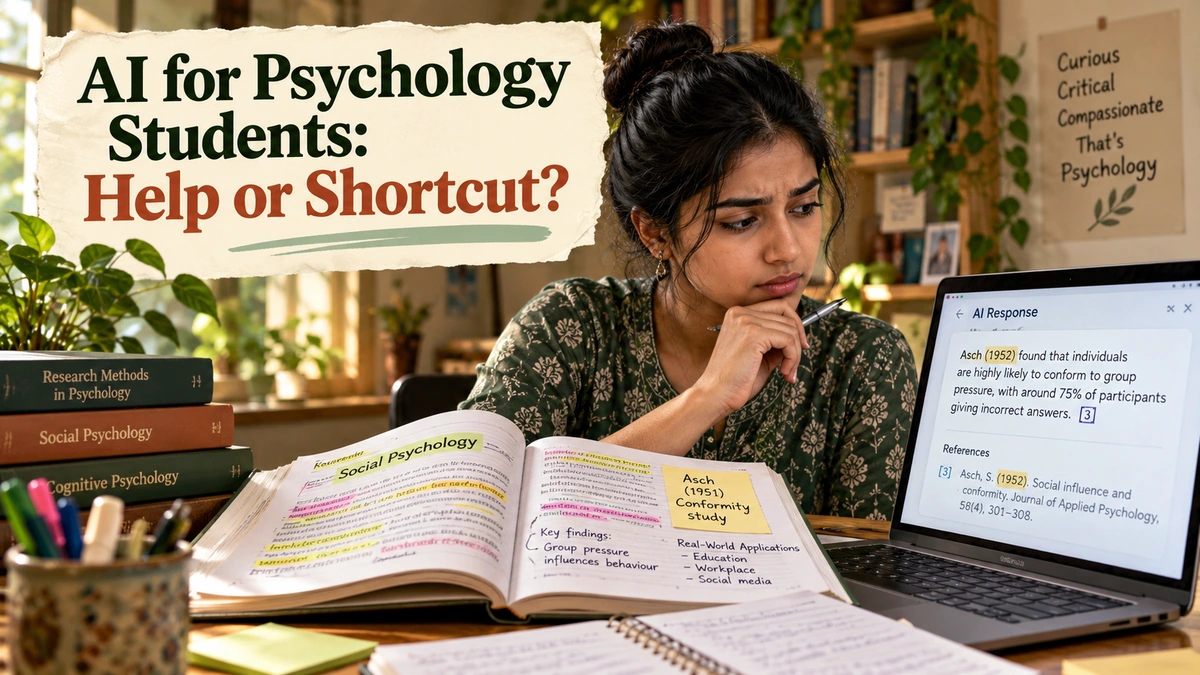
You ask an AI tool to explain a difficult psychology concept. The answer is clear, so you put it into your notes. Then you try to open its cited paper and cannot find it. At PsyQuench, we think AI for psychology students is most useful when it helps you ask better questions, practise explanations, and check your understanding. It becomes risky when a convincing answer replaces reading, judgement, or the human feedback you came to training to develop.
Table of Contents
- Can Psychology Students Use AI Without Outsourcing Their Thinking?
- Study Partner vs Shortcut: How Can You Tell the Difference?
- How Do You Check an AI Claim or Citation?
- What Psychology or Client Information Should Never Enter a Public AI Tool?
- Which Counselling Skills Still Need Human Feedback?
- How Can You Use AI More Carefully This Week?
- FAQs About AI in Psychology Study
Can Psychology Students Use AI Without Outsourcing Their Thinking?
Yes, but start with the learning task. If the assignment asks you to compare two theories, you need to form a comparison yourself. AI may help you find a question you missed or point out where your explanation is unclear, if the rules allow it. If it writes the comparison and you only change a few words, you have lost the thinking practice the task was designed to build.
The American Psychological Association’s student-focused discussion of AI use encourages explicit conversations about goals, accountability, rights and risks, and trust. It is a framework for talking with teachers, not blanket permission to use any tool in any assignment. Your course policy still decides what is allowed.
Which study tasks AI can support
You could ask for a plain-language explanation of a term after reading the assigned source, request a quiz from notes you wrote, or ask for alternative interpretations of a fictional case. You could also ask the tool to challenge an argument: “What evidence would weaken my claim?” The value comes from checking its answer and then deciding what you think.
Our article on skills beyond textbook answers explains why understanding a concept is only part of professional learning. ChatGPT psychology education can be useful for rehearsal, but it cannot observe how your response lands with another person or sign off on your competence.
Why responsibility stays with the student
If your submitted work contains a made-up citation, a false claim, or language you cannot explain, “the tool wrote it” will not make the work reliable. You are responsible for what you submit and for the privacy of material you enter. This is also a good preparation for later professional responsibility: confident wording is not evidence.
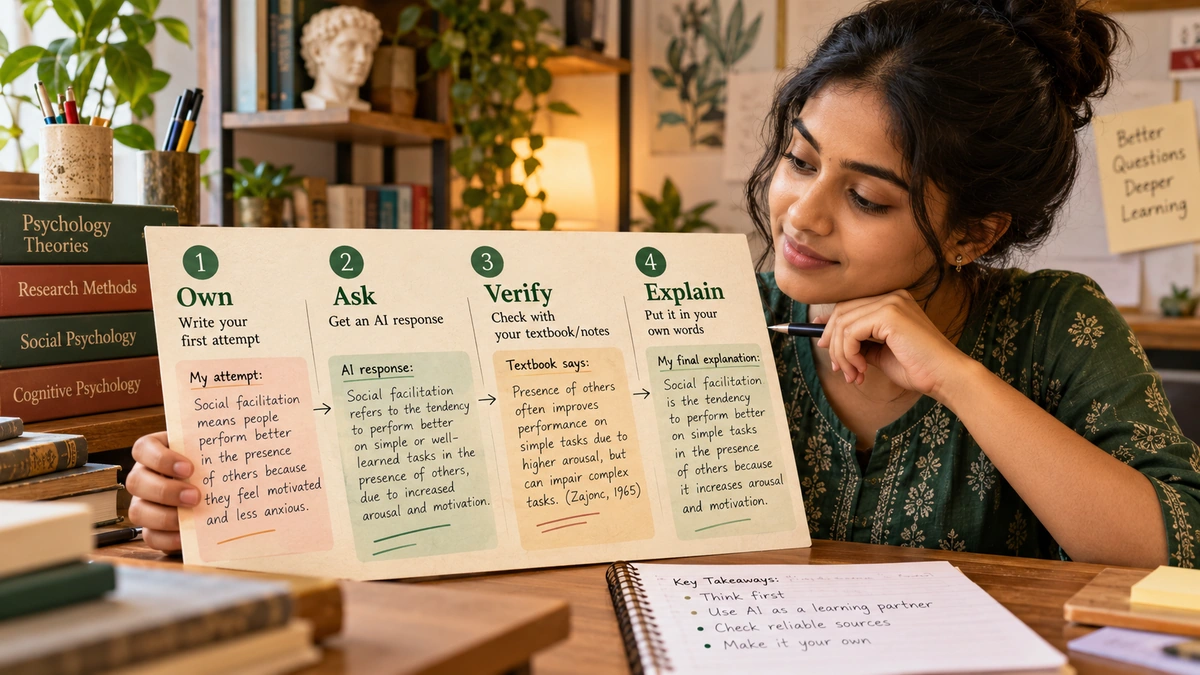
Try the Own–Ask–Verify–Explain check, an original PsyQuench study aid. Own: make your first attempt. Ask: use AI for a specific permitted gap. Verify: check claims and sources independently. Explain: put the answer away and explain the idea in your own words. If you cannot, the tool may have produced an attractive note without producing learning. This is a reflection aid, not a validated assessment.

Study Partner vs Shortcut: How Can You Tell the Difference?
A study partner helps you do the thinking; a shortcut does the thinking you were meant to practise. The boundary depends on the task and your institution’s rules. Generating practice questions from your own notes may deepen recall. Submitting an AI-written case analysis under your name may bypass the learning goal and breach academic integrity rules.
Does the activity deepen your learning?
Imagine a fictional student, Farah, studying cognitive distortions. She reads the chapter, writes two examples, then asks an AI tool to identify where her examples are ambiguous. She compares the feedback with the text and revises one example. She has still done the intellectual work. If she had asked for “ten perfect examples” and memorised them without judging why they fit, she would be less ready to recognise a real, messy statement later.
The tool can also be wrong in a way that teaches you something—if you catch it. Asking, “Which part of this answer is uncertain?” is useful only when you follow through by checking the source yourself.
When AI replaces the work you were meant to do
An assignment may be designed to build literature-search skill, writing skill, or case reasoning. If you ask AI to find all the studies, write the synthesis, and choose the conclusion, the finished document may look polished while the underlying skill remains unpractised. That matters beyond grades. Later, a client or supervisor may need you to explain why a claim is sound and where its limits are.
Do not assume every allowed use is a good use. A course may permit AI brainstorming, but you still need to decide whether it helped you learn. Conversely, an instructor may forbid it for a particular task because they need to see your unassisted reasoning. Ask when the rule is unclear.
How assessment rules change the answer
Read the assignment instructions for permitted tools, disclosure, citations, and privacy. Some policies distinguish idea generation from submitted text; some require a usage statement; some prohibit AI entirely for a task. Use the specific rule that applies, not a generic internet claim that “AI is allowed at university.”
If you have already used a tool in a way that may conflict with the rule, ask the instructor how to correct it before submission. Honest clarification is better than inventing a citation or concealing the process.

How Do You Check an AI Claim or Citation?
First check whether the source exists. Then read it. Finally ask whether it supports the exact claim in your notes. AI can produce plausible titles, authors, years, and page numbers that do not correspond to a real paper. It can also cite a real paper for a claim the paper never tested.
First check that the source exists
Search the title in a scholarly database or the publisher’s site. Match the authors, year, journal, and DOI. If you cannot find it, do not cite it. Ask a librarian or instructor if you are unsure. A confident-looking reference list is not evidence that the references are real.
If the paper exists, open the actual abstract and, when available, the full text. Do not cite a study from a snippet alone if your assignment requires you to understand it. Check whether it is primary research, a review, commentary, or a clinical guideline. These sources answer different questions.
Read the methods behind the claim
Suppose AI says, “A study proves a specific counselling question works for all clients.” Ask: Who participated? What was compared? Was the outcome measured in a session, a survey, or a simulation? A study of university students answering a vignette cannot establish the best intervention for every client in clinical care.
“Proves” should be a warning sign in many psychology contexts. Often a narrower statement is more accurate: “In this sample, this method was associated with…” You do not need to fill your writing with caveats, but you do need to match the strength of the sentence to the evidence.
Check whether the finding fits the context
A treatment result for adults with one diagnosis may not apply to adolescents, a different setting, or a person with several concerns. An ethical AI mental health study habit is to ask what population, setting, and outcome a source actually covers. If it does not fit, find a better source or narrow your claim.
Our article on practical tools for psychology interns offers psychology study tools beyond generated summaries and a wider learning toolkit. The core habit is the same: tools should help you inspect evidence, not make evidence optional.

What Psychology or Client Information Should Never Enter a Public AI Tool?
Do not upload identifiable client notes, transcripts, recordings, assessment results, or combinations of details that could reveal a person. Do not assume removing a name makes a case safe to paste into a public service. Your placement, institution, supervisor, consent agreement, and applicable privacy law control what may be used and where. If you are unsure, keep the information out and ask the responsible professional.
The APA’s ethical guidance for AI in professional health service psychology stresses human responsibility, evaluation of tools, and professional judgement. It is guidance for psychologists in a US context, not an Indian privacy-law manual. Its broad principle is relevant: a tool’s convenience does not transfer responsibility away from the person using it.
Why identifiable client data must stay out
A client may trust your service with information they would never choose to share with a technology provider. Even a “de-identified” vignette can be recognisable when it contains a rare event, age, location, profession, and family details together. Public tools may store or process inputs according to terms that your client never agreed to.
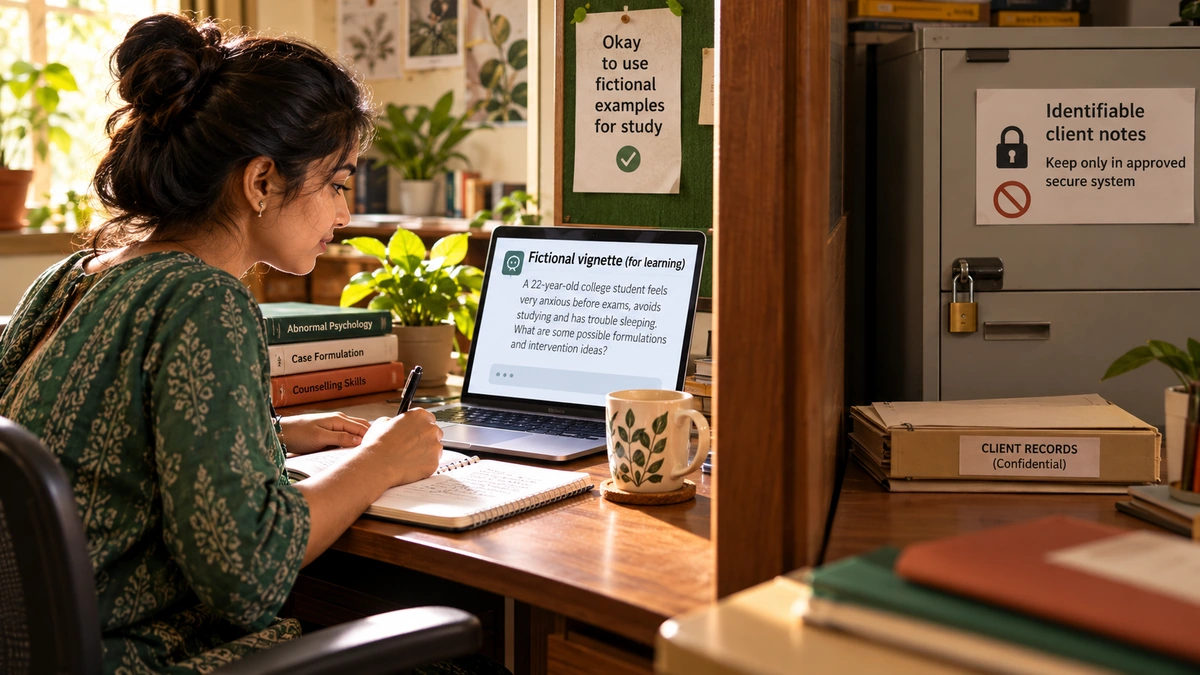
Use fictional cases for study exercises. If your institution has an approved system for clinical or educational use, follow its exact rules. “Another student uses this app” is not permission. If you have already entered protected information, tell your supervisor or privacy lead promptly according to your institution’s incident process; do not quietly try to erase the problem by deleting a chat.
How consent and institutional rules apply
Consent is not a single checkbox that makes every future use acceptable. What the client was told, what the tool does, who can access the output, and whether the use is necessary all matter. Students should never improvise a privacy policy. Ask the people accountable for the placement or service before trying an AI workflow with real material.
If you want guided, human feedback on practical counselling skills, explore PsyQuench’s counselling and psychotherapy course. Check the current course variant, price, eligibility, and professional scope before registering.
Which Counselling Skills Still Need Human Feedback?
Rapport, timing, silence, boundaries, and case reasoning all require you to notice another person’s response and adapt. AI can generate a plausible reply for a fictional client. It cannot tell you whether a real person felt interrupted, respected, misunderstood, or unsafe in the moment. Nor can it provide the accountable supervision required for actual clinical work.
Why rapport needs a real person
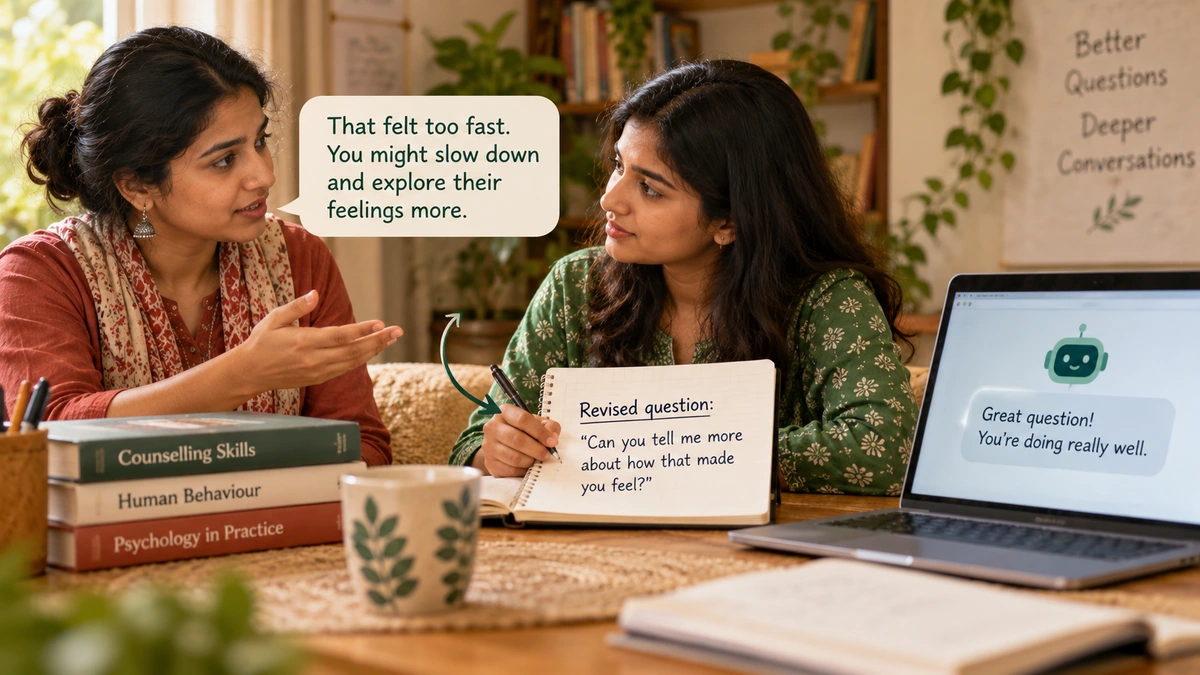
Farah asks a chatbot to play an upset client. It replies in paragraphs and praises her empathy. In a human roleplay, her partner pauses, looks away, and says, “That question felt too fast.” The second experience gives her information about timing and impact. Artificial intelligence counselling training may support rehearsal, but it should not be mistaken for live interpersonal feedback.
Our article on why hands-on training matters explains this practice gap. A learner needs opportunities to make a choice, observe its effect, receive feedback, and try again.
How silence and boundaries require judgement
A chatbot can list possible responses to a silent client. A real counsellor must notice whether the pause follows a painful disclosure, a confusing question, a safety concern, or a language barrier. A model can suggest a boundary phrase. A trainee must know the service policy, their role, and the client’s actual circumstances.
Human feedback can also expose the difference between kind-sounding words and useful action. “I understand” may feel warm to the speaker but empty to the listener if it comes before the story is told. A supervisor or roleplay partner can describe that impact directly.
Why case reasoning needs supervision
AI may help you outline a fictional formulation for study. It cannot validate a formulation for a real client or assume responsibility for risk, consent, diagnosis, or treatment. Your authorised supervisor helps you test hypotheses against actual information and professional standards. If the model gives a confident answer that conflicts with supervision or a guideline, investigate the disagreement with the responsible professional.
The human counselling experience is a reminder that people come to care expecting judgement, accountability, and a relationship with a professional, not a neat paragraph generated at speed.

How Can You Use AI More Carefully This Week?
Choose one study task that the rules allow. Make your own first attempt. Ask AI for a specific form of help, such as a counterexample or quiz. Verify its factual claims, then explain the idea without looking. For practical skills, add a human step: discuss or roleplay the concept with a peer, teacher, or supervisor in the appropriate setting.
A fictional, policy-aware study workflow
Farah has an assignment on case formulation. She reads the assigned material and drafts a short formulation for a fictional case. Her instructor permits AI as a feedback tool with disclosure. Farah asks, “What alternative explanation have I not considered?” The tool offers two, one of which depends on a fact not in the case. She rejects that suggestion, checks the other against her textbook, revises her draft, and records how she used the tool. She can explain the final reasoning herself.
If the assignment had prohibited AI, this workflow would not be appropriate. If the case were a real client, she would need the placement’s rules and authorised supervision instead. The method is conditional on the task, not a blanket permission.
A self-check before you trust the answer
Ask four questions: Did I try first? Can I find the claimed source? Can I explain the answer in my own words? Does the assignment and privacy policy allow this use? A “no” is a signal to pause and correct the process. It is not proof that using AI makes you a bad student.
Students also ask, “Is psychology a good career?” AI can help list possible roles, but it cannot decide what fits your interests, finances, academic path, and tolerance for uncertainty. Talk with practitioners and programmes, verify current entry requirements, and distinguish counselling skills training from regulated clinical psychology qualifications.
Does a course give you an RCI license?
No short course or internship should be assumed to grant an RCI license or registration. The Rehabilitation Council of India’s current registration guidance says registration in the Central Rehabilitation Register depends on a recognised qualification and the relevant registration process; clinical psychologists are one of the listed professional categories. Requirements can change, so verify the precise programme, institution, and category with RCI before paying for a course. A skills programme may be valuable learning without being a professional registration pathway. This third external source is included because the licensing question needs an authoritative current answer.

If you want practice with human feedback, review PsyQuench’s counselling and psychotherapy course. Confirm the current in-stock variant and course scope, and separately verify any regulated career requirements with the responsible authority.
FAQs About AI in Psychology Study
Can I use ChatGPT to make flashcards?
If your course permits it, yes. Build them from your own notes and check the answers against the assigned material. Flashcards can help recall, but they do not replace understanding a concept well enough to explain or apply it.
How do I check an AI-generated citation?
Search for the title, author, journal, year, and DOI in a reliable scholarly source. Open the paper and confirm it supports the exact statement you intend to make. If you cannot find or read the source, do not cite it as evidence.
Is AI-written assignment text plagiarism?
Your institution’s rules decide what use is permitted and how it must be disclosed. Submitting generated text as your own when the rules forbid it may breach academic integrity requirements. Ask the instructor about the specific task rather than relying on a general answer online.
Can I upload a de-identified client vignette?
Not automatically. Details can still identify a person, and your placement may prohibit use of a public tool. Use a fully fictional case for general study unless your institution has explicitly approved a secure workflow for real material.
Can an AI chatbot teach counselling skills?
It can help you rehearse language with fictional prompts, but it cannot replace human observation, feedback, formal supervision, or qualification requirements. Use it as one study aid within the rules, then test the skill in approved human practice.
What if my university has no clear AI policy?
Ask the instructor what is allowed for that assignment and what disclosure they expect. Until you know, keep your own attempt central, avoid submitting generated text as your work, and do not enter protected information.