What Should I Ask in a Counselling Session? Questioning Techniques That Help Clients Open Up

You ask a client how the week went. They say, “Fine.” You ask if work is stressful. “A bit.” You ask whether home is better. “I guess.” Three questions later, you know less than you hoped and the room feels like an interview. At PsyQuench, we teach students to look at the purpose and timing of a question before collecting more phrases to memorise. Counselling questioning techniques are useful when they create room for the client’s meaning, not simply when they keep the conversation moving.
Table of Contents
- What Makes a Question Helpful in a Counselling Session?
- Open vs Leading Questions: How Does the Conversation Change?
- When Is a Closed Question Useful in Counselling?
- When Should You Stop Asking Questions and Reflect Instead?
- How Does Socratic Questioning Work in CBT?
- How Can Beginners Practise Counselling Questions Safely?
- FAQs About Asking Questions in Counselling

What Makes a Question Helpful in a Counselling Session?
The best question is not necessarily the most open or the cleverest. It helps with the work happening now. A client who is describing a frightening argument may need the counsellor to understand what happened and whether they are safe. A client who is searching for words may need time. A client who has offered a vague phrase may benefit from one gentle invitation to say more.
Before asking, try the Purpose–Space–Timing check, an original PsyQuench practice aid. Ask yourself: What am I trying to understand? How much room will this wording give the client? Is this the right moment to ask, or should I reflect what I heard first? This is a learning tool, not a validated clinical scale. Its value is that it slows the urge to fill every gap with a new question.
Choose a question with a clear purpose
“How did that affect you?” can be useful if the client has just described an event and is ready to explore its impact. The same question can feel abrupt if they have barely begun and are struggling to feel safe. A question should help clarify a concern, deepen understanding, or support a decision within the agreed work. Curiosity alone is not enough reason to ask for intimate detail.
For the counselling skills students need in practice, write the purpose beside a question in a fictional roleplay. “Find out the exact time” is different from “understand what the client made of it.” The first may call for a focused question; the second calls for space. Our guide to core practical counselling skills places questioning alongside listening, reflection, and boundaries.
How neutrality changes the answer
Compare “Did your mother make you feel guilty?” with “What was that conversation like for you?” The first supplies a possible interpretation before the client has offered it. The second lets guilt, relief, anger, confusion, or something else emerge. Neutrality does not mean sounding cold. It means resisting the temptation to write the client’s story for them.
The WHO-hosted counselling skills chapter describes open questions as a way to explore a person’s situation and warns that suggestive questions can steer an answer. Its context is maternal and newborn care; the general question distinction is relevant to counselling training, but the examples should not be treated as a universal script.
Why timing matters as much as wording
You might prepare a thoughtful question before a session, but then the client arrives visibly shaken. Your planned wording may no longer fit. A short reflection—“Something happened before you got here”—may tell them you noticed and give them choice. If they say they are safe and want to continue with the original topic, you can return to your plan.
Questioning is a relationship skill. The client’s response, pace, and consent tell you whether your question opened a door or made them pull back. Emotional vulnerability grows more possible when the person can choose what to share; it cannot be manufactured by a perfectly phrased question.
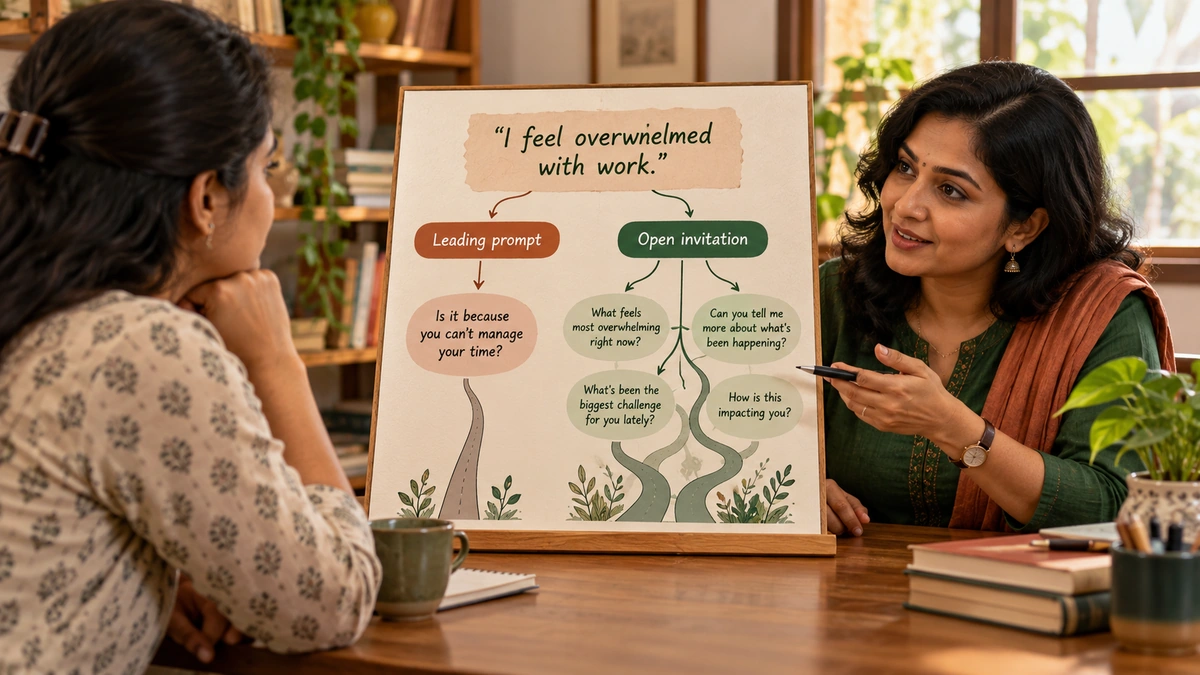
Open vs Leading Questions: How Does the Conversation Change?
An open question invites more than one possible answer. A leading question embeds an assumption or hints at the answer the counsellor expects. The distinction matters because the client may agree with the suggested meaning just to keep the conversation moving, even when it is not quite theirs.
What an open question invites the client to say
Open ended questions therapy students practise often begin with “what” or “how,” but grammar alone is not the skill. “What were you thinking when you made such a poor choice?” is open in form and judgemental in effect. “Could you tell me what mattered most in that moment?” is more inviting, even though it asks about a specific moment.
Take a fictional example: Kavya says, “I almost did not come today.” A trainee might ask, “Were you scared I would judge you?” That may be the trainee’s own worry. A more open invitation is, “What made it hard to come?” Kavya can then describe transport, money, an argument, mistrust, or something unexpected. The counsellor learns more by leaving the answer unwritten.
How a leading question can plant an assumption
Leading questions are easy to miss when the assumption sounds compassionate. “Did you feel abandoned?” may seem empathic, yet the client might have felt disappointed and still trusted the person. Reflect their own words first: “You expected them to call, and they did not.” Then ask what the moment meant to them, if exploration is useful.
This does not forbid tentative hypotheses. A counsellor can offer a thought and check it—“I wonder whether there was some disappointment there; does that fit?”—while making it easy for the client to disagree. The difference is whether the counsellor treats the idea as a question to explore or a conclusion to install.

When Is a Closed Question Useful in Counselling?
A closed question is useful when a specific fact matters. It may clarify a date, establish consent, check whether you understood, or address immediate safety. “Always ask open questions” is too simple. A good counsellor changes the kind of question to fit the need, then returns control of the story to the client where possible.
Use a focused question to clarify details
If a client says, “That happened last week,” you might need to know whether it was before or after another event. “Was that before your appointment on Thursday?” has a narrow answer and a clear purpose. It can prevent a misunderstanding. Follow it with “What was that day like for you?” if their experience matters more than the date.
Students learning client interview techniques sometimes use a long series of closed questions because they fear missing information. The result may resemble a form rather than a conversation. Group the essentials, explain why you are asking, and pause to check what the client considers important. Our article on tools psychology interns may use adds practical context, but a tool does not replace judgement about the person in front of you.
When safety needs a direct question
If you have a concrete safety concern, vague hints are inadequate. Follow your role, training, supervisor’s guidance, and local protocol for direct risk questions and immediate action. A general article cannot provide a universal risk-assessment script or decide what to do in a live emergency. Being direct can be respectful when it explains why the question matters and what will happen with the answer.
For example, if a client says they may not be safe tonight, you should not rely on a poetic open question to avoid discomfort. Ask the necessary specifics using the relevant protocol, and seek supervision or emergency support as required. Ordinary exploratory questions can resume only when the immediate concern is addressed.
How consent changes what you ask next
A client can signal that they do not want to discuss a topic yet. “Would it be okay to stay with that for a moment, or would you prefer to move elsewhere?” is a focused choice that respects agency. If the topic is necessary for safety, explain that responsibility clearly; do not disguise it as optional. If it is not necessary, a client’s “not now” should shape the pace.

When Should You Stop Asking Questions and Reflect Instead?
Stop asking when the next question would serve your discomfort more than the client’s understanding. A reflection can show that you heard the meaning, and a pause can give the person time to add to it. Neither is passive. Both are part of therapeutic communication skills when used with attention to the client’s response.
How to slow the pace when emotion rises
Kavya says, “My sister told me to stop being dramatic,” then looks down. A trainee might rush into “When did she say that? What did you reply? Has she done it before?” Those details can wait. “That landed painfully” or “You seem to be holding a lot in that moment” might allow Kavya to decide what comes next. If the reflection misses, she can correct it.
Notice how quickly a question can move the conversation away from an emotion that has only just arrived. A pause of a few seconds may be enough. There is no magic duration; watch for whether the client is thinking, overwhelmed, disconnected, or seeking help to continue.
Why a reflection can do more than another question
“You wanted support and heard criticism” offers a concise understanding the client can accept, reject, or refine. It does not demand a new answer immediately. If Kavya says, “No, it was more that she sounded tired of me,” the correction is valuable information. A well-timed reflection can make room for a more accurate story than a fast sequence of questions.
When silence gives a client room
Silence after a meaningful statement may be the time the client needs to find words. It can also feel uncomfortable or signal that you have lost the connection. Attend to context instead of assuming every pause is therapeutic. A gentle check-in—“Would you like a moment, or have I missed something?”—can restore choice.

If you want guided practice rather than another list of sample questions, explore PsyQuench’s counselling and psychotherapy course. Check the current syllabus, eligibility, price, and available variant before registering.

How Does Socratic Questioning Work in CBT?
Socratic questioning in CBT is a collaborative way to examine an idea, not a debate in which the therapist knows the correct answer. It often starts by understanding what the person believes, why it makes sense to them, and what information might help them reach a more balanced conclusion. Its purpose is guided discovery, not persuasion by repeated “why” questions.
The Beck Institute’s teaching material on the Socratic method describes helping people draw their own conclusions. The specific material was made for front-line medical professionals, so trainees should learn the method in the context of their own training and supervision rather than use it as a canned sequence.
What guided discovery means in practice
Suppose a fictional client says, “If I ask my supervisor one question, she will think I am incompetent.” A tempting response is, “That is not true.” Another temptation is to fire off questions until the client agrees with you. A collaborative path might be: “What makes that possibility feel likely?” followed by “Has there been a time you asked and her response was different?” The aim is to gather a fuller picture, including evidence that supports the fear and evidence that may complicate it.
If the supervisor has actually punished questions before, the concern may be realistic. Guided discovery should not become a way of talking a client out of a real workplace problem. The context changes what a useful question is.
How to test an idea collaboratively
Ask permission before shifting into a structured exploration. Agree on the question together, then summarise what the client concludes in their words. They may decide to ask a small question at work, seek information about expectations, or recognise that the environment is not safe for that experiment. The counsellor does not award marks for reaching a preferred answer.
This is part of the move from theory to real session skills. You can understand Socratic questioning in a textbook and still need feedback to judge when it fits a particular person.

How Can Beginners Practise Counselling Questions Safely?
Practise with fictional roleplays, observation, and feedback before applying a new technique with real clients. Choose one skill per practice round. If you are trying to master open questions, direct safety questions, reflections, and Socratic dialogue all at once, you may miss how the other person actually responds.
Rewrite a leading question
Take “Did your father make you feel worthless?” and try three alternatives. One may ask for the event: “What happened in that conversation?” Another may ask about meaning: “What did you take from what he said?” A third may reflect rather than ask: “Those words stayed with you.” There is no universally best line. Your partner in the roleplay can tell you which one felt most open and which sounded like it was supplying an answer.
The Purpose–Space–Timing check can guide the feedback. Did the question have a reason? Could the client disagree or take the story somewhere unexpected? Was it asked at a point when they were ready to explore? Record one change for the next round rather than giving yourself a vague grade of “good” or “bad.”
Use roleplay to hear the difference
Ask a partner to play a fictional client who has missed a family event and feels conflicted. In the first round, use only clarifying questions. In the second, try one open invitation and one reflection. Compare which round helped you understand the person’s experience. The exercise is about hearing the effect of your wording, not rehearsing a perfect script.
Keep roleplay cases fictional and avoid bringing identifiable client material into a class or unapproved tool. Real clinical work requires the relevant supervision and confidentiality safeguards.
Ask for feedback on timing and tone
Feedback should be specific: “When you asked the third question immediately after I looked down, I felt hurried.” That is more useful than “You need more empathy.” Ask what the learner noticed in themselves at that moment, then replay the scene with a pause or reflection. If a question involved safety, feedback should also examine whether the trainee followed the correct protocol.
Seeing what a first counselling session can look like from a client-facing perspective can remind trainees that real people may arrive uncertain about what they are expected to say. Training has to protect that person’s agency, not reward the number of questions asked.

If you are ready to practise questioning with structure and feedback, review the counselling and psychotherapy course. Check the current course details and suitability for your stage of learning before registering.
FAQs About Asking Questions in Counselling
Can a closed question ever be helpful?
Yes. It can clarify a fact, check consent, or address a safety concern. Use it for a clear reason. A run of closed questions may narrow the conversation, so return to the client’s own account when the immediate clarification is complete.
Why can “why” sound blaming?
“Why did you do that?” may sound as though the person must defend themselves. The difficulty is not the word in every context but the tone and assumption it can carry. “What was happening for you then?” may invite explanation with less pressure.
How many questions are too many?
There is no fixed number. Watch whether the client is developing their own account or giving shorter answers while you keep changing topics. If you feel driven to ask another question immediately, try reflecting what you already heard and allow a pause.
What should I ask in a first session?
Start with the purpose of meeting, the person’s main concern, what they hope for, and necessary consent and safety information under your service’s protocol. Explain why you ask sensitive questions. Do not use a generic first-session checklist in place of your organisation’s requirements.
Is Socratic questioning the same as debating a client?
No. In CBT, guided discovery explores a thought collaboratively and makes room for the client’s own conclusion. If the therapist treats every response as an obstacle to a preselected answer, the exchange has lost that purpose.
What if a client answers every question with one word?
Pause and consider the context: is the question too narrow, is trust still developing, is something difficult to say, or is there a language or accessibility need? A gentle check-in about how the conversation feels may be more useful than another clever question.