Why Do I Get Anxious When It’s Time to Sleep? Understanding Sleep Anxiety and What Can Help

At ten o’clock you are sleepy on the sofa. At ten fifteen you get into bed, check the clock, and suddenly feel wide awake. You start working out how many hours are left before the alarm. In this guide from PsyQuench, we look at why bedtime can become a moment of pressure and what sleep anxiety treatment may involve when the pattern keeps returning.
Table of Contents

Why Does Bedtime Make Me Anxious Even When I Am Tired?
Bedtime may have become the place where you expect a struggle. Anxiety when trying to sleep can start with memories of previous nights, predictions about tomorrow’s exhaustion, and checking for signs that sleep is near. Even if you were tired a few minutes earlier, this mental checking can make you feel alert. The problem is not that you have forgotten how to sleep; it may be that sleep now feels like a task you must succeed at.
There are also many other possible contributors: an irregular schedule, pain, medication, caffeine, breathing problems, a noisy room, or a demanding day. Do not treat a single article as a diagnosis. If sleep is repeatedly poor, assessment is more useful than guessing which cause applies.
How bedtime becomes a cue for worry
Think of a fictional reader, Neha, who had three rough nights before an important presentation. The presentation went well, but she now notices a small jolt of concern whenever she turns off the light. Her question has shifted from “Am I tired?” to “What if this happens again?” The bedroom is no longer only a place to rest; it has become a place where she evaluates her sleep.
This is why advice that starts and ends with “just relax” can feel frustrating. If Neha tries to prove that she is relaxed enough, she may keep inspecting her pulse, her thoughts, and the clock. Each check puts the question of sleep back in the centre of attention.
Why tomorrow’s demands raise the pressure to sleep
An early train, an exam, caring duties, or a long commute can make a bad night feel costly. The fear of not sleeping may be tied to real demands. Telling yourself that tomorrow does not matter would be unconvincing. A gentler approach is to prepare what you can for tomorrow and stop trying to control exactly when sleep arrives tonight.
If you want a broader explanation of when sleep problems need support, that article covers warning signs beyond this bedtime worry loop. Here we focus on the moment tiredness turns into monitoring.
How Can I Recognise a Sleep Anxiety Loop?
A sleep anxiety loop often looks like this: you anticipate a poor night, watch for evidence of it, feel more alert, and then treat that alertness as proof that the night will go badly. The loop is a useful description of an experience, not a diagnosis. It may happen alongside insomnia, another sleep disorder, daytime anxiety, or a temporary stressful period.
Why checking the clock can increase pressure
You look at the clock at 11:20 and think, “I still have enough time.” At 12:10, the same clock becomes a warning. At 1:00, it becomes a calculation about tomorrow’s performance. The digits did not cause the original wakefulness, but repeated checks can keep converting a quiet night into an urgent countdown.
Try noticing the question behind a check. Are you looking because you need to know when to wake, or because you hope to confirm you are still safe from a bad night? You can set an alarm and turn the clock away if watching it is making you more anxious. This is a small environmental choice, not a cure.
What body alertness feels like at bedtime
Some people describe a faster heartbeat, warm face, tense shoulders, or a sudden urge to get up and do something useful. Others feel mentally alert without dramatic body sensations. None of those experiences alone tells you the cause. New, severe, or concerning physical symptoms deserve medical advice, especially if they include breathing difficulty or chest pain.
Trying to force every sensation down can become another bedtime job. You might instead name it: “My body feels alert right now.” That statement does not promise sleep. It can reduce the extra struggle of treating the sensation as a verdict on the whole night.
How next-day calculations keep you awake
“If I sleep now, I will get six hours.” “If I do not sleep in twenty minutes, tomorrow is ruined.” These calculations feel practical because they use numbers, yet they rarely change what you can do in bed. You may need to plan an easier morning or ask for help with a duty if you are unwell. You do not need to recalculate the same loss every ten minutes.
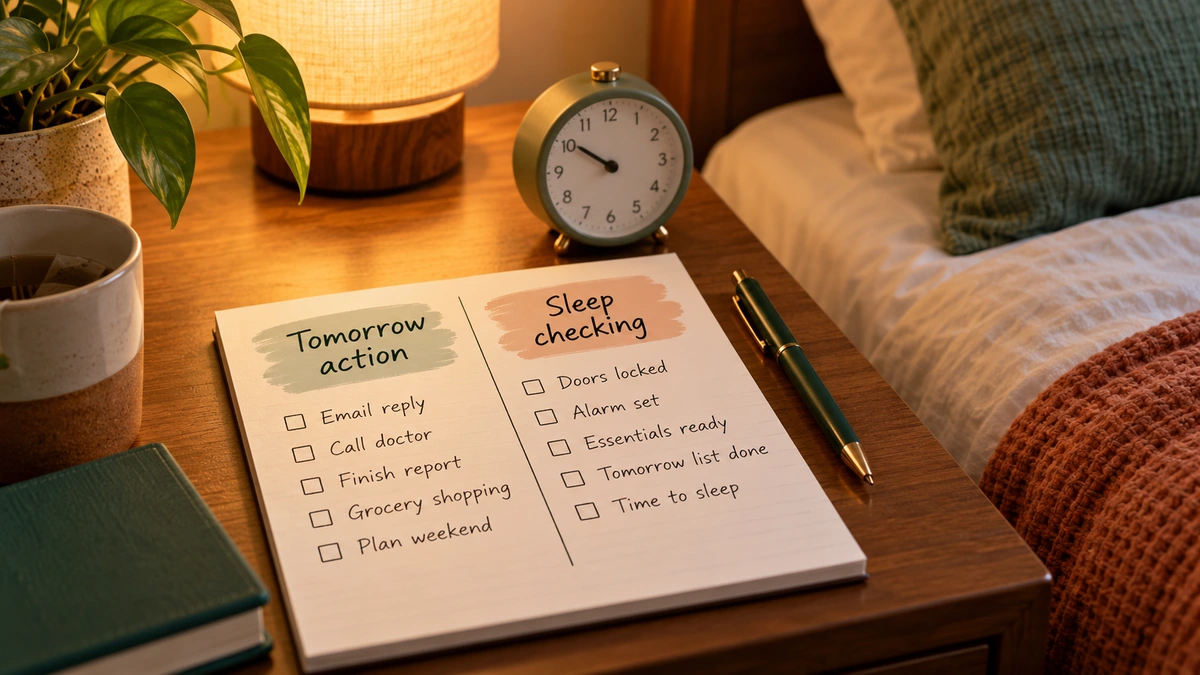
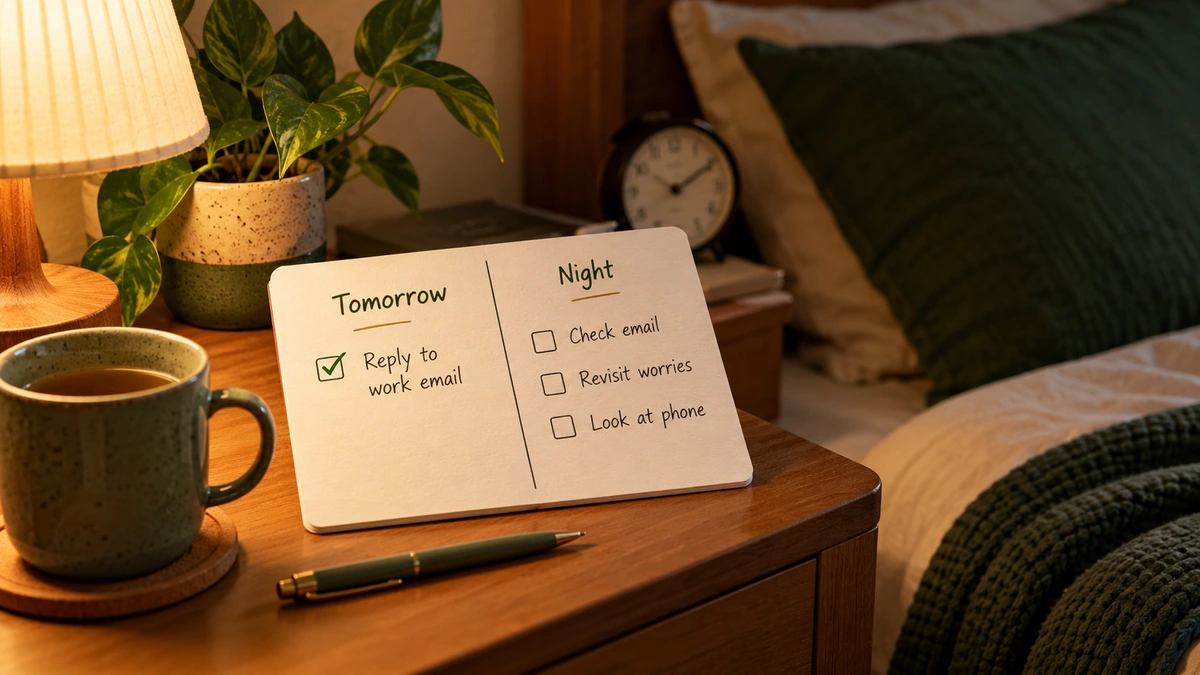
An original PsyQuench reflection aid is the Night–Tomorrow Split. Put a thought into one of two columns: “Something I can arrange for tomorrow” or “Something I am trying to settle by watching my sleep.” Pack the lunch, set the alarm, or move a meeting if appropriate. Then leave tomorrow’s arrangements alone. The second column is a sign to stop problem-solving at bedtime, not a reason to blame yourself for worrying.

Sleep Hygiene vs CBT-I: What Is the Difference?
Sleep hygiene means habits and conditions that support sleep, such as a consistent schedule and a comfortable bedroom. CBT-I is a structured treatment for persistent insomnia. It may address beliefs about sleep, the link between bed and wakefulness, and the timing of sleep. The two are related, but a list of sleep tips is not the same as CBT-I.
The American Academy of Sleep Medicine’s guideline summary gives a strong recommendation for CBT-I in adults with chronic insomnia. The US National Heart, Lung, and Blood Institute describes CBT-I as a structured plan that can include cognitive work, sleep education, stimulus control, and carefully managed changes to time in bed. These approaches should be tailored by an appropriate clinician; they are not a set of rules to copy from a blog tonight.
When simple sleep habits help
If your sleep changed after late caffeine, shift changes, or working in bed, a change in routine may help. Habits are most useful when they address a real obstacle. Buying a new pillow or downloading another tracker may do little if the main issue is fear that a poor night will be disastrous.
Our article on sleep problems and mental health gives a wider view of how the two can affect each other. The practical question here is whether the advice you are trying matches the pattern you are experiencing.
What structured CBT-I adds for persistent insomnia
CBT for insomnia techniques are not interchangeable with general relaxation exercises. For example, stimulus control aims to rebuild an association between bed and sleep. Cognitive work may examine rigid beliefs such as “If I miss exactly eight hours, I cannot function at all.” Other components can alter time in bed. Those changes are best planned with a trained professional, especially when health conditions, pregnancy, bipolar disorder, safety-sensitive work, or other factors complicate sleep.
“I tried a breathing exercise and it did not work” does not mean that all treatment has failed. Nor does a good week prove that assessment is unnecessary if you have a persistent pattern. Match the level of support to the problem rather than turning each night into a verdict.

What Can I Do When Tonight Is Going Badly?
Tonight, aim to reduce pressure rather than command sleep. If you are watching the clock, set the alarm and move the display out of sight. If you are calculating tomorrow’s failure, write down one realistic arrangement for the morning and stop repeating the calculation. If you remain awake and frustrated, consider a quiet, low-stimulation activity outside bed until you feel sleepy, while following any personalised medical advice you already have.
How to stop doing clock arithmetic
You may be tempted to replace a frightening number with a reassuring one: “Five hours will be fine.” That can start a fresh debate when the clock changes. Instead, shift from prediction to action: “The alarm is set; I will decide about tomorrow’s workload in the morning.” You do not have to feel convinced. You are choosing not to use the clock as an hourly performance review.
If you have a duty that would be unsafe after significant sleep loss, arrange a backup according to your workplace or medical guidance. This is not a situation where a positive thought should override safety.
How to respond to worry without forcing sleep
Try an ordinary, absorbing activity: a familiar book, gentle music, or sitting in a dim room for a while. Avoid treating it as a secret technique that must make you sleepy within ten minutes. The purpose is to step out of the “am I asleep yet?” test. You can return to bed when sleepiness comes back.
If you find yourself repeating the same bedtime struggle night after night, help can be more efficient than collecting more tips. You may need both a sleep assessment and support for anxiety during the day. They are related questions, but they are not identical.
If worry is spreading beyond bedtime, explore counselling to discuss what is keeping your mind on alert. For persistent insomnia, ask specifically about assessment and access to qualified CBT-I care.
If you are weighing whether to enquire, our guide to the cost of therapy in India can help you prepare questions about fees before you book.

When Should Sleep Problems Be Assessed?
Ask for an assessment when trouble falling or staying asleep recurs, affects daytime functioning, or does not improve with reasonable changes. You do not need to decide whether the problem is “mental” or “physical” first. A clinician can review sleep patterns, health conditions, medication, mood, and other factors.
When repeated poor sleep needs professional assessment
Bring simple observations: when you go to bed, when you wake, how often you wake during the night, and how you feel during the day. Keep the record brief if detailed tracking makes you more anxious. Mention shift work, caring duties, substances, and treatments you have already tried. The goal is to make assessment easier, not to produce perfect data.
Insomnia and mental health can interact, but there is no single direction for every person. Anxiety may keep you awake; repeated poor sleep may also increase worry about the next night. A clinician can help disentangle the pattern and decide whether medical or psychological treatment, or both, is appropriate.
Why breathing symptoms and daytime sleepiness matter
Loud snoring, pauses in breathing reported by someone else, waking gasping, or marked daytime sleepiness are reasons to discuss possible sleep-breathing problems with a clinician. They should not be assumed to be “just anxiety.” Likewise, a sudden change in sleep alongside other concerning symptoms needs medical attention. This blog cannot rule out a sleep disorder.
The NHLBI treatment guide makes clear that insomnia care can involve behavioural treatment and, in some cases, medication decisions with a doctor. Do not start, stop, or change a prescribed medicine because of an article or a bad night.
For a broader perspective on anxiety outside sleep, see PsyQuench’s guide to understanding anxiety in India. It is useful if the same worry appears at work, in relationships, or throughout the day.

Can Counselling Help With Anxiety Beyond Bedtime?
Counselling may help when sleep worry is part of a wider pattern: fear of making mistakes tomorrow, pressure to be constantly productive, or a mind that rehearses problems long before bedtime. A conversation can examine that pattern without pretending that all sleep difficulties have a psychological cause. If chronic insomnia is present, ask whether the professional is trained in CBT-I or can refer you appropriately.
How fear of tomorrow can enter the night
Neha’s worry began with a presentation. Later, a single restless night made her anxious about every demanding morning. Counselling might explore what “not coping tomorrow” means to her, what she actually does after a poor night, and which assumptions can be tested. It would also ask whether the presentation pressure, schedule, or workload remains a real problem.
The purpose is not to persuade her that sleep does not matter. Sleep matters. The purpose is to reduce the extra layer of fear that turns one difficult night into a threat about the entire next day.
When daytime stress belongs in the conversation
If you spend the day anticipating bedtime, or bedtime becomes the only quiet moment in which worries surface, tell the counsellor. Describe one typical evening and what you do when you cannot sleep. Also mention medical conditions and any assessment already under way. This gives the professional enough context to recommend the right next step, which might include a sleep specialist.
Readers who want to study CBT can see PsyQuench’s CBT training page. That is a professional learning option, not a substitute for personal sleep assessment or CBT-I treatment.

If anxiety is taking over evenings or days, ask PsyQuench about counselling. If you have persistent insomnia or possible breathing-related sleep symptoms, also seek a qualified medical or sleep assessment.
FAQs About Sleep Anxiety
Why am I tired until I get into bed?
The change of setting can make you notice the pressure to sleep. You may begin monitoring the clock, your body, and tomorrow’s demands, which can increase alertness. Other health or sleep factors may also be involved, especially when this is recurring.
Does checking the time make sleep anxiety worse?
It can for some people, particularly when each glance becomes a calculation about how badly tomorrow will go. You can set an alarm and move the clock out of view. The aim is to reduce repeated checking, not to make a strict rule that creates more worry.
Can one bad night start a worry cycle?
Yes. A difficult night before an important day can make the next bedtime feel high stakes. A single bad night does not mean a lasting disorder. If fear of repeating it begins to shape many nights, ask for help with the pattern rather than waiting for it to become severe.
Is CBT-I the same as general CBT?
They share cognitive and behavioural ideas, but CBT-I is designed for insomnia and includes sleep-specific assessment and strategies. General counselling or CBT for anxiety may be helpful for daytime worry, yet it should not be presented as equivalent to qualified CBT-I for chronic insomnia.
Can a sleep tracker make bedtime worry worse?
It may if you repeatedly check scores and treat small changes as evidence that you will not cope. A tracker cannot diagnose the cause of poor sleep. If the numbers increase pressure, discuss whether you need that device or a simpler record with a clinician.
When should I ask a doctor about insomnia?
Ask when poor sleep repeatedly affects daytime life, when you have concerning symptoms such as gasping or marked sleepiness, or when usual adjustments are not helping. Seek urgent medical help for acute severe symptoms. A doctor can consider other causes and the right treatment path.
Can bedtime anxiety feel like a panic attack?
Yes. Some people have a sudden surge of fear with a racing heart, trembling, or breathlessness at night. These may be symptoms of a panic attack, but similar sensations can have other causes. The US National Institute of Mental Health describes panic symptoms; this third source supports the distinction. If symptoms are new, severe, or include chest pain or significant breathing trouble, seek prompt medical help rather than assuming they are “just anxiety.”