Why Can’t I Relax After Work? Why Your Mind Keeps Working Even When the Day Is Over

You leave the office, close the laptop, and sit down to dinner. Then you remember a sentence you said in the meeting and spend the next hour wondering how it sounded. If you keep asking, “Why can’t I relax after work?” you are not alone in finding that a finished workday and a finished work thought are different things. At PsyQuench, we think the useful question is what your mind is still trying to hold on to: an unfinished task, an uncertain interaction, or a message that might arrive tonight.
Table of Contents
- Why Can’t I Relax After Work Even When I Am Home?
- Am I Making a Useful Plan or Replaying the Same Work Worry?
- Why Do I Still Feel On Duty After Work?
- How Can I Hand Work Over to Tomorrow? (The Handover Routine)
- How Can I Switch Off When I Really Am On Call?
- When Is After-Work Anxiety a Reason to Seek Support?
- FAQs About Feeling Unable to Relax After Work
Why Can’t I Relax After Work Even When I Am Home?
Being at home does not automatically tell your mind that a work concern has been dealt with. A report still needs a decision. Someone’s brief reply may feel ambiguous. A manager might send a message later. Your attention returns to these open questions because you have not yet decided what, if anything, to do about them.
The NHS guide to work-related stress notes that work stress can affect thoughts, feelings, and behaviour. That does not mean every evening thought is a symptom of a disorder. It does mean that the workday can leave traces after you log off, especially when you have had little room to process what happened.
Why an unfinished task can stay active in your mind
Imagine you were meant to send a client a revised plan, but a meeting ran over and you left before completing it. At dinner, you remember the plan three times. Each reminder seems urgent because “finish the plan” is too vague to feel safely parked. You may need one concrete next step, such as “At 9:15 tomorrow, check the figures and send the revised first page.” That does not complete the task. It tells your mind when and how you will return to it.
If the deadline is actually tonight, a personal routine will not make it disappear. You need a realistic agreement about the task, the time available, and who is responsible. The same thought can be a signal of a real work problem, an unmade decision, or both.
Why a work conversation keeps replaying at dinner
A conversation has no neat checkbox. You might recall your colleague’s expression, mentally edit your own reply, and wonder whether silence meant disapproval. Your mind is searching for certainty it cannot get from replay alone. A useful question is, “What information could change what I do?” If the answer is “I can ask for clarification tomorrow,” write that down. If there is no new information available, another imaginary version of the conversation is unlikely to settle it.
People who look capable at work can still feel strained after hours. If that broader pattern sounds familiar, our article on high-functioning anxiety signs explores it separately. This article stays with the specific transition between work and home.

Am I Making a Useful Plan or Replaying the Same Work Worry?
Useful planning ends in a decision you can act on. Replaying returns you to the same question without new information. Both may start with a genuine concern, so the point is not to forbid thinking about work. The point is to notice whether the next minute of thought is helping you choose a next step.
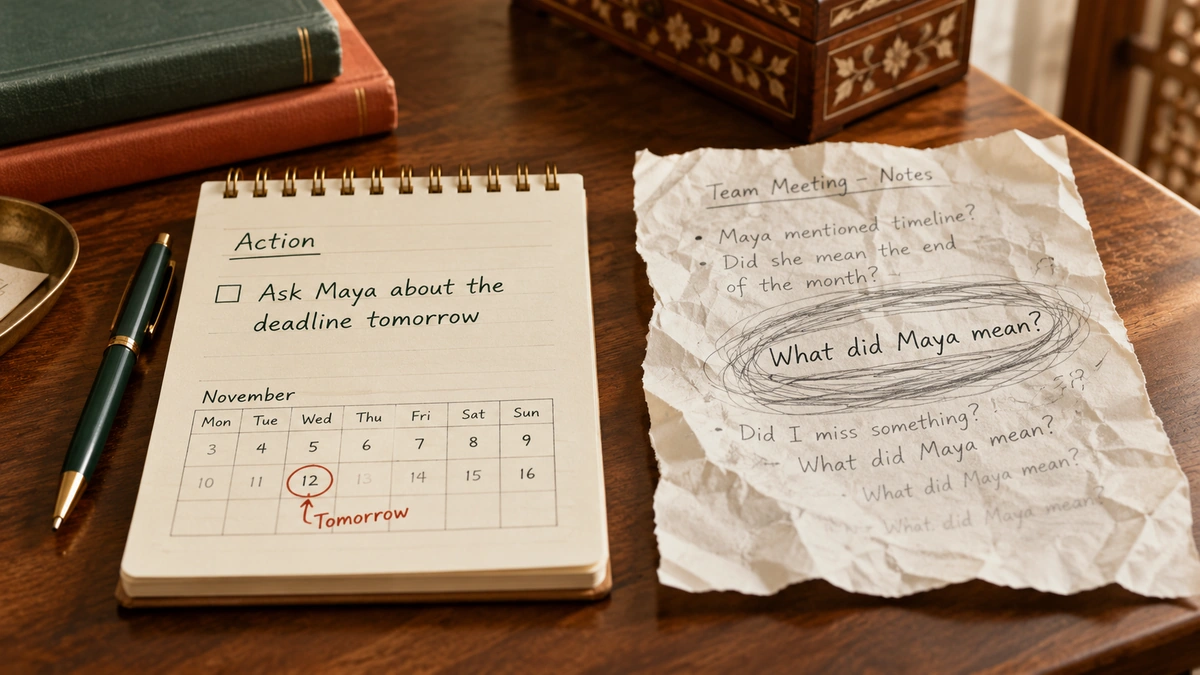
Consider a fictional example. A colleague says, “Let’s revisit this later.” One evening, you write: “Tomorrow at 10, ask whether she wants changes to the proposal or just more time.” That is a plan. Another evening, you reconstruct her tone, compare it with four earlier meetings, and ask your partner what she “really” meant. That may feel active, but you still have the same missing information.
How a plan leads to a next action
A practical plan has three parts: what can be done, who can do it, and when it can happen. “I should handle the project better” fails this test. “I will send two possible dates to the team at 11 tomorrow” passes. Smallness is helpful here. You do not need to solve a whole career issue before your evening can begin; you need to identify the part that can wait safely and the part that cannot.
If an issue is emotional rather than logistical, the next action might be to ask for a conversation, write down what you want to say, or decide that you need more information before drawing a conclusion. “I will never think about that meeting again” is not a workable action. Thoughts can return without needing another investigation.
How replay keeps returning without a decision
When you catch yourself replaying work conversations, ask whether anything new has entered the picture. If the answer is no, label the loop in ordinary language: “I’m running that meeting again.” This is a reminder to return to the next action you already chose, not an order to force the thought away.
The linked article explains how overthinking differs from anxiety in more detail. For tonight, a modest test is enough: is this thought helping me decide, or asking me to predict a feeling, reaction, or outcome I cannot know yet?
Why Do I Still Feel On Duty After Work?
Sometimes the problem is more than a thought. Your workplace may have trained you to expect late messages, unclear priorities, or praise for always being reachable. At other times, no one has asked for an evening reply, but you have begun treating every notification as though it carries a deadline. Often the two patterns reinforce each other.
How notifications pull you back into work
A phone lights up at 8:07 p.m. The subject line says “For tomorrow.” Before opening it, you may already be working out whether a response is expected. The interruption is not only the time it takes to read the message. It is the way it reopens the day and leaves you waiting for a second message.
Where your role allows it, a shared expectation helps more than a private rule you cannot keep. Ask which kinds of issues warrant an after-hours call, which can wait, and what response time is realistic. The NHS also recommends agreeing realistic deadlines and workloads and switching off work notifications outside working hours where possible. If you are genuinely on call, the rule needs to fit that duty rather than pretend it does not exist.
Why unfinished tasks feel urgent at home
An unfinished task can feel larger once you are away from the people and documents that would help you complete it. You are left with a mental version of the problem, which may omit useful detail and enlarge imagined consequences. Recording the next action before leaving often gives that thought a place to land.
Research on work beliefs and unwinding after work examines how beliefs about work relate to difficulty recovering after the day. It is one study, not a formula for your individual evening. It does support looking beyond “I just need more willpower” and asking what expectations you carry home.
How assumed availability keeps you alert
Ask yourself: “Who has actually said I need to answer tonight?” Perhaps the answer is your supervisor; then you need a conversation about scope. Perhaps no one has said it, but you worry that waiting until morning will seem uncommitted. The difference matters. You can test an assumption with a reasonable, explicit question rather than keep trying to read your manager’s mind.
This is where work anxiety after hours can be connected to real boundary language. You can care about the work and still ask when you are expected to be available. If the answer is “always,” an individual relaxation exercise is unlikely to fix the underlying arrangement.

How Can I Hand Work Over to Tomorrow?
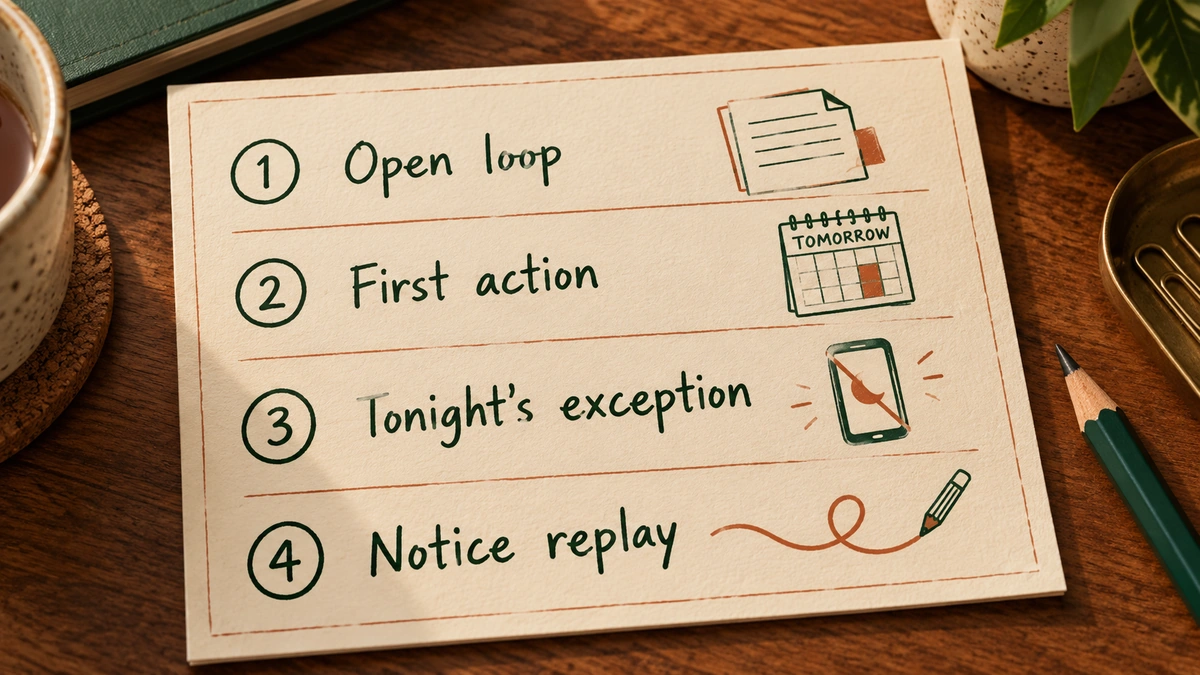
If you are wondering how to switch off after work, try making a Work-to-Home Handover before you leave. This is a PsyQuench reflection aid, not a clinical treatment or a guaranteed way to stop thoughts. It gives unfinished concerns a specific next step and separates genuine evening duties from mental replay.
- Capture the open loop. Write the task or conversation in plain words. “The budget figures need checking” is clearer than “Everything is behind.”
- Choose tomorrow’s first action and time. Make it small enough to begin: “At 9:30, compare the two totals and ask finance about the difference.”
- Set tonight’s exception. If you are on call, name the kind of issue that truly requires a response, the channel it will use, and who handles it. If you are not, note that ordinary email can wait until the agreed work time.
- Notice replay without reopening the plan. When the same thought returns, check whether it brings new information. If not, refer to the recorded next action and return to what you are doing.
Capture the open loop before you leave
Use a note you can actually find tomorrow. A private work notebook or approved task system is better than sending confidential client details to a personal app. Write enough to help your future self, not a transcript of the entire day. If there are several open tasks, choose the one most likely to interrupt your evening and give it the first slot.
Here is a completed, fictional handover card:
Example: Completed Work-to-Home Handover Card
- Open loop: The revised report is unfinished and I am unsure whether the chart totals match.
- Tomorrow’s first action: At 9:15, compare the totals in the approved file and message Arun with the one difference I cannot resolve.
- Tonight’s exception: Only a direct call about the scheduled launch needs an answer; routine comments on the document can wait.
- If the thought returns: The figures have a check time. Re-running them in my head now will not make the file available.
Notice what the card does not say: “Everything will be fine.” You may still feel uncertain. The card simply identifies a responsible place for the task. It is especially useful when vague promises to “deal with it tomorrow” have not helped.
Choose when you will return to it
The time matters because “tomorrow” can be as slippery as “later.” If your mornings are unpredictable, name an event instead: “After the daily check-in, I will open the report.” For shift work, use the next scheduled handover or shift rather than a nine-to-five time that does not apply to you.
If someone else must act first, write the dependency: “When I receive the revised numbers, I will update the table.” That can reveal why repeated private thinking is not moving the problem forward.
Decide what truly needs attention tonight
Be honest about exceptions. If an urgent safety issue, a live service, or a genuine on-call rota exists, the handover should state it. Otherwise, the “just in case” category can expand until every message feels urgent. You may need to agree this boundary with a supervisor rather than set it alone.

If your evenings keep disappearing into work worry, explore counselling at PsyQuench. A conversation can help you examine the pattern while you also address practical work demands.
How Can I Switch Off When I Really Am On Call?
You cannot switch off every channel if your role requires a response. You can still make the duty clearer. The aim is to distinguish genuine urgency from “a message arrived,” and to agree what happens when you are unavailable. Without that agreement, you remain alert for everything.
Separate genuine urgency from routine messages
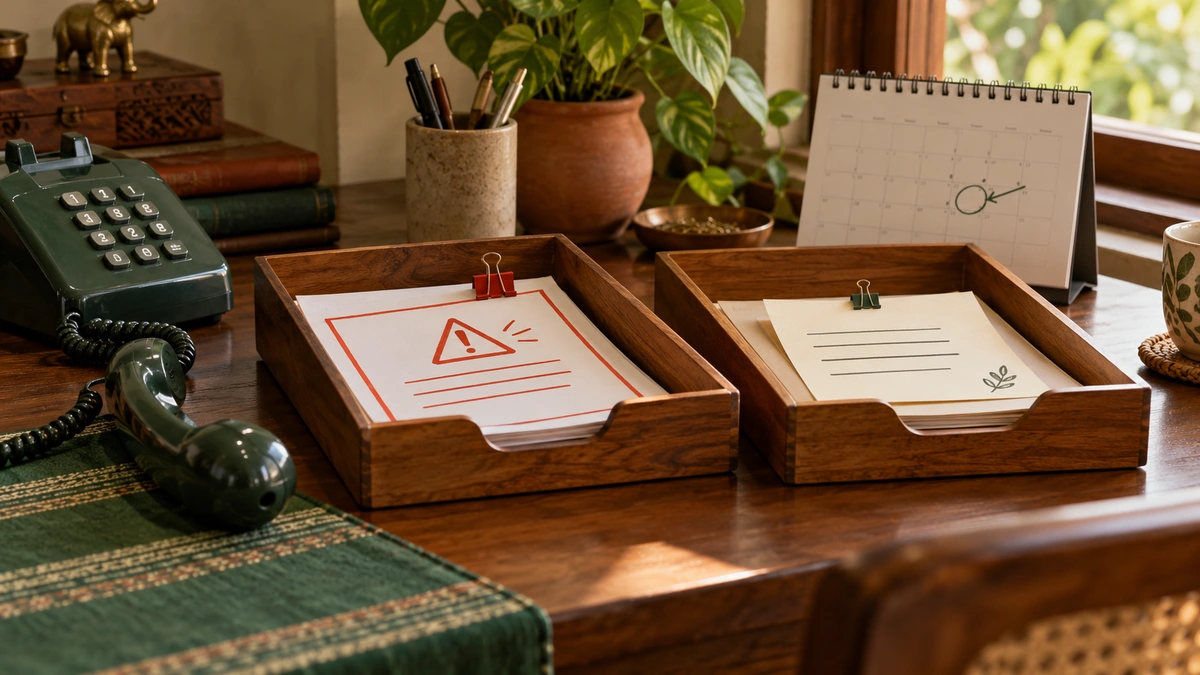
Write a two-column version of the evening rule with the people responsible for the work. In one column are events that require action before the next shift: for example, a live system failure that affects users. In the other are updates, ideas, and requests that can be handled during normal hours. The right examples depend on your job. A counsellor, a hospital employee, and an office administrator do not have the same obligations.
Do not use a personal judgement list to override a formal emergency process. If you are unsure what counts as urgent, ask the organisation to define it and record the agreed channel. A phone call for urgent matters and email for routine ones can reduce the need to scan every subject line.
Agree on availability with the people involved
Try: “I want to respond reliably when something is genuinely urgent. Can we agree which situations need me after 7 p.m. and how those will reach me?” This asks for a workable system, not a special favour. If your role changes week by week, make the agreement fit the rota.
Our guide to setting boundaries without guilt offers more language for conversations that feel uncomfortable. A boundary is stronger when it is shared and realistic than when it exists only in your head.
Notice when workload needs a wider solution
If the tasks truly cannot fit into paid hours, or constant availability is required without support, your stress may be responding to a workload problem. Document concrete examples: which requests arrive late, how often, and what they displace. Talk with a manager, appropriate workplace support, or someone who can advise you on your options. Counselling can help you think clearly and protect your wellbeing, but it cannot take the place of organisational changes.
When Is After-Work Anxiety a Reason to Seek Support?
Consider support when the pattern is frequent, hard to interrupt, or affecting parts of life you value. You do not need to wait until work becomes impossible. Sleep loss, repeated conflict at home, dread before the next day, and spending most evenings mentally at work are all reasons to take your experience seriously. They are not, by themselves, a diagnosis.
Notice the effect on sleep and relationships
Look beyond how intense the thought feels. Is it costing you ordinary conversations, meals, or rest? Do you repeatedly check messages when you are not on duty? Are you avoiding time off because the return feels unmanageable? A single difficult week may call for recovery and workload adjustment. A repeating pattern may call for a broader conversation about work, anxiety, or both.
Therapy for work anxiety can explore the meaning you attach to unfinished tasks, what you predict will happen if you do not respond, and how to test those beliefs without ignoring real responsibilities. The exact approach should be agreed with a qualified professional after understanding your situation. Readers interested in how structured techniques are taught can also see PsyQuench’s CBT course page; that professional learning option is separate from seeking therapy for yourself.
What to say when you enquire about counselling
You need not arrive with the correct label. A clear enquiry could be: “I keep replaying work conversations after I get home, and it is affecting my sleep. I have tried writing tomorrow’s tasks down, but I still feel on duty most evenings.” If there is a real on-call obligation or excessive workload, mention it. A useful first conversation should take those circumstances seriously rather than treat every worry as a thinking error.
If the price of getting help is another worry on your mind, read our guide to the cost of therapy in India before you enquire. Knowing what to ask about fees can make the first step feel more manageable.

If you want help understanding why work stays with you after the day ends, enquire about counselling. Bring one recent evening and the demands of your actual role; both are part of the story.

FAQs About Feeling Unable to Relax After Work
Is it normal to think about work after dinner?
Yes, an occasional thought about an unfinished task or difficult meeting can be ordinary. The useful question is whether it passes, leads to a decision, or repeatedly takes over the time you expected to have for yourself. If it keeps disrupting your evenings, look at both the work situation and the habit of replaying it.
Why do I replay one conversation more than unfinished tasks?
An unfinished task may have a visible next action. A conversation can leave you guessing what another person thought, and there may be no way to know until you speak again. You can prepare a clarification for the next workday; replaying the tone again tonight may not provide the answer.
Can checking email once help me relax?
Sometimes a planned check is part of a genuine on-call role. If you are not on call, “just once” can train your attention to wait for the next message. Ask whether you are checking to perform a defined duty or to briefly reduce uncertainty. The latter often needs a clearer work agreement or another way to tolerate not knowing until tomorrow.
What if my manager expects quick replies at night?
Ask what response time is actually required, for which issues, and through which channel. If late work is routine, the question may be about workload and expectations, not only your ability to relax. Keep a concrete record of requests so the conversation can be about the work system rather than your character.
Why does work worry become louder at bedtime?
Bedtime removes many of the distractions that kept a work thought in the background. You may also start calculating the effect of lost sleep on tomorrow, adding a second concern. Record the next practical work action earlier in the evening. If bedtime worry persists, a sleep-focused assessment may be useful; do not assume every sleep problem has the same cause.
What should I tell a counsellor about this pattern?
Describe one specific evening: what happened at work, what thought returned, what you did in response, and what it cost you. Include genuine on-call duties, workload pressures, and any sleep or relationship effects. You do not need to decide in advance whether this is “stress,” “anxiety,” or “overthinking.”
Are these symptoms of anxiety or a panic attack?
Difficulty relaxing and repeated work thoughts can occur with stress or anxiety, but they do not by themselves identify a panic attack. A panic attack is a sudden episode of intense fear or discomfort that can include a racing heart, shaking, dizziness, or breathlessness, according to the US National Institute of Mental Health. People often use “anxiety attack” for intense distress, but the wording alone cannot tell you what is happening. New, severe, or concerning physical symptoms need medical assessment. This third source is included to support the safety distinction.