Do I Have Relationship OCD or Am I Just Overthinking My Relationship? Understanding the Symptoms
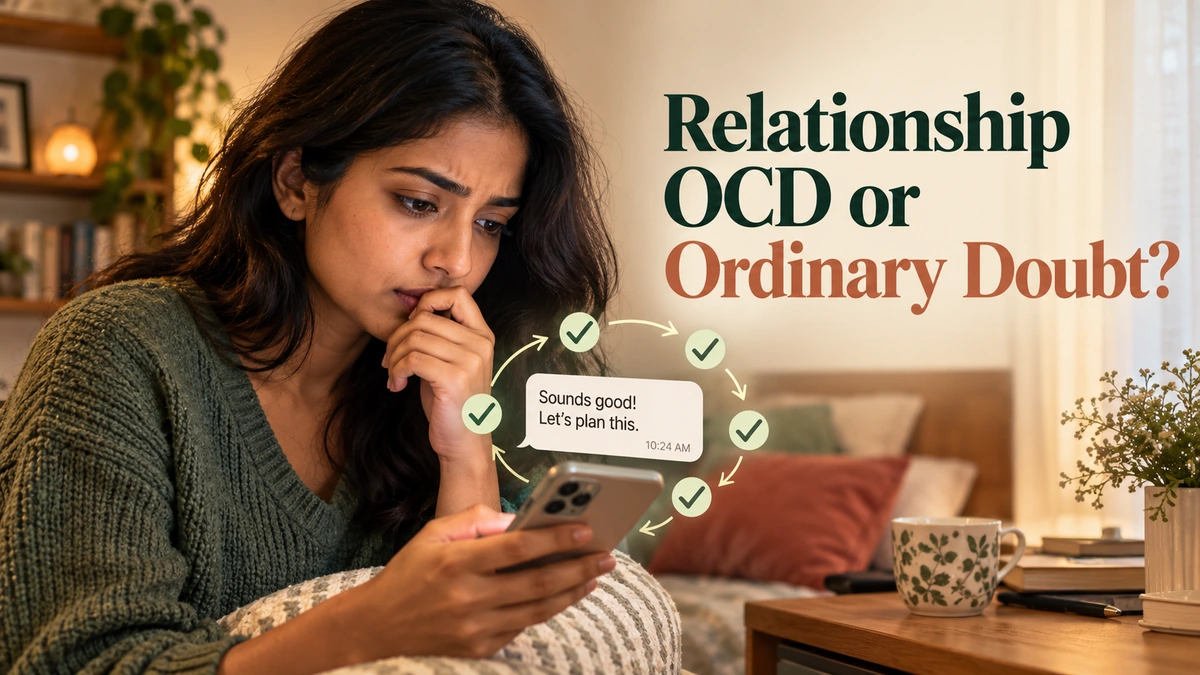
Your partner replies, “Okay.” You reread the message, ask a friend what the tone means, then search the internet for signs the relationship is wrong. For a moment you feel calmer. Ten minutes later you wonder if you missed something. This PsyQuench guide explains relationship OCD symptoms in ordinary language, including why repeated checking can keep a doubt alive. It cannot tell you whether you have OCD or whether your relationship is right for you.
Table of Contents
- What Can Relationship OCD Symptoms Look Like?
- Ordinary Relationship Doubt vs an OCD-Like Loop: What Changes?
- Why Does Reassurance Make Relationship Doubts Return?
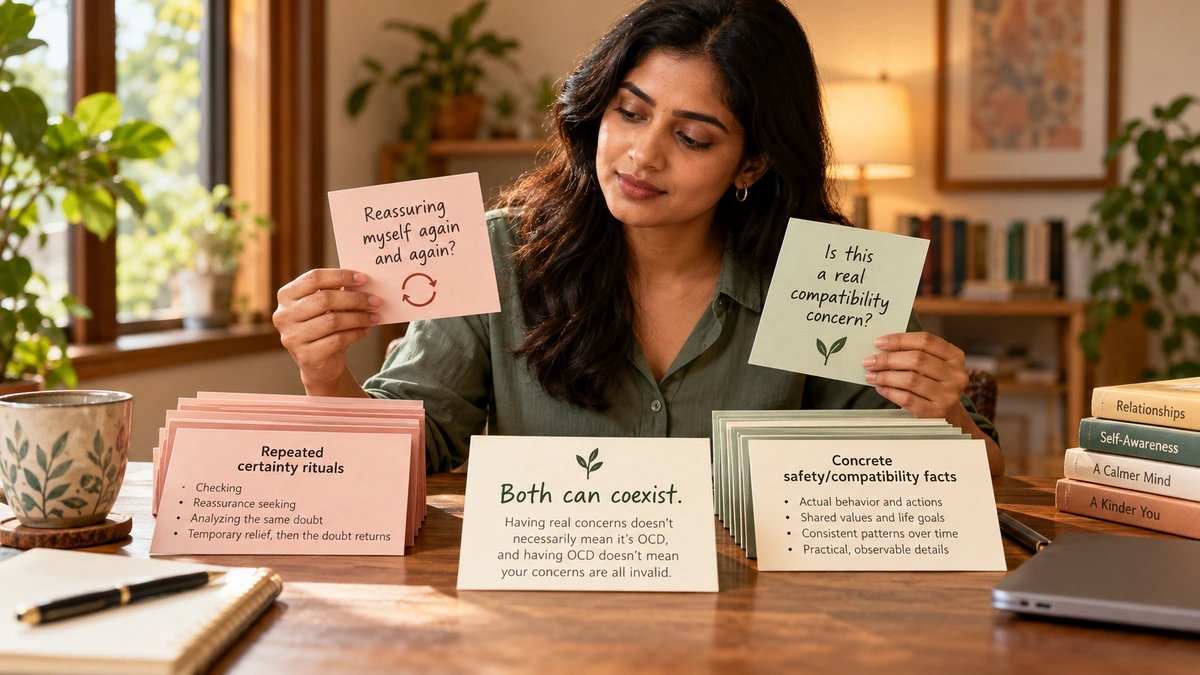
- Can Relationship OCD and Real Relationship Problems Coexist?
- What Help Is Available for Relationship OCD Symptoms?
- What Can I Notice Before an Appointment Without Checking More?
- FAQs About Relationship OCD and Repeated Doubt
What Can Relationship OCD Symptoms Look Like?
Relationship OCD, often shortened online to “ROCD,” describes OCD symptoms focused on a relationship. The International OCD Foundation’s relationship OCD overview describes intrusive doubts that can focus on whether the relationship is “right” or on a partner’s qualities, alongside checking and reassurance-seeking. Those experiences may be distressing, but an article cannot establish a diagnosis from a few examples.
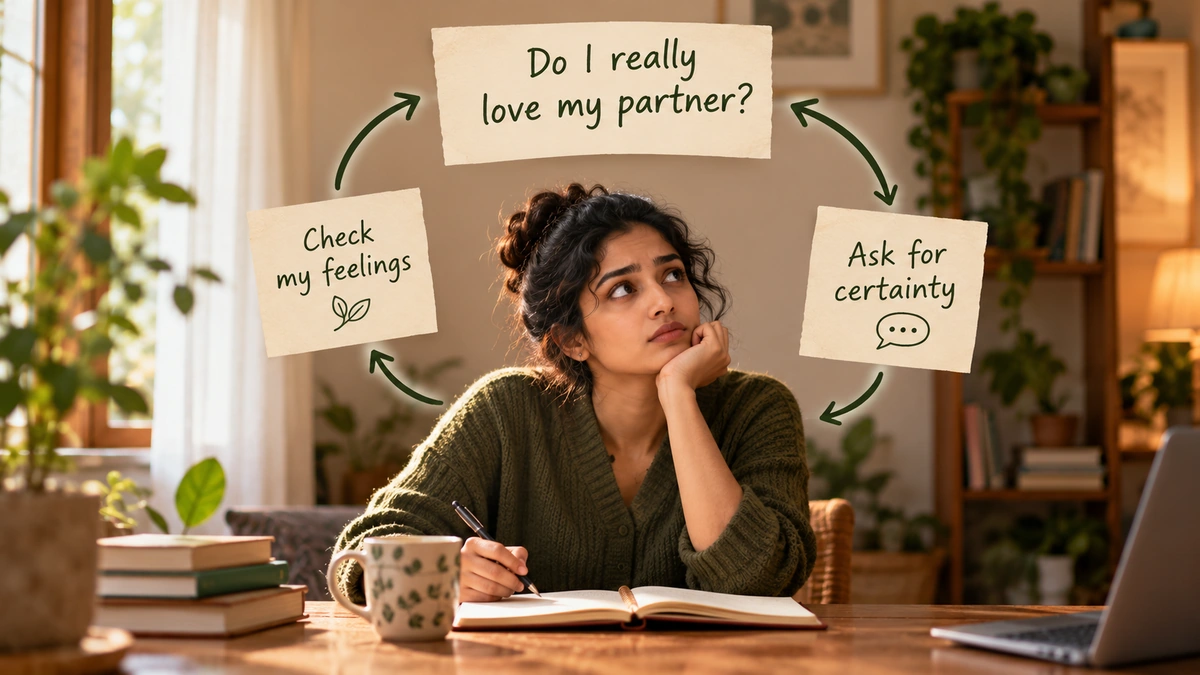
The ordinary-language version is: a question about the relationship keeps returning, and you feel driven to do something to settle it. The action may be visible, like repeatedly asking a partner to confirm they still love you. It may be private, like testing whether you feel “enough” affection every time they walk into a room. The focus is not only what you think; it is also what happens after the thought arrives.
How relationship-centred and partner-focused worries can differ
Some doubts sound like, “Am I truly in love?” or “What if this is the wrong relationship?” Others become obsessive doubts about partner compatibility: a person fixes on appearance, personality, intelligence, or a small habit and asks whether that detail proves a deeper problem. The topics differ, but the repeated need for certainty can be similar.
Imagine a fictional person, Aditi, who likes spending time with her partner. One morning she notices she feels tired instead of excited and asks herself whether that means she has never loved him. She spends the commute recalling every affectionate moment. That evening she asks a friend whether “real love” should feel constant. Her distress is real; the absence of a single answer after hours of checking is what deserves attention.
This is different from our article on repeated partner-choice patterns, which explores why someone may choose similar dynamics across relationships. The two questions may both matter to a person, but they are not the same search intent or a reason to assume OCD.
Ordinary Relationship Doubt vs an OCD-Like Loop: What Changes?
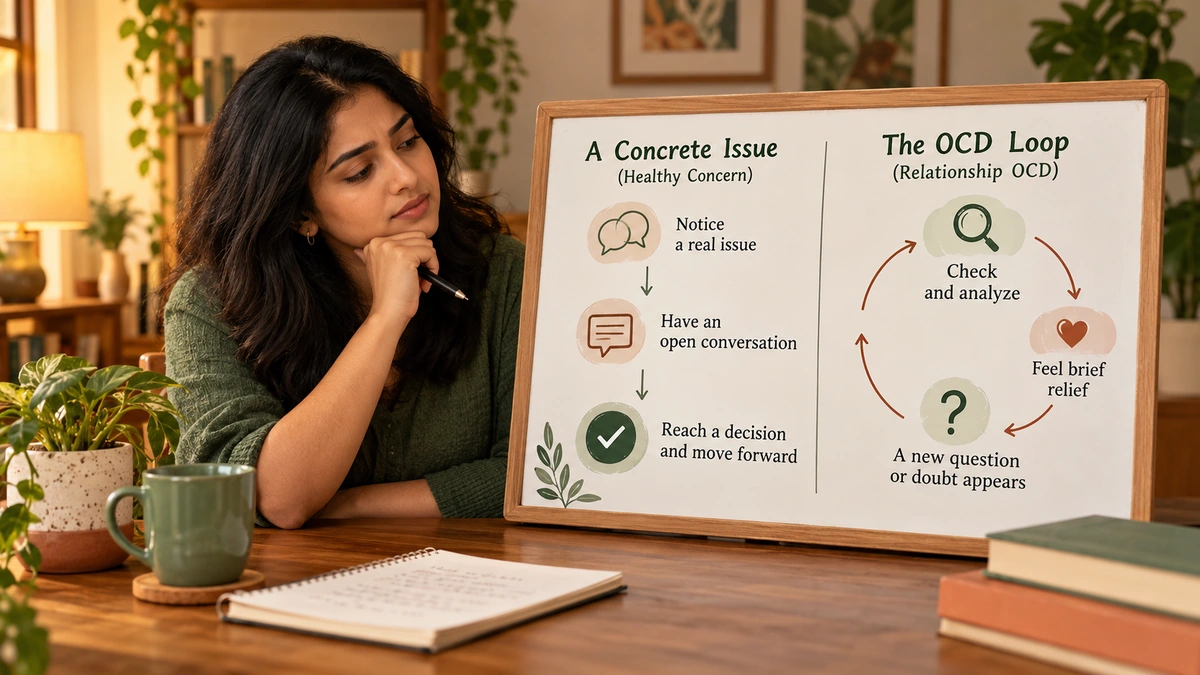
Ordinary doubt can lead to a conversation, a decision, or acceptance that a relationship is imperfect. An OCD-like loop tends to demand complete certainty and repeats the same checking even after a reasonable answer. The difference is not that one person cares and the other does not. Both may care deeply. The pattern of distress and repeated responses is the clue to bring to an assessment.
This table is a reflection aid, not a diagnostic test. A person can have real relationship concerns and compulsive checking at the same time. A partner’s harmful behaviour must not be explained away as “just your OCD.”
Notice the intrusive thought
Intrusive thoughts in relationships can be unwanted and feel out of step with what you value. A thought may appear suddenly: “What if I do not love them?” “What if their laugh annoys me because we are incompatible?” “What if I am lying to both of us?” Trying to prove the thought impossible may make it more prominent. Having the thought does not settle what you want, nor does it prove an illness.
For Aditi, the trigger was not a fight or a change in how her partner treated her. It was noticing an ordinary fluctuation in excitement. Another person might be concerned about a genuine pattern of disrespect. The trigger and context both matter.
Notice the response you repeat
The response may be asking, searching, comparing, mentally reviewing, confessing a thought, or testing how you feel during a date. These can be subtle. You might call them “doing research,” yet the research never produces a decision you can live with. It only buys a few minutes of calm.
If you are searching “ROCD vs relationship anxiety,” avoid using a symptom list as a verdict. The question a clinician would examine is broader: what is the repetitive pattern, how much time does it take, what function do the checks serve, and what else is happening in the relationship and in your health?
Why relief lasts only briefly
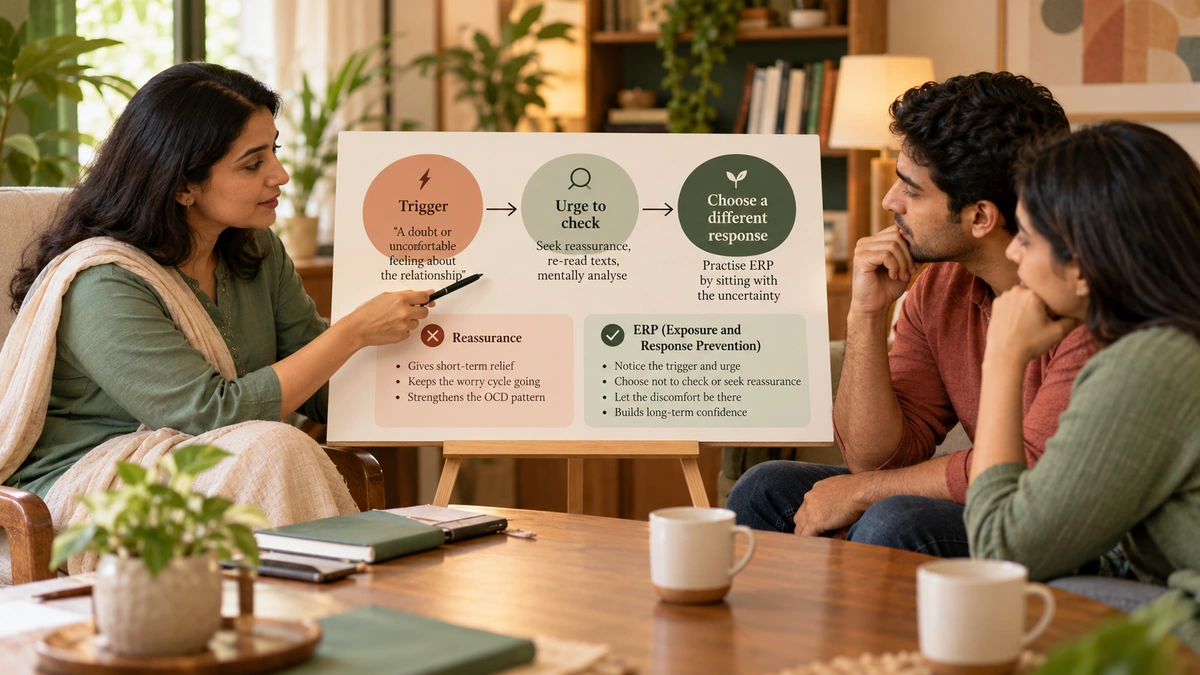
When someone says, “Of course you love them,” you may feel better. Then a new doubt arrives: “What if they are just being kind?” The reassurance did not fail because the person used the wrong words. It may have become part of a cycle in which certainty must be repeatedly renewed. A treatment conversation can focus on changing the response to uncertainty rather than finding an ever more perfect answer.

Why Does Reassurance Make Relationship Doubts Return?
Reassurance can be kind and useful in ordinary relationships. The difficulty comes when it becomes a repeated ritual for neutralising the same intrusive doubt. The question is asked again, the answer calms you for a short time, and the next moment of uncertainty sends you back for another answer. Over time, the relationship can become organised around checking rather than connection.
When asking a partner becomes a ritual
Aditi asks, “Do you think we are compatible?” Her partner answers thoughtfully. The next day, she asks in a slightly different way. Soon her partner feels examined, while Aditi feels guilty and still uncertain. The aim is not to ban honest relationship conversations. A person should be able to say what they need and discuss a real conflict. A ritual is suggested by repetition, urgency, and the demand that an answer remove all doubt.
Partners should not be made responsible for diagnosing or treating this pattern. If a clinician recommends involvement, they can explain how to support the person without turning every conversation into a certainty check. In the meantime, a partner can be caring while maintaining boundaries in the relationship.
How searching online can keep the loop going
Online advice can be useful when you are learning what OCD is. It becomes less useful when you run the same search each time a feeling changes. “Does this mean I have ROCD?” and “Does this mean I should leave?” may give opposite answers depending on the page. Neither search can observe your whole situation.
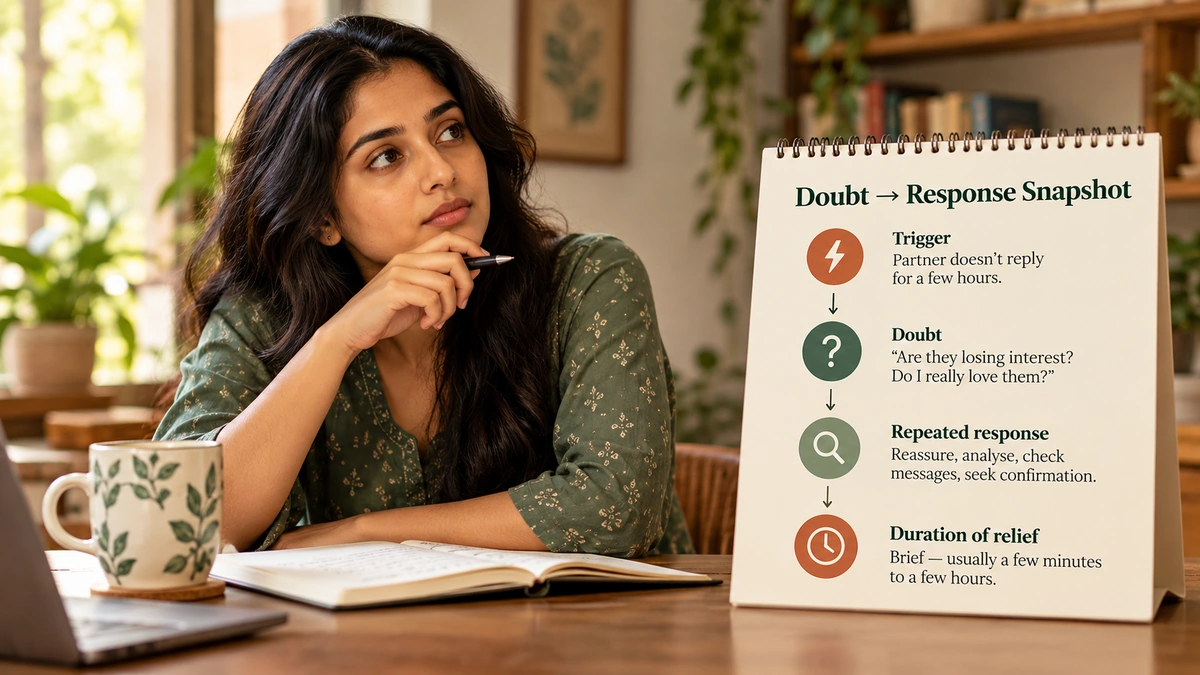
If you notice you are searching to lower panic for ten minutes, write down the pattern to discuss with a qualified professional. Do not turn “tracking” into a new test of whether you have OCD. A simple note—trigger, urge to check, what you did, how long relief lasted—is enough.
Why checking your feelings gives little certainty
Feelings vary with tiredness, stress, conflict, hunger, and context. If you monitor every greeting for a particular level of warmth, the monitoring itself can make the moment feel unnatural. That awkwardness may then become another “sign” to analyse. The solution is not to force a loving feeling. It is to step back from using each moment as an exam.
Obsessive doubts about a partner can also hide a real issue if you dismiss every discomfort as a symptom. That is why the next section asks a different question: what is actually happening between the two of you?
Can Relationship OCD and Real Relationship Problems Coexist?
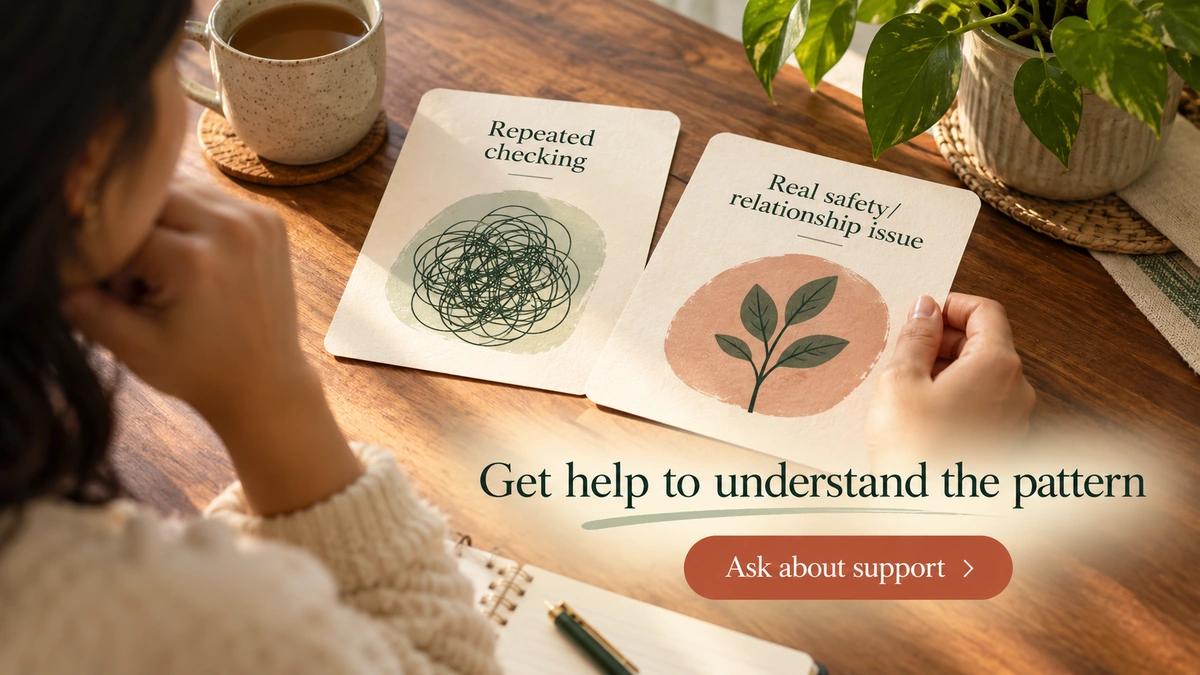
Yes. A person can repeat OCD-like checking and still face a real compatibility issue, conflict, or harmful behaviour. A diagnosis would not make every partner action acceptable. The safest approach is to consider concrete behaviour, consent, respect, and fear separately from the urge to achieve perfect certainty about the future.
How to think about compatibility without self-diagnosis
Ask about patterns you can describe: Do agreements get kept? Can disagreements be discussed without punishment? Are your values around major life choices broadly compatible? Are you free to spend time with others and make your own decisions? These are different from checking whether you felt the “correct” amount of love at breakfast.
There may be no flawless answer to “Is this the one?” People make relationship decisions with incomplete information. An OCD-informed professional can help you notice compulsive checking, while appropriate relationship support can help you discuss actual differences. They should not make the decision for you.
When harm or coercion needs a different response
If a partner threatens you, controls your movements or money, coerces sex, isolates you, or makes you afraid to disagree, prioritise safety and practical support. Joint couples counselling may be unsuitable when there is coercion or violence. Seek help from a local domestic-violence service, trusted support person, or emergency services if there is immediate danger. Do not use this article’s uncertainty exercise to talk yourself out of recognising harm.
If you are unsure what type of support fits, a general counselling enquiry can be a starting conversation about referral and service fit. Ask directly whether the provider has OCD/ERP experience if intrusive doubts are your main concern. The existence of a counselling page does not establish specialist OCD treatment.
If fees affect your choice, our guide to the cost of therapy in India offers a starting point for questions to ask a provider. Confirm the current fee and the professional’s relevant training directly.
Why certainty may be impossible
No therapist, friend, or online quiz can guarantee the future of a relationship. The goal is to make thoughtful decisions with the information you have while responding to uncertainty in a way that does not consume your life. That is different from settling for harm or refusing to ask for change.
If intrusive doubts are taking hours or safety is uncertain, ask PsyQuench about appropriate support or referral. Ask about OCD-specific qualifications when seeking treatment for OCD.
What Help Is Available for Relationship OCD Symptoms?
An assessment with an appropriately qualified mental health professional can examine whether the pattern fits OCD, another anxiety presentation, a relationship difficulty, or more than one issue. The professional should ask about intrusive thoughts, repetitive responses, time and distress, and what is actually happening in the relationship. A blog cannot replace that assessment.
What an assessment can clarify
Bring examples rather than a self-diagnosis: “I search for signs of incompatibility for an hour after an ordinary date” or “I ask my partner the same question most evenings and the reassurance wears off.” Include the context of any genuine conflict, fear, or coercion. The clinician needs the whole picture, not just the thoughts that most resemble a search result.
PsyQuench’s general OCD treatment overview explains OCD care more broadly. Use it for orientation, then ask any potential provider about their actual training and service scope.
How ERP differs from repeated reassurance
Exposure and response prevention, or ERP, is an established OCD treatment approach described by the International OCD Foundation. In supervised treatment, people practise facing uncertainty or triggers while resisting the repetitive response that has been maintaining the cycle. The plan is tailored and paced with a qualified professional. It is not an instruction to stay in an unsafe relationship, ignore genuine harm, or force yourself into frightening exercises from a website.
For Aditi, the question might be less “Can I find the perfect proof that I love my partner?” and more “How do I respond when the urge to check appears?” That is a treatment question, not a verdict about her relationship. A therapist trained in OCD care can explain whether ERP is appropriate and how to apply it safely.
When partner involvement may help
A partner may need to understand why repeated reassurance has become hard for both people and what a treatment plan asks of them. Their involvement should be discussed with consent and clinical judgement, not imposed by an article. A partner still has their own feelings, boundaries, and right to raise real relationship concerns.
What Can I Notice Before an Appointment Without Checking More?
Prepare a few observations, then stop. You do not need to catalogue every thought or prove that a thought is “really OCD.” A short account of the pattern gives a professional useful information without turning preparation into another ritual.
Track the pattern rather than testing your feelings
Use four prompts for one or two examples: What happened just before the doubt? What did the doubt ask you to resolve? What did you do to feel certain? How long did the relief last? Add any real issue that concerned you. This is the Doubt–Response Snapshot, an original PsyQuench reflection aid. It is not a test and should not be repeated each time you feel unsure.
Aditi might write: “After I noticed I felt flat during dinner, I asked whether I was in love. I read articles and asked two friends. I felt better for half an hour, then checked again.” That snapshot is more useful than a ten-page argument for or against staying together.
Bring practical questions to the appointment
Ask: “How do you assess OCD in this context?” “What training do you have in ERP?” “How would you handle genuine relationship concerns alongside repetitive checking?” “What would you recommend if I am afraid of my partner?” A qualified provider should welcome questions about fit and limits.
PsyQuench also has a CBT training course for people learning the approach professionally. It is not a treatment referral and should not be used to infer that any particular counsellor offers ERP.

If repeated doubt is consuming your time, enquire about support and referral options. For OCD-specific treatment, confirm that the professional is qualified and experienced in ERP. If you are unsafe, seek local safety support first.
FAQs About Relationship OCD and Repeated Doubt
Is every relationship doubt a sign of OCD?
No. Doubt can be part of making a serious decision or responding to a real problem. OCD assessment considers the recurring intrusive pattern, compulsive responses, distress, and impact on life. One thought or one difficult week is not enough to diagnose it.
Can a real red flag exist alongside an OCD pattern?
Yes. Repeated checking does not make harmful behaviour harmless. Describe concrete incidents to a qualified professional, and prioritise safety if you feel threatened or controlled. The person supporting you should not reduce every concern to a symptom.
Why does reassurance only help for a little while?
If reassurance is being used to remove all uncertainty, a new question can undo its effect. The issue is the demand for certainty, not necessarily the quality of the reassurance. A clinician can help assess whether that repeated cycle is present and how to respond.
Is checking whether I feel love a compulsion?
Repeatedly monitoring feelings can be a compulsive response for some people, particularly when it follows intrusive doubt and briefly relieves distress. It can also be ordinary reflection in other contexts. The pattern and function matter; seek assessment rather than labelling one moment.
Can couples counselling treat relationship OCD?
Couples counselling can address relationship communication, but it is not automatically OCD treatment. If OCD is suspected, ask for an OCD-trained assessment and about ERP. An OCD relationship counselling enquiry should ask about the provider’s actual training rather than assume a general couples service includes it. Joint work also needs careful consideration if there is coercion, fear, or violence.
How do I find an OCD-trained professional?
Ask about their training and experience with OCD and ERP, how they assess relationship-focused symptoms, and how they distinguish compulsions from real relationship or safety issues. If a service cannot offer that care, ask for an appropriate referral.