What Do I Do When a Client Goes Silent? Understanding Silence in a Counselling Session

You ask a question, your client looks down, and neither of you speaks. Your mind begins offering fixes: ask it again, change the subject, say something reassuring. At PsyQuench, we encourage trainees to slow that impulse and notice the person, the moment, and what happened just before it. Silence in a counselling session can mean several things. Responding well starts with curiosity and respect, not a stopwatch.
Table of Contents
- What Might Silence Mean in a Counselling Session?
- Helpful Pause or Lost Connection: How Can You Tell?
- Why Do New Counsellors Rush to Fill Silence?
- When Should You Wait, Reflect or Check In?
- What If a Client Remains Silent?
- How Can Students Practise Therapeutic Silence Safely?
- FAQs About Silence in Counselling

What Might Silence Mean in a Counselling Session?
Silence is part of the conversation, but it has no single translation. A search for “silence in counselling session” may suggest one technique; the actual moment belongs to this client and this relationship. A client may be putting words to an experience for the first time. They may be deciding whether you are safe to tell. They may not have understood the question, may be overwhelmed, or may want to move on. Treating every pause as a breakthrough is as risky as treating every pause as a problem.
An integrative research review of silence in psychotherapy distinguishes potentially productive pauses from obstructive ones. Research does not give a simple timing rule for an individual session. It supports attending to the function of the pause, the relationship, and the client’s experience.
Silence is one of several communication skills for counselling trainees. It works alongside listening and reflection; it is not a technique that becomes helpful merely because you wait longer.
When a client may be thinking
Suppose a fictional client, Sameer, has said, “I suppose I was relieved when they cancelled.” He looks out of the window and goes quiet. He may be testing an unfamiliar feeling. If you immediately ask, “Why were you relieved?” you may interrupt the thought before he has understood it himself. A few unhurried moments can show that he does not need to perform an answer on demand.
Notice whether he appears engaged with the thought. Is he searching for words, nodding, or returning his attention to you? You cannot read his mind from posture, but you can use what you see to decide whether to wait or ask.
When emotion needs space
Some clients go quiet just as a feeling becomes vivid. A small change in breath, wet eyes, or a sentence left unfinished may suggest that asking for details is too much right now. A reflection such as “That part seems hard to put into words” can acknowledge the moment without claiming to know exactly what the client feels. The client can correct you or choose to remain quiet.
Emotional vulnerability should never be extracted by making silence feel like a test. The person should have a genuine choice about whether to speak, pause, or change direction. Being present is different from waiting silently until they surrender a detail.
When uncertainty or disconnection may be present
The client may be thinking, “I do not know why you asked that,” “I am afraid you will judge me,” or “We have lost the point.” They may also have a language, hearing, processing, or accessibility need that makes your pace unsuitable. A calm check-in can help: “I notice we paused. Was my question unclear, or would you like some time?” The wording offers options without deciding the meaning for them.

Helpful Pause or Lost Connection: How Can You Tell?
You cannot tell from silence alone. Look at the sentence before it, the quality of the relationship so far, and what happens when you offer a gentle check-in. A useful pause may help a client return with their own words. A pause that follows a misunderstood or intrusive question may need repair, not more waiting.
Look at what happened just before the pause
Sameer may go quiet after recognising relief. That pause fits the content. If he goes quiet after you ask, “So you secretly wanted the relationship to end?”, your question may have pushed an interpretation he did not offer. The same length of silence has a different context. Ask yourself whether you introduced a label, changed the subject, or moved ahead of him.
Good counselling microskills include tracking your own contribution. A trainee who knows several techniques can still miss that the client became quiet after the counsellor’s words. Curiosity about that sequence is more useful than counting seconds.
Notice what changes in the client’s response
If Sameer returns and says, “Actually, I was relieved because I had been exhausted,” you have learned something. If he says, “I do not think you understood me,” the next task is repair. You can acknowledge the miss: “You are right; I moved too quickly. What did I miss?” If he says nothing, do not assume either interpretation is confirmed.
A client’s behaviour may vary from session to session, especially around painful subjects. A pattern of withdrawn responses deserves discussion and supervision. One pause is not enough to label the relationship or the person.

Why Do New Counsellors Rush to Fill Silence?
Silence can make trainees feel as though they are failing at a job that requires them to speak. They may worry the client is bored, angry, or judging their competence. That discomfort is understandable. It is also information about the counsellor, not automatic evidence about the client.
How performance pressure shows up
You may rehearse the next question instead of listening to the one the client has just answered. You may offer reassurance before the client has explained the problem. You may move to a worksheet because it feels more visibly “therapeutic” than sitting with a difficult feeling. These moves can be useful in another moment; their timing is the issue.
Trainees often discover that real practice feels different from textbooks. A textbook can show the words of a response but not the uncertain two seconds before you decide to use them. The learning task is to tolerate that uncertainty enough to make a thoughtful choice.
Why doing less can still be active listening
During a pause, you can notice the client’s words, your own urge to rescue the moment, and whether your body language remains open. That is active attention. It is not the same as disappearing behind a professional mask or withholding a response to provoke disclosure.
An original PsyQuench reflection tool is Pause–Notice–Offer:
Pause: Let the moment exist briefly without treating it as an error.
Notice: Recall what preceded it; notice visible cues and your own impulse to fill it.
Offer: If needed, reflect what you heard or offer a choice: time, clarification, or a change of direction.
It is a practice aid, not a clinical protocol or a timing formula. Safety concerns and service procedures take priority. Its purpose is to make your next move more responsive to the person in front of you.

When Should You Wait, Reflect or Check In?
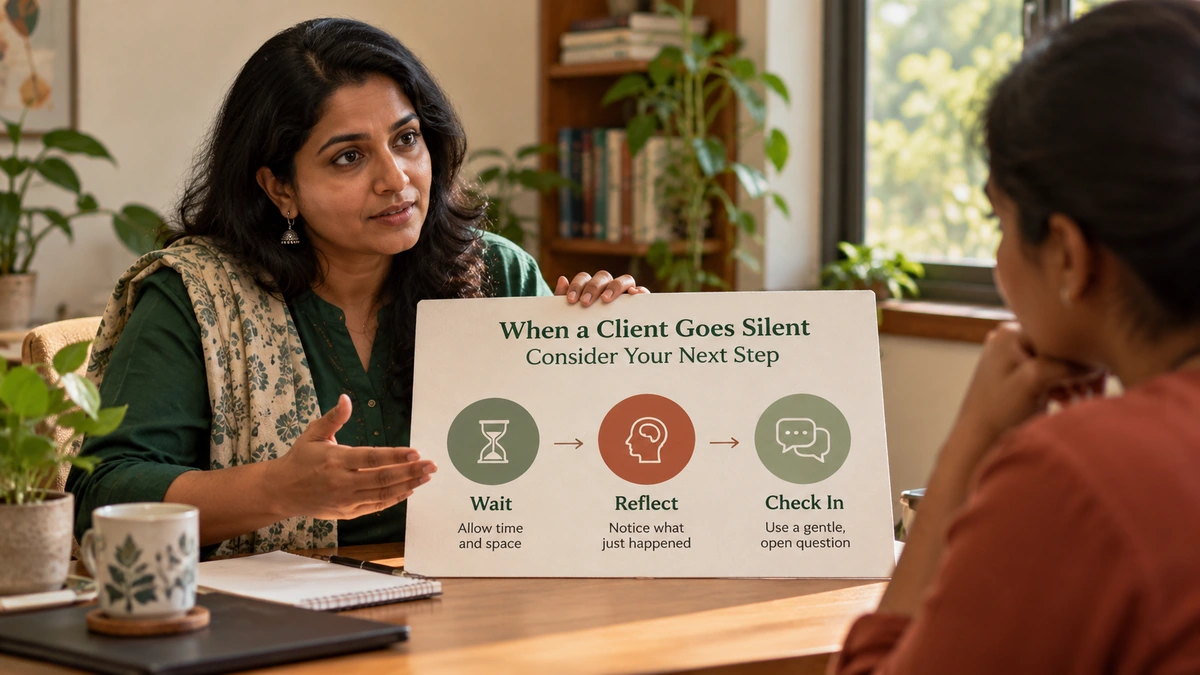
Wait when the client appears to be finding their own words and there is no reason to press. Reflect when a feeling or meaning has just been expressed and a brief acknowledgement may help. Check in when the pause follows a possible misunderstanding, the client seems unsettled, or you cannot tell whether silence is welcome. The choice can change in seconds.
Use a respectful decision path
Start with what happened just before the silence. Did the client finish a thought, or did you ask for something very personal? Then notice your own urgency. Are you about to speak because the client needs help or because you want the discomfort to end? Finally, choose the least demanding useful response. Sometimes that is simply staying present. Sometimes it is, “We can take a moment.” Sometimes it is, “I think I may have moved too quickly.”
Do not use a “therapeutic silence” rule as a reason to ignore clear distress. A client who seems disoriented, unresponsive, or at immediate risk needs an appropriate assessment and your service’s safety process. A blog cannot replace that judgement.
Try wording that leaves the choice with the client
“Would you like a moment with that?” is different from “You must be feeling overwhelmed.” “I wonder if my question missed what mattered” leaves room for correction. “We can slow down or come back to this later” gives a genuine option. The wording should sound like you, not a phrase rehearsed so perfectly that you stop hearing the response.
If you notice the pause followed a question about identity, family, or trauma, do not assume your good intent removes its impact. You can ask how the question landed and accept the client’s answer without defending yourself.
To practise therapeutic silence skills with feedback, review PsyQuench’s counselling and psychotherapy course. Confirm current course format, eligibility, price, and availability before registering.

What If a Client Remains Silent?
If silence continues, do not turn it into a contest over who speaks first. Check whether the client understood the question, wants a break, or would prefer another way to communicate. If the silence suggests a rupture, name your part gently. If there is a safety concern, follow the relevant procedure.
Check consent and accessibility needs
The client may need more time to process, an interpreter, a different pace, or permission to write instead of speak. Ask what would help without assuming that one adaptation fits everyone. Consent is ongoing: agreeing to therapy does not mean agreeing to discuss every topic at the pace the counsellor chooses.
In a video session, technical delay can also look like an emotional pause. Before interpreting the silence, check whether the connection is stable and whether the client heard the question. In person, consider whether the room feels private enough for the answer. These practical checks are small, but they can prevent a trainee from giving a deep psychological meaning to a straightforward barrier.
The BACP Ethical Framework emphasises client wellbeing, respect, and professional responsibility. Apply your own service’s policies and local standards; the framework is not a substitute for them. The practical point is that the client’s agency remains important even when the room is quiet.
How to notice a possible rupture
A rupture is a strain in the working relationship. You do not need to label it aloud immediately. Look for a change from the client’s usual engagement, especially after something you said. If you suspect a miss, try: “I think I may have misunderstood that. Would you be willing to tell me how it came across?” The invitation should be sincere. If the client says no, the no is information too.
How to repair without forcing speech
Take responsibility for the part you can identify: “I asked that in a way that assumed an answer.” Then allow the client to decide what comes next. Avoid a long explanation of your intentions. The goal is to restore choice and clarity, not obtain quick forgiveness for the counsellor.
In some circumstances, you may need consultation or supervision after the session. Record and discuss the issue according to confidentiality rules. Our article on hands-on training in clinical psychology explains why feedback on these moments matters more than memorising phrases.

How Can Students Practise Therapeutic Silence Safely?
Beginner therapist tips about silence start with fictional cases, guided roleplay, and observation. These therapy communication techniques are learned through the client’s response, not by reaching a target number of quiet seconds. A useful exercise is to have one learner play a client who pauses after a meaningful sentence while another practises waiting, reflecting, and checking in. The observer notes the exact moment and effect of each response. No one needs to disclose a personal trauma to make the exercise realistic.
Use fictional roleplay and observation
Start with a simple line: “I did not tell anyone I lost the job.” In round one, the counsellor fills the pause with questions. In round two, they allow a brief pause and offer one reflection. The person playing the client reports which response gave them more room and which felt pressuring. The exercise does not prove what would work with every real client. It helps trainees hear the difference.
You can also practise noticing your own signs of haste: a quick inhale, moving your pen, or mentally rehearsing a technique while the other person is still thinking. Treat these as cues to become more attentive, not evidence that you are unfit to practise.
What to discuss in supervision
Bring the context, not just the duration. What had the client said? What did you ask? What did you notice in them and in yourself? What did you do next? How did they respond? Ask what other interpretations are possible and what you might try if the pattern returns. Do not include identifiable details outside approved supervision channels.
If you are exploring the profession, PsyQuench’s client-facing counselling page can remind you how different the session may feel from the other chair. A client does not experience your technique labels. They experience whether they can think, speak, pause, and be heard.

If you want to build these skills in practice, view PsyQuench’s counselling and psychotherapy course. Course practice can support learning; clinical decisions still require the supervision, qualifications, and professional scope appropriate to your role.
FAQs About Silence in Counselling
Is silence always therapeutic?
No. A pause may help someone think or feel, but it can also follow a confusing question, signal discomfort, or reflect an accessibility need. Look at the context and check in when you are unsure. Do not use silence as a technique to pressure disclosure.
How long should I wait before speaking?
There is no universal number of seconds. A pause after an emotional insight may need room; a pause after a misunderstood question may need clarification. Notice the client’s response and your own reason for speaking. Ask your supervisor to review difficult examples.
What if the client looks uncomfortable?
Offer a gentle choice: “Would you like a moment, or would it help if I said that differently?” If there are signs of immediate distress or risk, follow your service’s safety process. Avoid deciding that discomfort is necessarily productive.
Can I ask what the silence means?
Yes, if you ask tentatively and leave room for “I do not know.” “I notice we have paused; what is happening for you right now, if you want to say?” may be more useful than “Why are you silent?” A client can choose not to explain.
What if my own anxiety makes me talk too much?
Notice when the urge to speak appears, practise one pause in roleplay, and bring a concrete example to supervision. Your discomfort is common learning material; it should not be treated as the client’s responsibility to soothe.
Should I discuss difficult silences in supervision?
Yes, especially when you felt lost, worried about safety, or think the relationship was strained. Bring the sequence and your response while protecting confidentiality. Supervision can help you consider meanings you missed without turning a client into a textbook example.