Why Is This Client Affecting Me So Much? Understanding Countertransference Through Realistic Examples

You notice you keep looking at the clock before one client arrives. With another, you want to solve every problem for them before the session ends. You may feel embarrassed by either reaction, especially if you are still learning. At PsyQuench, we use realistic countertransference examples to show how a feeling can become useful reflection when you notice its effect on your choices and bring it to appropriate supervision. The examples below are fictional; they are not patient accounts.
Table of Contents
- What Is Countertransference in Counselling?
- Countertransference vs Ordinary Empathy: What Changes?
- What Do Realistic Countertransference Examples Look Like?
- How Can You Notice a Reaction Without Judging Yourself?
- What Should You Bring to Supervision About Countertransference?
- How Can Training Build Reflective Practice?
- FAQs About Strong Feelings Toward Clients

What Is Countertransference in Counselling?
In countertransference counselling discussions, the focus is the clinician’s emotional, cognitive, or behavioural response to a client in the treatment relationship. The NCBI MeSH definition describes the clinician’s reactions toward the patient. Different therapy traditions explain the origins of those reactions differently, so students should not assume every strong feeling has the same meaning.
In plain language: something about this client, this situation, or what it brings up for you is affecting how you respond. That may be a normal human response. It becomes important when it shapes what you say, avoid, recommend, or permit. The focus is on your professional choices, not on making the client responsible for your feelings.
A plain-language definition of countertransference
Suppose a fictional trainee, Tara, works with a client whose account of family pressure resembles something in Tara’s own life. Tara feels a sharp need to tell the client to leave home. The feeling may alert her to the importance of the topic. It may also tempt her to move faster than the client wants. Countertransference is not “the client made me feel this”; it is a prompt to ask how Tara’s response enters the work.
You do not have to trace every emotion to a childhood memory to usefully reflect. Begin with what happened in the room and what you did next. Did you interrupt? Did you avoid a question? Did you change a boundary? These are observable entry points for supervision.
Why having a feeling is not a failure
Therapists are people. Warmth, concern, frustration, boredom, or uncertainty can arise in any relationship. Trying to feel nothing may make you less aware of the reactions that matter. The professional task is to recognise the feeling, consider what it may and may not mean, and keep the client’s needs and consent in view.
Our article on supervision in psychology training explains why such reflection belongs in supervised practice. A course or article can teach the concept; it cannot resolve an active clinical concern for you.

Countertransference vs Ordinary Empathy: What Changes?
Empathy helps you understand and respond to a client’s experience. Countertransference is a broader name for your own reaction within the relationship. The two are not opposites. A caring feeling may coexist with a personal urge to rescue; irritation may coexist with accurate understanding. The practical question is whether your reaction is narrowing what the client can say or changing your professional judgement.
Separate the feeling from what you do
Tara might feel protective and still ask, “What options feel possible to you?” She could also tell the client exactly what to do and miss the risks of that choice. Same feeling, different action. This distinction makes reflection possible without pretending emotions can be switched off.
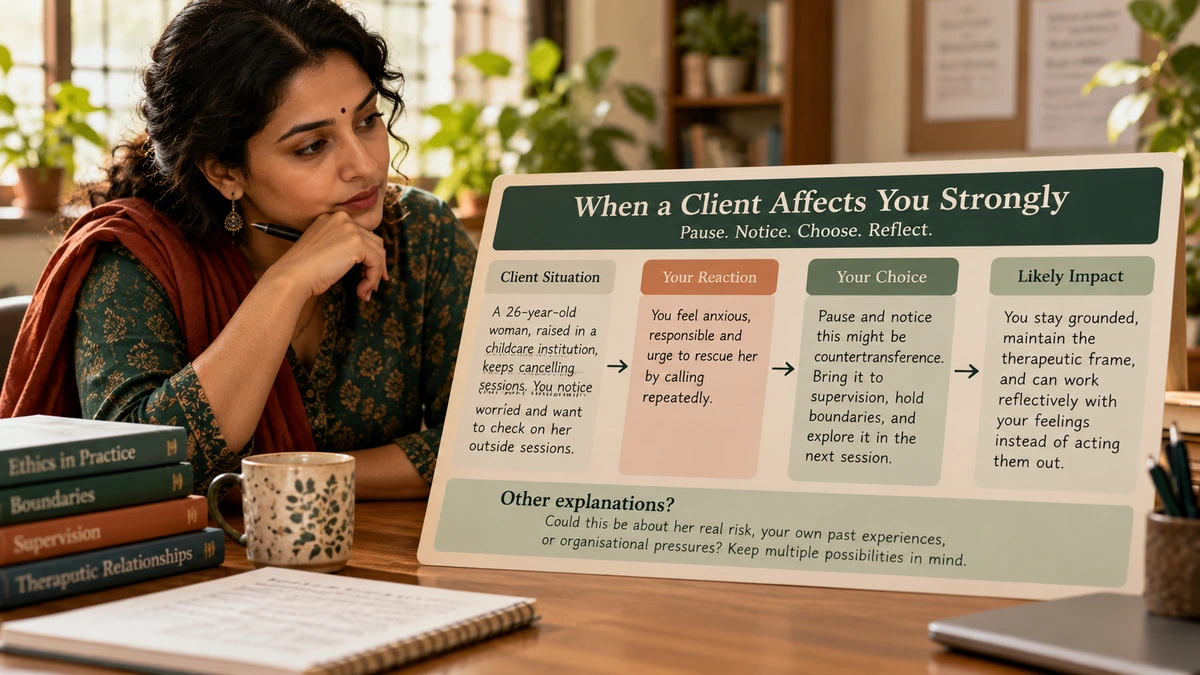
An original PsyQuench reflection tool is the Reaction–Choice–Impact check. Write one sentence for each: “What did I feel or predict?” “What did I do differently?” “How might that have affected the client?” Then add “What else could explain the moment?” This is not a validated measure. It is a way to prepare a specific supervision question.
Notice when judgement may shift
You might be more lenient about a boundary with one client, more sceptical of another’s account, or quick to offer advice to someone who reminds you of a relative. These shifts are easier to examine when you compare decisions with your usual practice and the service’s standards. The client should not bear the cost of your unexamined reaction.
If a decision may have affected care, safety, or confidentiality, seek timely supervision under your setting’s procedures. Reflection after the fact is useful, but it is not a reason to postpone needed action.

What Do Realistic Countertransference Examples Look Like?
Countertransference examples are most useful when they show the inner reaction and the possible change in behaviour. These fictional scenes are not diagnoses of the trainees. They illustrate questions to examine with a supervisor, not conclusions to impose on a real client.
When the urge to rescue takes over
Tara’s client describes pressure to choose a career path approved by family. Tara wants to say, “Move out and apply elsewhere.” She starts drafting a plan before asking about money, safety, values, or what the client wants. Her protective feeling is understandable. The risk is replacing the client’s decision with her own preferred outcome.
The Reaction–Choice–Impact check might read: “I felt urgent anger at the family pressure. I moved into advice without exploring options. The client may have felt unheard or pushed.” The supervision question is not “Am I a bad therapist?” It is “How can I respond to this topic while allowing the client’s pace and assessing actual constraints?”
When irritation changes your questions
A fictional client, Ravi, misses two appointments and jokes about being unreliable. The trainee feels irritated and asks, “Are you actually committed to this?” The question may sound like a judgement rather than curiosity. There may be important issues to discuss about attendance, but the wording and timing have been shaped by the trainee’s reaction.
A different response could be: “I notice it has been hard to meet at this time. What has been getting in the way, and should we review whether this arrangement works?” That leaves room for practical barriers, ambivalence, and responsibility. It does not pretend missed sessions have no consequences.
When you identify too strongly with a client
A client’s experience resembles the trainee’s own family conflict. The trainee begins finishing the client’s sentences and interpreting a parent’s motives as though the two families were identical. The client becomes quieter. The trainee may think the session went well because they felt an intense connection. The observable clue is that the client had less room to disagree.
This is also why emotional vulnerability in a client should not be treated as proof that the therapist’s interpretation is correct. Therapist emotional reactions can be powerful clues about the encounter, but they are not evidence that the client shares the therapist’s meaning. A person may share something tender and still need the freedom to say, “That is not what I meant.” The trainee can stay warm while checking the client’s words, pace, and preferred direction instead of using their own similar history as a shortcut.
Strong identification can make a trainee feel especially competent or especially frightened for the client. Both deserve reflection. It may help to ask, “What did the client actually say that differs from my story?” and “Which part of my interpretation has not been checked?”
When you begin avoiding a topic
Another client’s grief brings up the trainee’s own recent loss. Whenever the client approaches it, the trainee changes to a coping exercise. The exercise may be useful in some circumstances, but the repeated timing suggests avoidance. A supervisor can help consider whether the trainee can stay present, needs personal support, or requires an adjustment to protect care.
Our article on practical challenges students may meet discusses why real sessions rarely follow a script. These examples show one reason: the practitioner brings a human response into the room too.

How Can You Notice a Reaction Without Judging Yourself?
Look for patterns in your body, thoughts, and behaviour. The goal is to become more accurate, not to shame yourself for having feelings. A useful observation is specific: “I interrupted twice when the client mentioned their father.” A less useful one is “I am too emotional to do this work.” Specifics can be tested and discussed.
Notice body cues
You may tense your jaw before a client arrives, feel an urge to lean forward, or become unusually tired after a particular topic. These cues are not proof of countertransference. They are invitations to ask what else is happening: your workload, health, the session content, and your relationship with the client. Keep the interpretation tentative.
Spot a thought that keeps returning
“I must fix this before they leave.” “They never listen.” “I understand this better than they do.” The thought may be brief, but it can shape a question or decision. Write it in neutral terms for supervision. Do not make a private certainty test out of each passing thought.
Look for a change in your behaviour
Compare what you do with this client to your usual practice and the agreed treatment frame. Are you extending sessions, answering messages unusually fast, avoiding a relevant topic, or pushing one solution? This is the most actionable part of the check because behaviour can affect the client even when you never disclose the feeling.
The research discussion of countertransference in CBT supervision describes how therapist reactions can enter treatment and supervision. It does not mean every reaction fits a single category or that a self-observation is a diagnosis. Use it as a reason to reflect with a supervisor rather than as an online label for yourself or a client.
If you want guided practice in noticing how your responses affect a conversation, review PsyQuench’s counselling and psychotherapy course. Confirm its current format and eligibility; live client decisions still belong in authorised supervision.

What Should You Bring to Supervision About Countertransference?
Bring the sequence: what the client said or did, what you felt or predicted, what you did next, and what you are concerned that response may have changed. Ask what other explanations might fit and what action is needed now. Protect identifying details according to your service’s rules. If client safety or care may have been affected, raise it promptly rather than waiting for routine supervision.
Describe any effect on clinical decisions
“I felt protective” is a useful start. “I felt protective and advised a housing change before asking about the client’s safety or resources” gives your supervisor a concrete decision to review. The focus is on the clinical impact and the next responsible step, not extracting a confession.
Supervision can also help separate personal emotion from a real ethical problem. A trainee may feel anxious because a boundary has actually been crossed. Another may feel anxious because a client’s uncertainty resembles their own. The action required will differ.
Our guide to foundational counselling skills places reflection beside listening and boundaries. Those skills are more than a list; they are choices made in a specific moment.
Review boundaries and consultation needs
Ask whether you need to repair something with the client, change a practice pattern, document a concern, seek further training, or take a break or referral under your service’s procedures. Do not disclose your reaction to the client simply to relieve yourself. Self-disclosure, if ever used, needs a client-centred rationale and appropriate supervision.
If the issue includes attraction, anger, fear, or an urge to break a boundary, be especially direct with your authorised supervisor. A difficult feeling is precisely the kind of material supervision should help you manage safely.

How Can Training Build Reflective Practice?
Psychotherapy training students can use fictional roleplay, structured observation, and feedback on how a response lands. These exercises help psychology students building counselling skills connect self-awareness to visible choices rather than memorise definitions alone. They can help you notice the gap between what you intended and what the other person experienced. They cannot license independent practice, replace clinical supervision, or certify that you have resolved your personal reactions.
Use fictional roleplay to notice reactions
In a roleplay, ask a partner to say, “I think I will ignore the advice and keep doing what I have been doing.” Notice whether you feel impatient, protective, relieved, or curious. Then try a response that protects the learner’s agency: “What feels important about staying with that choice?” The observer notes whether the question left room for the fictional client’s meaning.
Another exercise is to replay Ravi’s missed-appointment scene with different wording. Ask the trainee to name their reaction first, then choose a response that addresses attendance honestly without punishing the client. This links self-awareness to a behaviour you can see and improve.
Why feedback cannot replace supervision
Roleplay feedback tells you how a practice exchange felt. Formal supervision considers real client care, confidentiality, ethics, organisational policy, and your scope of work. Keep client-identifying material out of ordinary course exercises. If you are uncertain about what you may share, ask your supervisor or institution before using it.
PsyQuench’s client-facing counselling page can remind trainees of the person who experiences the therapist’s choices. The client is not there to teach you about your reaction. The learning responsibility belongs with you and your supervisor.

If you are learning counselling skills and want structured practice, view PsyQuench’s counselling and psychotherapy course. Check the current course details and the professional scope it does and does not provide.
FAQs About Strong Feelings Toward Clients
Is countertransference always harmful?
No. A reaction can become useful information when you notice it and examine it responsibly. It can also harm care if it drives unexamined decisions, boundary changes, or avoidance. The effect on your work matters more than the mere presence of a feeling.
Can positive feelings be countertransference?
Yes. Admiration, protectiveness, or a wish to be especially helpful may be relevant if they alter judgement or boundaries. Warmth toward a client is not automatically a problem; ask whether you are behaving differently in a way the client has not chosen.
How is it different from empathy?
Empathy aims to understand the client’s experience. Countertransference concerns your own response within the relationship. They can coexist. A practitioner can understand a client well and still need to examine an urge to rescue or avoid a topic.
Should a trainee tell the client about the reaction?
Not simply to ease the trainee’s discomfort. A disclosure must be considered for the client’s benefit, within the treatment approach and service policy, with supervision as appropriate. When unsure, discuss it with your supervisor first.
What if a reaction affects boundaries?
Bring the specific behaviour to your supervisor promptly. Review the service policy, any impact on the client, and the next corrective step. Do not wait until you have a perfect explanation of why you felt that way.
Can roleplay help me notice my responses?
Yes. Fictional roleplay can make the link between a feeling, your next question, and the other person’s response easier to see. It is a training exercise, not a substitute for formal clinical supervision of real work.