Do We Really Need Couples Counselling If Nothing Is “Wrong”? Why Waiting for a Crisis Can Make Things Harder

You love each other. You also have the same Sunday argument about family plans, end up apologising, and repeat it the next week. Neither of you thinks the relationship is “failing,” so asking for help feels dramatic. At PsyQuench, we see preventive couples counselling as a reasonable conversation to consider when a pattern matters to you, even before it becomes a crisis. The point is to understand and practise something together, not to declare one partner the problem.
Table of Contents
- Can Couples Counselling Help Before a Crisis?
- What Early Relationship Patterns Make Support Worth Considering?
- Preventive Couples Counselling vs Crisis Support: What Changes?
- How Can I Suggest Couples Counselling Without Blame?
- What Happens in Early Couples Counselling Sessions?
- When Should Another Kind of Help Come First?
- FAQs About Starting Couples Counselling Early

Can Couples Counselling Help Before a Crisis?
Yes. You do not have to prove that the relationship is badly damaged before asking for a structured conversation. Some couples want help with a recurring disagreement, a major transition, or the feeling that they keep missing one another’s point. The American Association for Marriage and Family Therapy describes couple and family therapy as work that considers relationships and context, rather than treating an issue as belonging to one person alone.
That does not make therapy a required milestone for every couple. You may make progress through a frank conversation, a practical agreement, or time to adjust to a change. Counselling becomes more useful when you both want help seeing a pattern that your usual conversations have not shifted.
What early conversations can address
Think of a fictional couple, Meera and Karan. On Sundays they discuss whether to visit family the following weekend. Meera hears “We should go” as a plan already made. Karan thinks he is only raising an option. By Tuesday they are arguing about who respects whose time. The topic appears to be a visit. The pattern is that one person assumes agreement while the other expects discussion.
Early counselling could help them slow down that exact exchange: what each meant, what each heard, and what a clearer decision process would look like. It does not need to search for a dramatic hidden wound to justify the appointment. A small, repeated misunderstanding can still deserve attention.
For a practical overview of what to expect from couples counselling, see our separate guide. This article concentrates on when early support may be a good fit.
What early counselling cannot promise
Counselling cannot ensure that you will stay together, agree on every major issue, or never repeat an old argument. It cannot make one person participate honestly. A good first goal may be more modest: identify the recurring moment, understand each person’s part, and practise a different response. Sometimes clearer understanding also reveals a real incompatibility. That may be painful, but it is not proof the conversation was a mistake.
Avoid the claim that all couples wait a fixed number of years before seeking help. A research note on how long people wait before couples therapy examines the often repeated “six-year” figure; it is not a sound rule for your relationship. Your decision should rest on what is happening now, not a dramatic statistic. This third source is included to support that specific accuracy correction.
What Early Relationship Patterns Make Support Worth Considering?
If you are wondering when to start couples therapy, consider support when the same issue returns despite sincere attempts to resolve it, or when you cannot repair well after disagreements. You might also seek help during a transition, such as moving in, marriage, parenting, caring for relatives, or a job change. You do not need to count arguments. Notice whether the pattern is costing closeness, trust, or a sense that you can be heard.
When the same argument keeps returning
A recurring argument often has a visible topic and a less visible process. The topic might be household work. The process might be that one person raises the issue late at night, the other becomes defensive, and both leave without a plan. If you only debate who did the dishes last Tuesday, you may miss the part that repeats every week.
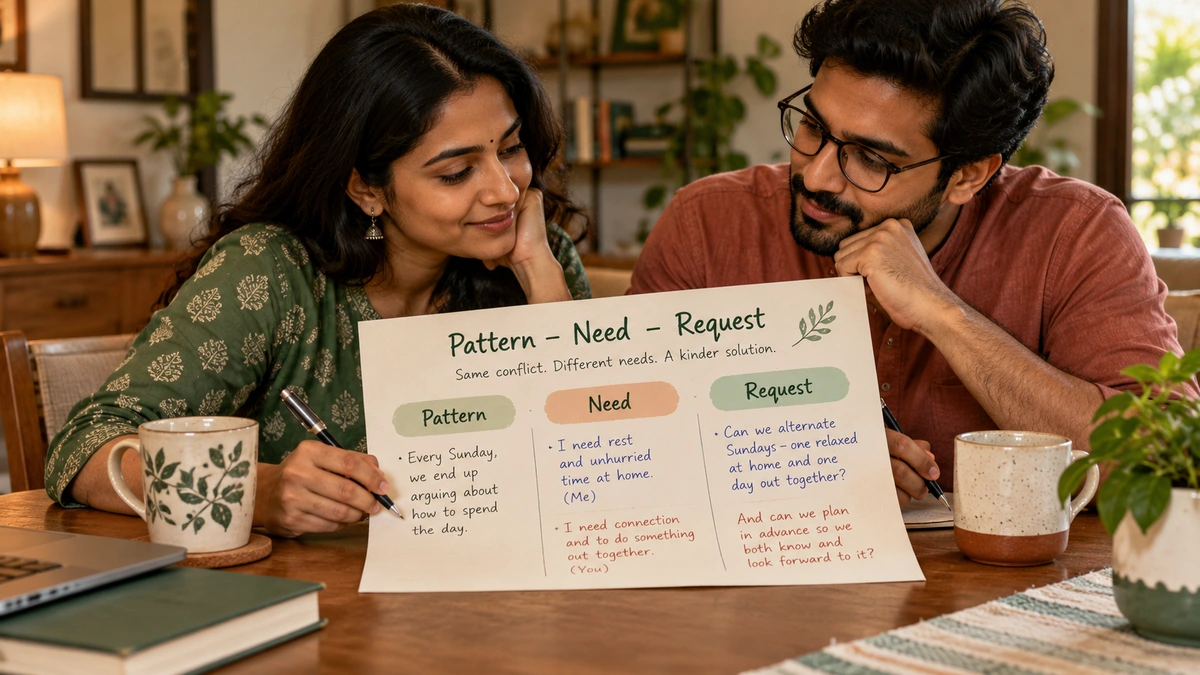
Try a Pattern–Need–Request card, an original PsyQuench reflection tool. Each partner completes three short lines separately: “When this starts, what usually happens?” “What need am I trying to express?” “What request could the other person actually respond to?” For Meera, that may be: “Plans are announced; I need a say in our time; please ask before telling family we are coming.” For Karan: “Suggestions are heard as decisions; I need room to discuss options; please check what I mean before assuming I have promised.” This tool is educational, not a validated therapy technique or a way to grade who is right.
The card can reveal that both people have a reasonable need and that the old method of asking is not working. It may also reveal that one partner repeatedly ignores a clear boundary. If so, the issue is not simply wording.
How poor repair affects connection
Couples disagree. What can wear a relationship down is the sense that every disagreement ends with withdrawal, sarcasm, a rushed apology, or a promise that disappears. Repair is not saying “sorry” quickly enough to close the topic. It is understanding what landed badly, taking responsibility where appropriate, and choosing a change the other person can notice.
If Meera and Karan end each Sunday with “Fine, we will see,” neither knows whether next week’s plans are settled. A more useful repair might be: “I told my parents we would come before checking with you. I will ask first next time. Can we decide together by Wednesday?” The details matter because they make a future test possible.
Why major transitions can expose a pattern
Before moving in, you may have had separate routines and fewer shared decisions. After a child arrives, every choice may affect sleep, money, and family support. A transition does not create every difficulty; it can make an old assumption more visible. Premarital relationship therapy or early counselling can provide a place to discuss expectations before they harden into resentment.
The aim is not to prove you are “ready” by agreeing on everything. It is to discover how you handle differences about work, finances, intimacy, relatives, privacy, and future plans. If you find a difficult topic, that is useful information for a respectful conversation, not a failed test.
Preventive Couples Counselling vs Crisis Support: What Changes?
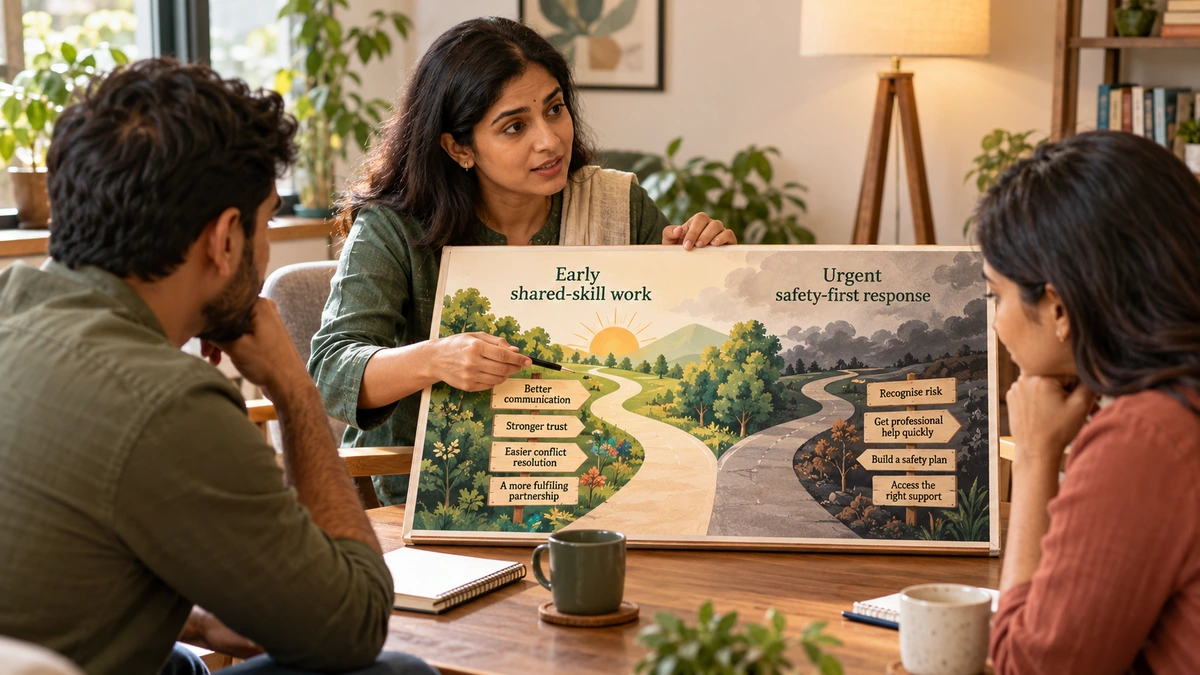
Preventive work often begins with enough calm to examine habits and practise new ones. Crisis work may begin with a rupture, a decision about whether to stay, or an immediate safety concern. Neither path is morally better. Starting earlier can give you more room, but a crisis may still be the first point at which both people are willing or able to seek help.
What calm skill-building looks like
Meera and Karan might practise a five-minute planning conversation in a session, then use it once before calling either family. They would notice where it felt awkward and bring that back. Counselling is not simply a place to repeat the argument in front of a third person. It can be a place to understand what each partner does under pressure and test a more workable exchange.
If one partner repeatedly finds themselves in painful relationship dynamics, our article on recognising repeated partner patterns may add individual context. It should not be used to turn a shared conversation into a hunt for the “wrong” partner.
When urgent safety needs come first
If there is violence, coercion, fear, or a threat of retaliation for speaking honestly, joint counselling may be unsafe or inappropriate. A person who cannot disagree freely in the room may also be unable to discuss the session safely afterwards. Seek local domestic-violence support, medical care, or emergency help as needed. The decision about joint work should be made with qualified professionals who assess safety privately.
The WHO guidance on responding to intimate partner violence centres safety and appropriate support for those experiencing harm. Preventive couples counselling is for a different situation from asking someone to negotiate with a person who is controlling or hurting them.

How Can I Suggest Couples Counselling Without Blame?
Speak about a pattern both of you can recognise and what you hope to learn. “We keep ending up in the same argument, and I want us to understand it better” is easier to hear than “You need therapy.” Ask for a conversation about the idea; do not present a booking as a verdict already reached.
Try a non-blaming invitation
Choose a time outside the argument. You might say: “I care about us. We keep getting stuck when we plan weekends, and I do not think either of us is getting heard. Would you be open to one session to see whether it helps us talk about it?” This invitation identifies the issue, expresses a shared goal, and allows the other person to respond.
Do not promise that counselling will be easy or that a therapist will agree with your view. If you want the counsellor to prove your partner wrong, the invitation may feel like a trap. Ask yourself what you are willing to examine about your own part in the cycle.
What to do if your partner declines
Ask what concerns them. They may worry about privacy, cost, time, being blamed, or the idea that therapy means failure. You can discuss those concerns without pressing for an instant yes. One partner can also seek individual support to think about communication, boundaries, and options. Individual work cannot make the other person change, but it can help you decide what you need.
When cost is the main concern, read our guide to the cost of therapy in India together, then ask any provider for their current couples-session fee and format. Do not assume an individual session price applies to couples work.
If a partner uses “we do not need therapy” to avoid every conversation about a serious problem, take that response seriously. The question then may be what you can choose, not how to find a perfect persuasive sentence. Our guide to setting boundaries without guilt may help you put a need into words.

If you both want support with a pattern that keeps returning, explore counselling at PsyQuench and ask whether the available professional offers couples work suited to your situation.
What Happens in Early Couples Counselling Sessions?
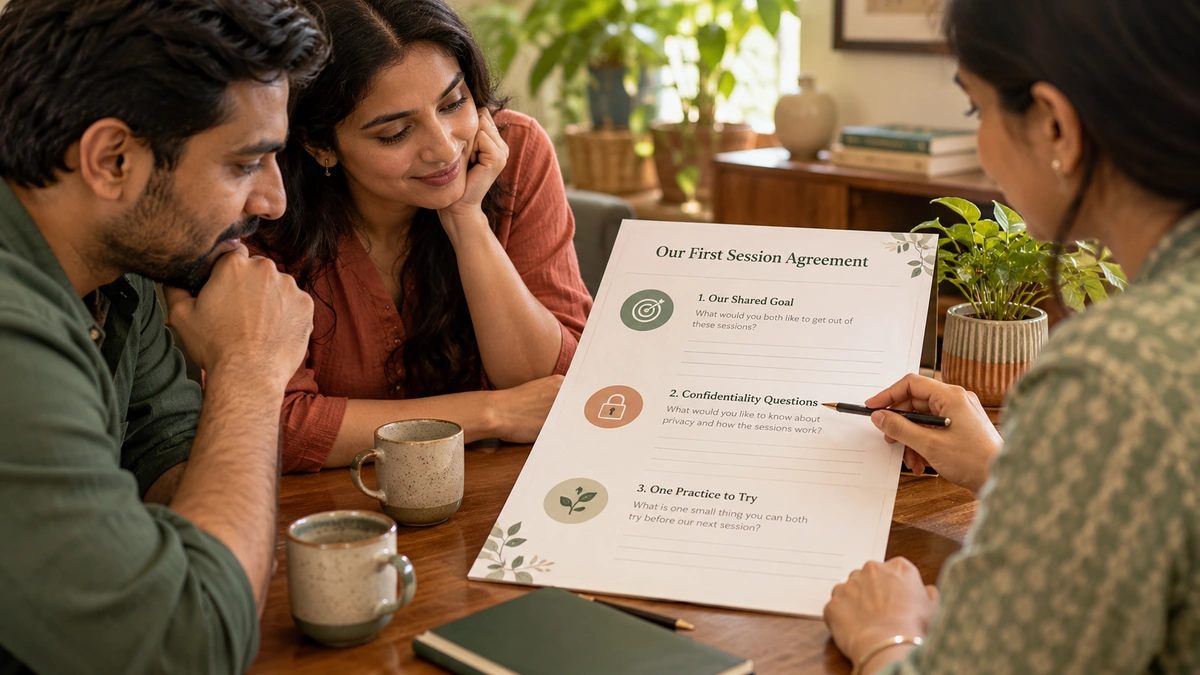
A first meeting usually involves understanding why each of you came, what you hope will change, and whether the service is a safe fit. Ask how sessions are structured, how confidentiality works, and whether the therapist meets partners together or separately at any point. The answer may vary by provider, so check rather than assume.
How you agree on shared goals
“Communicate better” is too broad to evaluate. A more useful early goal for Meera and Karan is: “Make weekend plans without one person feeling their time was committed without asking.” That goal gives both people a concrete situation to explore. Another couple might focus on how to repair after conflict, discuss money without shutting down, or make decisions during a move.
Healthy relationship counselling should leave room for both partners’ perspectives. It should also allow the professional to notice when a shared goal is not possible because one person feels unsafe or does not consent to the work.
What to ask about confidentiality
Ask who can see notes, what happens if one partner contacts the therapist privately, whether individual meetings are offered, and what limits to confidentiality apply. Policies differ. You should understand them before sharing something you assume will remain solely between you and the therapist. Clear ground rules can make the work feel safer and prevent later surprises.
How between-session practice may work
A counsellor may invite you to try a short conversation, notice a pattern, or complete a reflection between meetings. It should fit your actual life. If the exercise becomes another arena for scoring or blaming each other, tell the therapist. Couples communication therapy is most useful when both people can learn from what happened, including when an attempt went awkwardly.
The goal is not to act like ideal partners for the therapist. Bring the imperfect example. “We tried to plan the weekend and argued at minute three” gives more useful material than pretending the homework went smoothly.

When Should Another Kind of Help Come First?
If fear, coercion, or violence is present, seek individual safety support and an appropriate professional assessment before joint work. If one partner has a pressing mental health or substance-use concern, individual assessment may be needed alongside or before couples work. A therapist can help decide what is suitable; a web article cannot assess the risk for a specific couple.
Why coercion changes the decision
Couples work assumes that each person can speak and disagree with a reasonable degree of freedom. If one partner monitors the other’s phone, controls money, threatens consequences, or uses disclosures from sessions to punish them later, that freedom may not exist. The answer is not “communicate more clearly” with the person causing harm. Prioritise safety and specialist support.
What to do when violence or fear is present
If you are in immediate danger, use local emergency services. If it is safe to do so, speak with a domestic-violence support service or trusted professional privately. Avoid joint exercises that could increase risk. The appropriate plan depends on your circumstances and local services.
When one partner may need individual support
Even without violence, one person may need space to decide whether they want the relationship, manage their own distress, or discuss a personal issue they are not ready to share jointly. Individual counselling can serve that purpose. It should not be used to secretly recruit a therapist to take sides in a later couples session.
Readers interested in the professional skills behind relationship work can see PsyQuench’s counselling and psychotherapy course. That course is a separate learning path, not a claim that a learner is qualified to provide couples therapy after completing it.

If early support sounds right for both of you, ask PsyQuench about couples counselling fit and availability. If one of you feels unsafe, seek private safety support first.
FAQs About Starting Couples Counselling Early
Is couples counselling only for a failing relationship?
No. Some couples seek help with a repeating issue or a transition while they still feel close. It is a choice about getting support, not a diagnosis of the relationship. Ask what you hope to understand or practise together.
Can we go before marriage?
Yes, many couples explore expectations before marriage. Premarital work can cover communication, money, family roles, conflict, and future plans. Ask a provider what format they offer; premarital education and therapy are not identical services.
What if we rarely fight but feel distant?
Distance can matter even without loud arguments. Describe when you began noticing it, how you spend time together, and what happens when one of you reaches out. You may find a practical change together or decide a structured conversation would help.
What if my partner says we should solve it ourselves?
Ask what they want to try and agree on a clear time to review whether it helped. You can respect the wish to try privately while still being honest that the pattern matters to you. If every attempt to talk is refused, individual support can help you think about your options.
Does one partner have to be the problem?
No. A shared pattern often includes misunderstandings and responses from both people. That does not mean responsibility is always equal, and it must not erase harmful or coercive behaviour. A good assessment keeps those differences clear.
When should safety or individual help come first?
When a person is afraid, threatened, controlled, or at risk of retaliation for speaking honestly, private safety support comes first. Individual assessment may also be appropriate for urgent personal mental health needs. Do not assume a joint session is the safest starting point.