What Should I Bring to Clinical Supervision? How to Make Every Session Actually Useful

The supervision meeting starts in ten minutes. You know several sessions felt difficult, but your notes say only “discuss case.” When your supervisor asks what you need, you begin retelling the week and run out of time before reaching the question that mattered. At PsyQuench, we think preparation should make it easier to ask for help, not turn supervision into a performance. If you are wondering what to bring to clinical supervision, begin with one decision you cannot yet make confidently.
Table of Contents
- What Should I Bring to Clinical Supervision?
- How Do I Choose a Useful Supervision Question?
- How Much Case Detail Should I Share in Supervision?
- What Does a One-Page Supervision Agenda Look Like?
- What If I Feel Ashamed or Have Nothing Dramatic to Bring?
- How Do I Turn Supervision Feedback Into Practice?
- FAQs About Preparing for Clinical Supervision
What Should I Bring to Clinical Supervision?
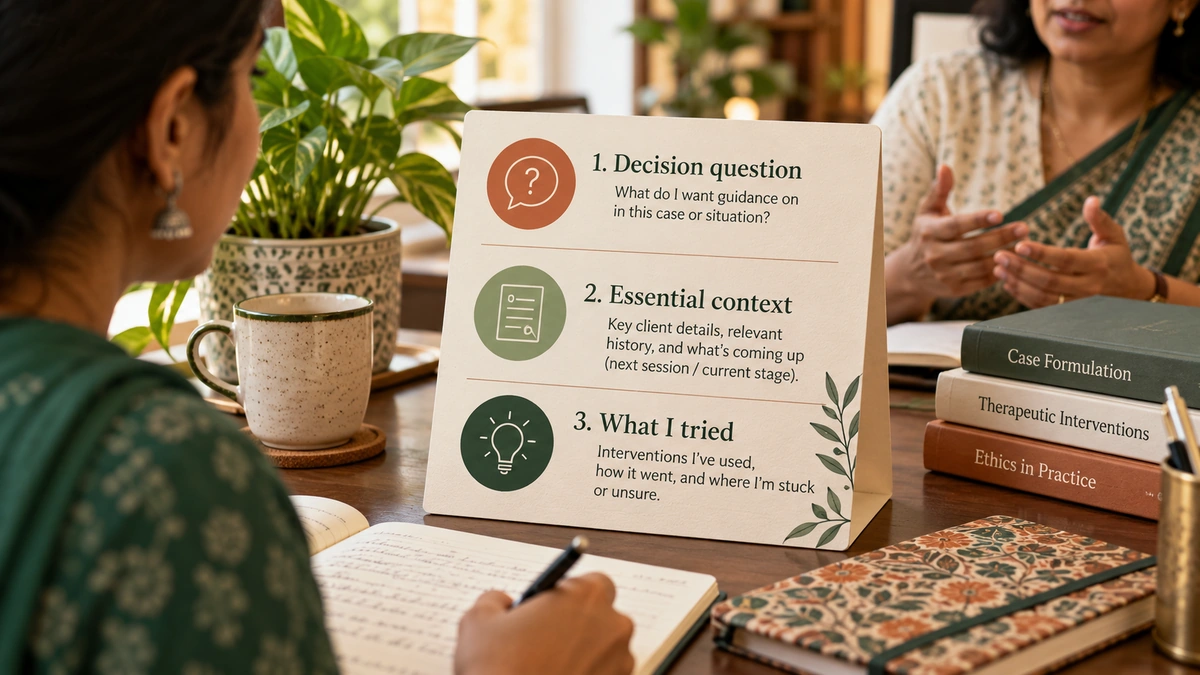
Bring the part of your work where you need guidance. That might be a decision about risk, a question about boundaries, uncertainty in your formulation, a moment when you felt unusually pulled to rescue a client, or feedback you have not yet put into practice. It does not have to be the most dramatic case of the week.
The NSW Health Professional Councils Authority’s guidance on clinical supervision encourages practitioners to reflect before the meeting and bring challenging cases, ethical issues, boundaries, emotional reactions, and questions about competence. That guidance is written in an Australian regulatory context. Your own jurisdiction, role, supervisor, and organisation determine formal requirements, but the preparation principle is useful across settings.
Bring one question you need help deciding
“I need to discuss this client” is a topic. “I am unsure whether to ask about risk again after what changed yesterday” is a supervision question. The second makes it easier for a supervisor to understand the decision point and what information is still missing. If the matter is urgent, follow the service’s escalation process now; do not wait for the next scheduled meeting.
Our article on why supervision matters in psychology training explains its broader role. Here the focus is how to arrive ready to use the conversation.
Include only essential case context
Write the facts your supervisor needs to understand the question, not a full life history. For a boundary concern, the relevant context might be the client’s request, the service policy, your response, and what you are considering next. The client’s occupation, exact age, neighbourhood, and unrelated family details may be unnecessary and could increase the chance of identification.
Use your approved case system and supervision channel. An anonymised case discussion still needs care: a rare combination of details can identify a person even after a name is removed. Ask what may be shared, recorded, or sent ahead under local rules.
Explain what you have already tried
Your supervisor needs to know what happened after your last decision. “I asked the client how the plan felt, and they said it was too much” is more informative than “the intervention did not work.” This helps the conversation build on actual client feedback rather than repeat a textbook answer.
You do not have to hide an attempt that went badly. A clear account of what you did, why, and how the client responded gives supervision something useful to work with.
How Do I Choose a Useful Supervision Question?
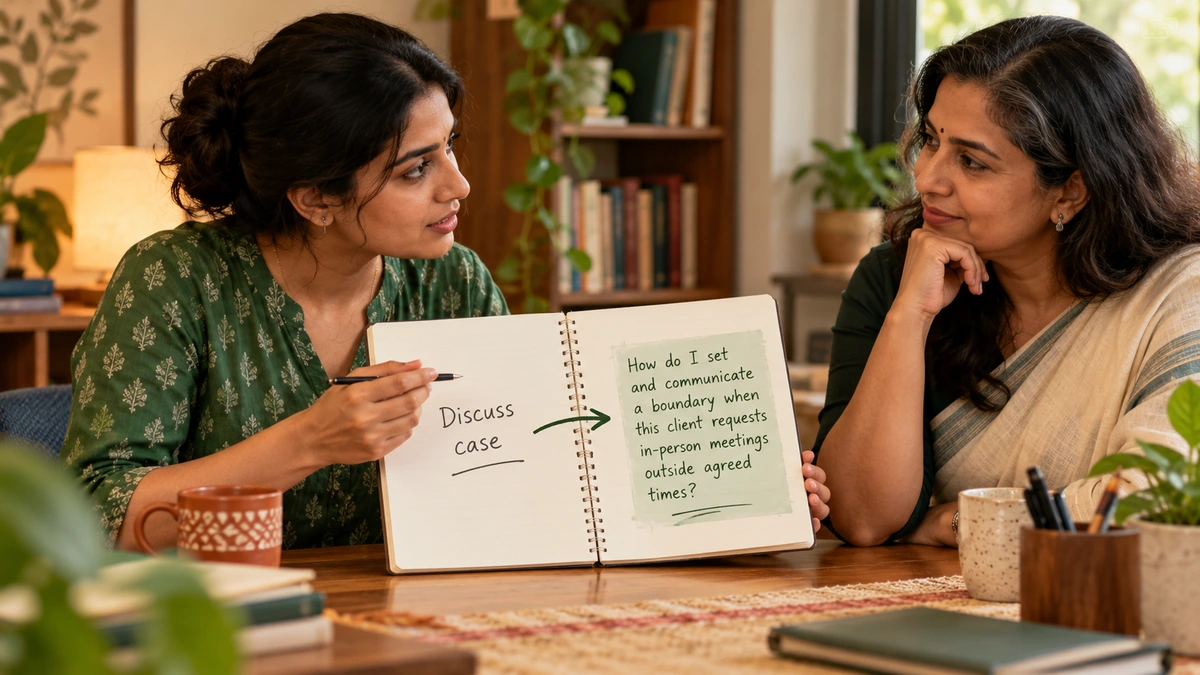
Find the point where you are stuck between possible next actions. “I feel uncertain about this case” is a beginning; “I need help deciding whether the client understood our safety plan” gives the supervisor a path. You can be honest about uncertainty without pretending there is one obvious answer.
Find the decision point
Consider a fictional trainee, Riya. A client often asks to extend the session by ten minutes. Riya says yes because the client appears upset, then feels resentful and worries that saying no would be unkind. A vague question is, “How do I handle this difficult client?” A useful one is, “How can I respond when the client asks for more time while keeping the agreed session boundary and attending to their distress?” The new question describes a decision, not a judgement of the person.
It also invites a review of risk. If the request came alongside an immediate safety concern, the response may differ from a routine pattern. A good supervision question brings in the facts that could change the decision.
Name the kind of feedback you need
You might need help with assessment, wording, ethics, formulation, or your own reaction. Tell your supervisor which. “Can we roleplay a respectful boundary statement?” asks for a different response than “Can we review whether I followed the service policy?” Both may be needed, but naming the priority keeps the meeting focused.
If several concerns compete, choose one that is urgent or has the greatest impact on client care. Put the others on the agenda in case there is time or arrange a separate discussion. Supervision is not improved by rushing through six cases without reaching a decision on any of them.
How Much Case Detail Should I Share in Supervision?
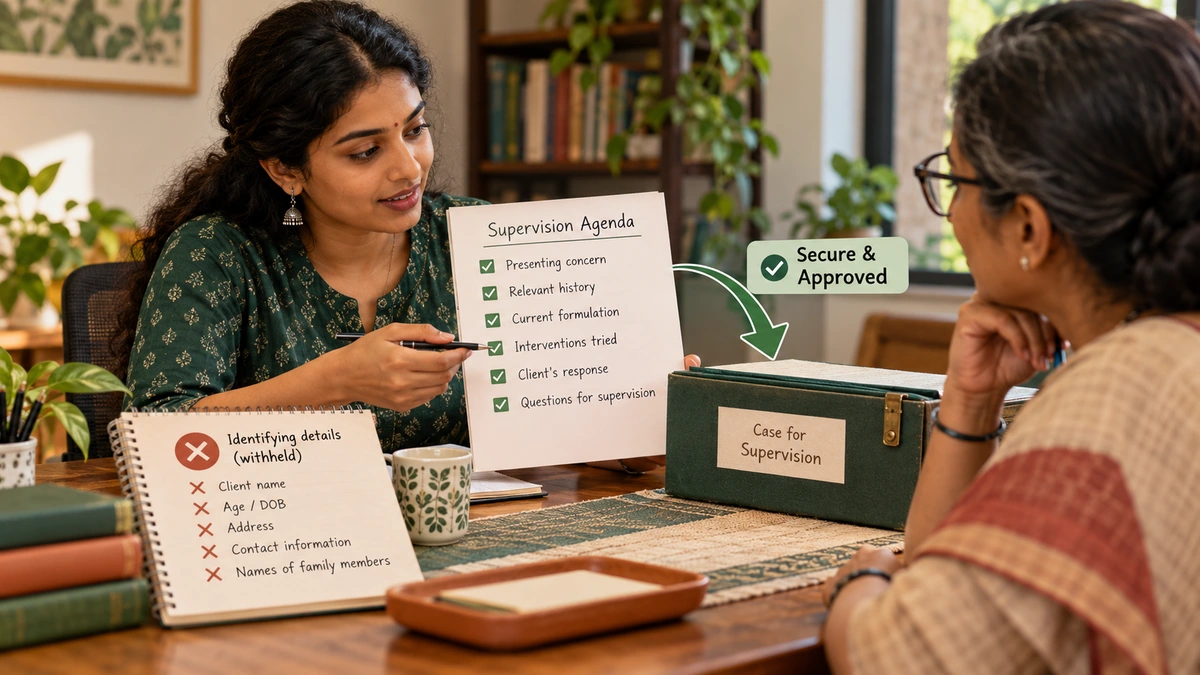
Share enough to support safe, informed supervision and no more than your setting permits. A supervisor may need protected information through an approved system to guide clinical responsibility. A public classroom exercise or personal messaging app has a different purpose and should not receive identifiable details. Follow your employer, professional body, and local law rather than a blog’s generic privacy rule.
The APA Guidelines for Clinical Supervision in Health Service Psychology discuss clear supervision agreements, goals, roles, and limits of confidentiality. They are US professional guidance, not a statement of Indian law. Use them to frame the questions you should ask of your own supervisor and institution.
Keep context relevant to the question
For Riya’s boundary question, the useful context is how often the request occurs, what happens at the end of session, any safety concern, the agreed session length, and how she has responded so far. A full transcript of the client’s childhood is unlikely to help unless it changes the formulation or decision.
One way to test a detail is: “If I removed this, would my supervisor give materially different guidance?” If not, it may not belong in the one-page agenda. This is not a reason to omit significant risk information. When safety is involved, follow the service’s full reporting and consultation process.
Protect confidentiality while following local rules
Use the secure channels your setting requires. Do not paste identifiable case notes into a public AI tool, class chat, or personal email because it is convenient. When you make a private preparation note, know where it lives, who can see it, and whether it must become part of the formal record. Ask your supervisor before you assume a fictionalised version is safe enough to circulate.
The gap between classroom exercises and live confidentiality decisions is one of the practice questions students meet after study. Good preparation includes knowing when to ask your supervisor what may be recorded.

What Does a One-Page Supervision Agenda Look Like?
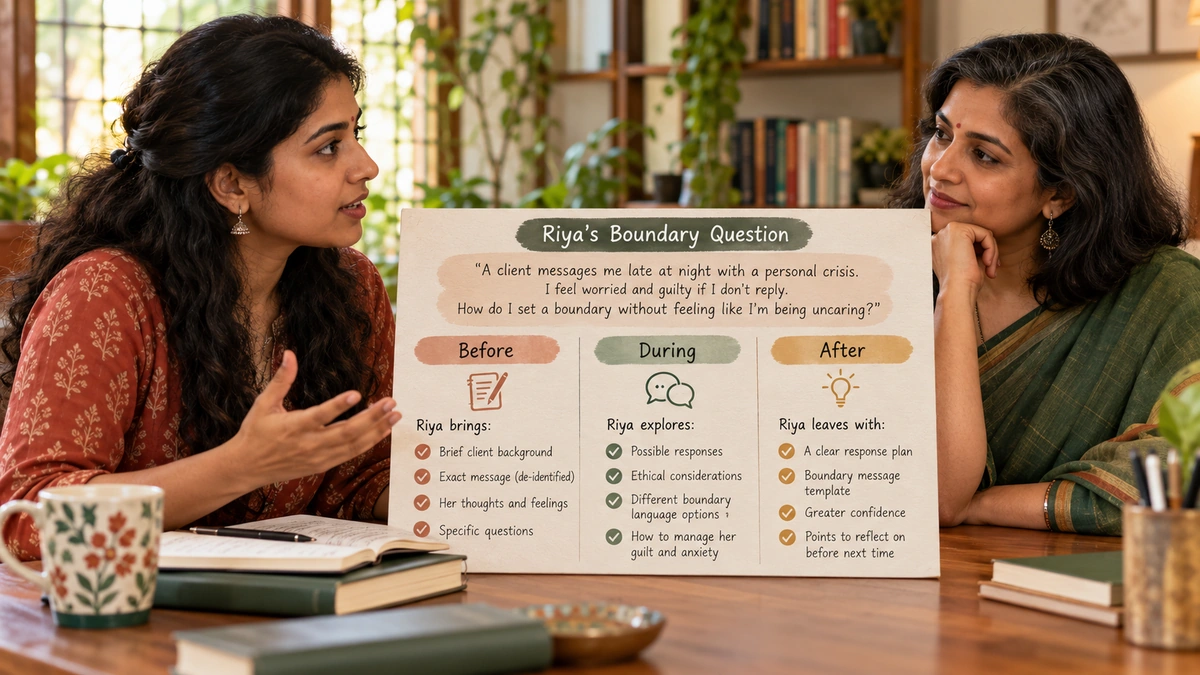
A practical supervision session agenda gives your supervisor enough to start and gives you a way to remember the decision afterwards. It need not be a formal template unless your workplace requires one. The Before–During–After card below is an original PsyQuench educational tool for preparation; it does not replace your organisation’s documentation.
What to write before the meeting
Riya’s card might read: “Question: How do I hold the agreed end time when the client asks to continue? Context: This has happened in three of four sessions; there was no immediate risk at those endings; service sessions are 50 minutes. Tried: I gave a five-minute warning once; the client said it felt abrupt. Need: Wording and a plan for exploring what the ending means.” That is enough to begin without writing a case essay.
If there is a current safety issue, a card does not substitute for immediate action. Contact the appropriate supervisor or emergency process as required. The agenda helps with scheduled learning; it is not an escalation channel.
What to record during the discussion
Record the decision, its reason, and any condition that would change it. For example: “Discuss the ending early next session; agree on a closing routine; consult immediately if risk emerges near the end.” Avoid making a vague note that says “work on boundaries.” If your supervisor gives feedback you do not understand, ask for one example or a roleplay before the session ends.
Not every suggestion is a directive you can apply unchanged. Check how it fits the client, service policy, and your level of responsibility. If you are unsure about an instruction, say so during supervision rather than privately improvising.
What to carry forward afterwards
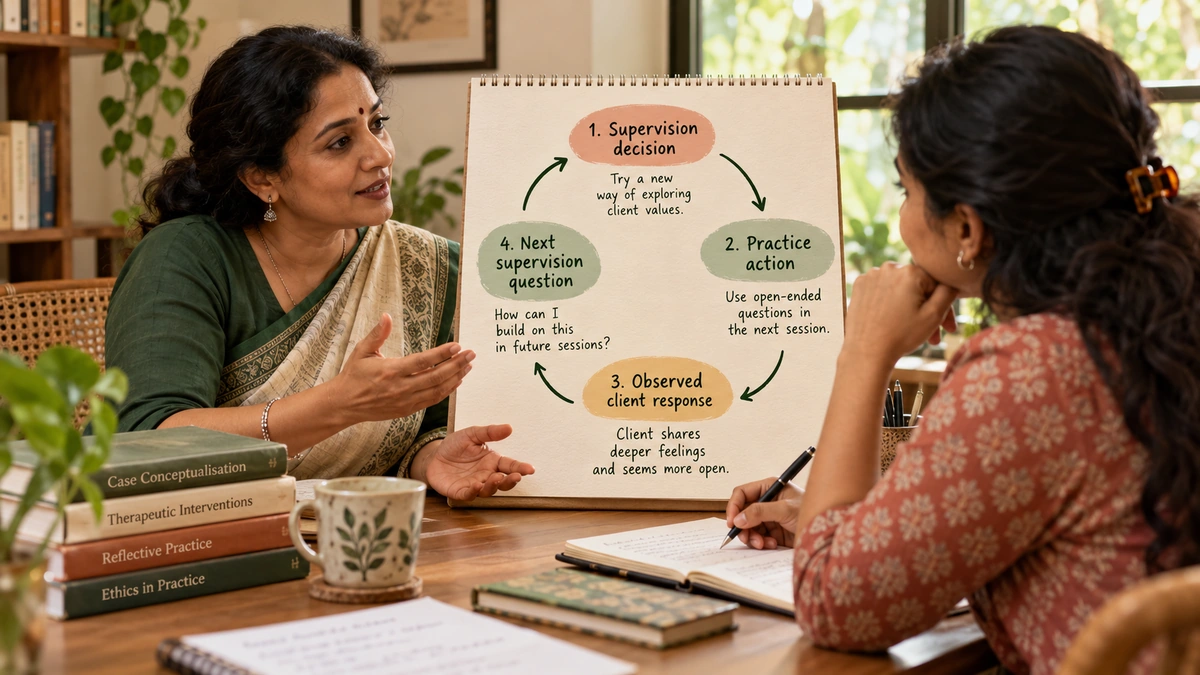
Choose one observable step. Riya might practise a closing sentence, use it in the next appropriate session, and bring the client’s response back. That creates a learning loop. If it goes poorly, the information is useful. If it goes well, ask what made it work and whether it can be adapted.
If you want to practise the communication skill you identified in supervision, review PsyQuench’s counselling and psychotherapy course. Check the current variant, eligibility, price, and availability; course practice does not replace your formal supervision.

What If I Feel Ashamed or Have Nothing Dramatic to Bring?
Bring ordinary uncertainty. A repeated late session, a question you avoided asking, or an unexpected emotional reaction can matter precisely because it is easy to dismiss. You do not need to wait for a serious mistake to make supervision worthwhile.
Bring ordinary uncertainty before it grows
Maybe you are unsure whether you explained confidentiality clearly at intake. Maybe you notice that you always give extra time to one client and not others. These are questions about fairness, boundaries, and practice. They deserve a place on an agenda even if nothing visibly went wrong.
“I have nothing” can sometimes mean you are looking only for unusual cases. Ask instead: Which decision took me longer than expected? Where did I feel least sure? What feedback from a client surprised me? What do I keep postponing? The answers often reveal useful clinical supervision questions.
How to discuss mistakes and emotional reactions
Shame can make a trainee minimise a concern, then spend the meeting talking around it. A direct opening might be: “I am embarrassed to bring this up, but I think my reaction affected how I responded.” You do not need a polished analysis before asking for help. Describe what happened, what you noticed, and what you did or did not do.
If a mistake may affect safety, confidentiality, or client welfare, follow the required reporting and consultation process promptly. A scheduled meeting may be too late. Supervision should help you take responsibility, not hide the issue until you can present it neatly.
Our article on the value of guided practice explains why feedback during training matters. In actual client work, that feedback belongs within the proper supervisory relationship and privacy safeguards.
How Do I Turn Supervision Feedback Into Practice?
Using supervision feedback well means leaving with one action, one date, and one way to check what changed. “Be more confident” is not an action. “At the next session, explain the time boundary at the start and ask how the client experiences the ending” is. Then return with what happened, including what did not go as expected.
Choose one action after the meeting
If the supervisor offers several ideas, agree which to try first and why. Some issues need an immediate policy step; others need skill practice. Distinguish the two. A roleplay can help you rehearse the wording, while the supervisor remains responsible for guidance within the actual clinical setting.
If you are studying counselling, looking at how PsyQuench describes its client-facing counselling service can help you see what prospective clients may expect. It is context for learning, not a replacement for your own service’s consent and supervision arrangements.
Set a date to check what changed
Bring the result to the next appropriate supervision meeting. “I used the closing sentence and the client said it felt abrupt” is new information. You and your supervisor can then decide whether to adjust the wording, explore what endings mean to the client, or review your formulation. Without a return step, supervision can become a collection of good ideas that never meet practice.
Where course practice can support the skill
A course can offer fictional scenarios, demonstration, and feedback on wording or listening. It cannot approve a clinical decision for a particular client or replace the supervisor and institution responsible for your work. If you are looking for an RCI license, check the Rehabilitation Council of India’s current registration guidance for the recognised qualification and registration requirements of the professional category you intend to enter; a short skills course does not by itself confer that status. This third source is necessary for the time-sensitive licensing clarification. Keep these learning channels in their proper roles.

If you want structured practice alongside your formal supervision, view PsyQuench’s counselling and psychotherapy course. Check the course details and professional scope before enrolling.
FAQs About Preparing for Clinical Supervision
Should I send my agenda before the meeting?
Ask your supervisor. A short agenda may help them prepare, but use only approved channels and include only information you are authorised to share. Urgent safety concerns should be escalated immediately, not left in a pre-meeting email.
What if I have several cases to discuss?
Prioritise by urgency and the impact of the decision. Agree with your supervisor how to handle the rest. One well-examined question may be more useful than a hurried summary of five cases. Safety and mandatory reporting needs follow their own timelines.
Can I bring a question about my own reaction?
Yes. A strong feeling, avoidance, over-identification, or urge to rescue may affect judgement. Describe the situation and what changed in your response. Supervision is an appropriate place to reflect on the clinical impact while respecting the limits of the supervisory relationship.
What should I avoid writing in personal notes?
Avoid identifiable client information in unapproved notebooks, devices, or tools. Follow your organisation’s rules on what belongs in the clinical record and what may be kept for supervision. Ask when you are unsure; privacy duties vary by role and jurisdiction.
How do I ask for feedback that is specific?
Name the moment and the choice: “When the client asked to stay longer, what else could I have said while keeping the boundary?” Ask the supervisor to roleplay a response or explain why one option fits better. “How can I improve?” is a reasonable start, but a concrete example will produce clearer feedback.
Can a course assignment replace clinical supervision?
No. A course exercise can build skill with fictional material. Formal clinical supervision involves responsibility for real work, ethical decisions, and the requirements of your placement, employer, and regulator. Confirm those requirements directly rather than assuming a certificate or assignment meets them.