NCAHP Psychologist Registration 2026: Am I Eligible and What Should I Do Next?
Start with your exact qualification, study mode, experience record and intended professional role.
The NCAHP psychologist registration update has left many students and practitioners asking the same thing: what does this mean for my degree and my next career step? A recent MA graduate may be worried about the experience requirement. A distance learner may be unsure whether their qualification will count. Someone already seeing clients needs to understand which registration route applies to them.
At PsyQuench, we want to make those decisions easier to approach. This guide explains the 2026 registration framework through the questions that matter to psychology students, graduates and working professionals. It also draws on the educational webinar by Pragati Prasad, an RCI-registered clinical psychologist, while using the official notification as the reference for regulatory requirements.
The essential point is that a psychology degree, an internship certificate and an online enrolment ID are not interchangeable with professional registration. Your eligibility depends on the applicable qualification route and its conditions, followed by verification by the competent authority.
Updated 20 September 2026. This article provides general educational information; individual registration decisions rest with the competent authority.
Understanding NCAHP Psychologist Registration in 2026
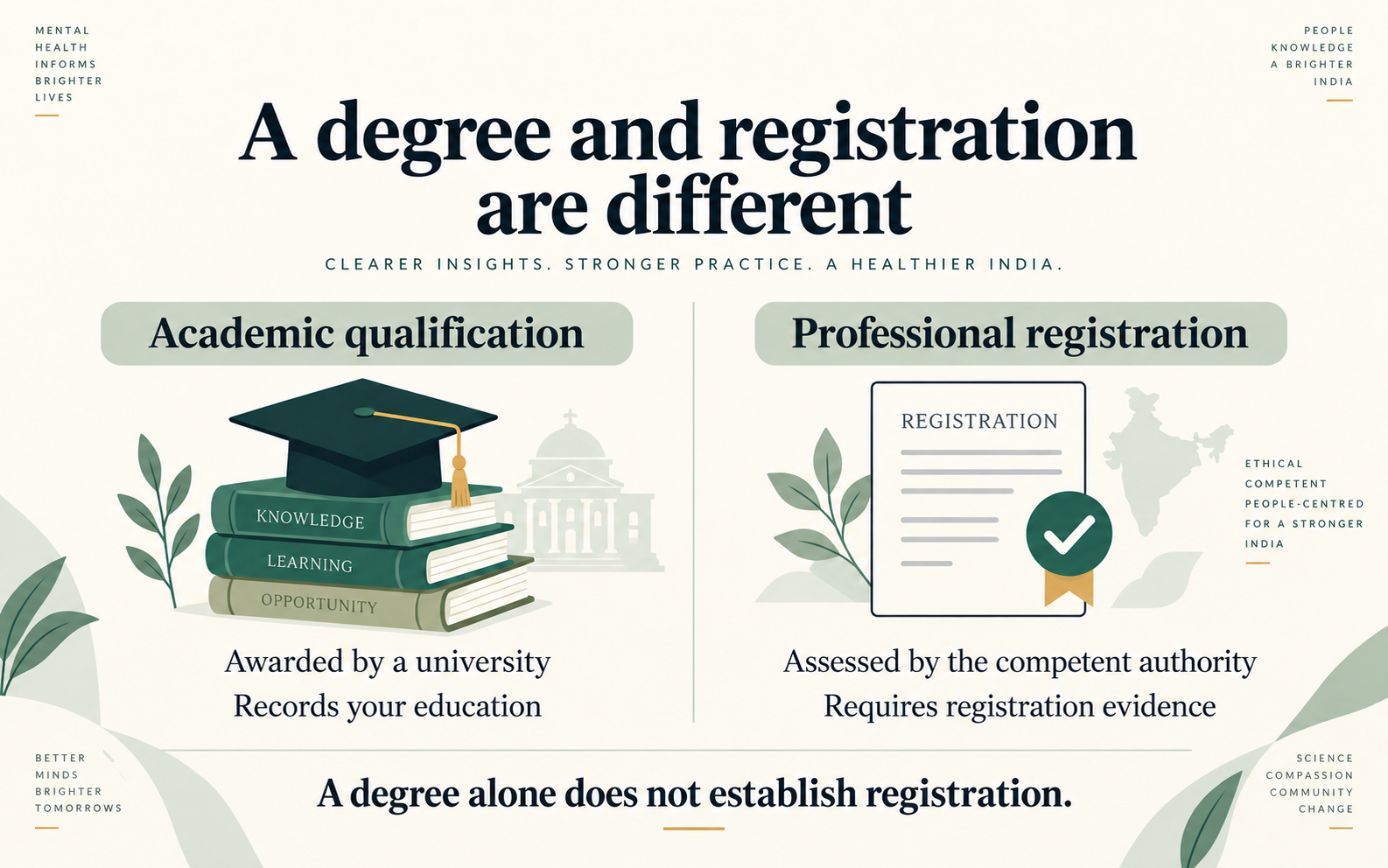
A psychology degree records your academic qualification. Professional registration records your acceptance into a regulated professional category. One does not automatically produce the other.
Think of a graduate holding a university marksheet and an internship certificate. Those documents may support an application, but neither is a registration certificate. Under Regulation 3, the ordinary registration framework involves entry in the relevant State Register and Central Register and receipt of the relevant UID. There is a Central Register route where the State Council has not been established.
Pragati Prasad, an RCI-registered clinical psychologist, explains this distinction between academic qualifications and professional registration in her webinar. You can watch her discussion of NCAHP registration and student questions. She also explains that she is sharing her understanding, not speaking for a legal authority. That distinction matters when applying a general answer to your own degree or work history.
The governing Act is the NCAHP Act, 2021. The registration regulations are from 2026. Keep those dates separate when checking older advice, because rules for an existing practitioner can depend on when they began offering services.
The National Commission for Allied and Healthcare Professions is usually shortened to NCAHP. In the registration schedule, psychology sits within Community Care, Behavioural Health Sciences and Other Professionals. The psychologist category includes an explicit exclusion for clinical psychologists covered under RCI for PWD. This makes it important to identify your intended professional role before choosing a qualification or application route.
A degree and a professional registration certificate answer different questions.
NCAHP Eligibility: How Your Psychology Qualification Fits
The most useful starting point is your complete educational history. Schedule I lists qualification titles, course durations, learning modes, experience requirements and accompanying remarks. Read these together; a familiar course title in one column does not establish eligibility on its own.
MA and MSc Psychology Graduates
Not on the basis of the master’s certificate alone. The listed MA and MSc psychology rows show two years of health-setting experience, two years of course duration and regular mode of learning. The accompanying remarks also describe a three-to-four-year undergraduate qualification in Psychology or Applied Psychology followed by two years of postgraduate study in those fields.
This is why “my master’s is on the list” is only the start of the eligibility check. Read your degree row together with the remarks, then check your undergraduate background, programme duration, learning mode and experience evidence. Schedule I pages 82–85 contain the relevant undergraduate and postgraduate entries.
For example, a recent graduate with a regular BA in Psychology and a regular two-year MA in Counselling Psychology has an educational history to compare against that route. They still need to establish how the applicable experience requirement is met. Someone with the same MA title but a different undergraduate background needs an answer about that combination as well.
The two-year experience requirement understandably attracts attention, but it should not be read as a promise that every graduate becomes eligible exactly two years after graduation. The acceptance and calculation of your experience need to be established for your route.
BA and BSc Psychology Graduates
Do not assume that the undergraduate row provides a standalone BA-or-BSc-plus-experience route. Those rows show three years in the experience column, but the shared remarks describe undergraduate and postgraduate study together. Reading only the left-hand qualification cell leaves out a significant condition.
The schedule also has separate Bachelor of Psychology entries, including B.Psy and B.Psych. These should not be casually treated as alternative spellings for every BA or BSc in psychology. The recognised qualification and institution matter, not just a similar abbreviation.
For an undergraduate planning the next stage, ask the university which qualification route the programme supports. If you are considering a four-year degree followed by a one-year master’s, request clarification about that combination: the ordinary remarks specify two years of postgraduate study. An assumption about equivalence is not the same as a documented regulatory decision.
A Psychology Master’s After a Different Bachelor’s Degree
Your master’s qualification may be academically valid, but that does not settle your NCAHP registration eligibility. The ordinary UG-plus-PG remarks expressly refer to undergraduate study in Psychology or Applied Psychology as well as postgraduate study. A university’s decision to admit you to an MA does not override the registration authority’s requirements.
If you studied commerce, engineering or another subject before your psychology master’s, seek a response that addresses your exact qualification combination. Other listed routes must be considered on their own terms; they are not automatic exemptions.
A useful written query would say: “I completed a three-year BCom in 2021 and a two-year regular MA in Psychology in 2024. I have the following work experience. Which Schedule I route, if any, applies to my qualifications?” Attach the relevant academic records when requested.
Do not pay for a second bachelor’s degree, bridge course or diploma solely because someone says it will fix the issue. First establish what the authority actually requires and whether the proposed programme meets it.
Distance and Online Psychology Degrees
No conclusion about the value of your entire degree follows from a registration question. Academic recognition and eligibility for a particular professional register are different matters. Equally, it would be misleading to assure every distance learner that their degree automatically satisfies NCAHP requirements.
The listed BA, BSc, MA and MSc psychology entries specify regular mode. If your programme was offered through open and distance learning or online study, that is a material issue to clarify. The university name alone cannot answer it, and a general statement that online and offline learners should register is not proof that both meet the same eligibility conditions.
Keep your admission date, completion date, programme title, learning mode, marksheets and relevant recognition records together. If you have been practising, include when that work began and what it involved. Ask whether any applicable transitional provision or other recognised route addresses your circumstances.
Describe the learning mode accurately in any application. If your certificate does not state it, keep the supporting university records available. The authority needs to assess the actual programme rather than infer its delivery mode from an incomplete certificate.
Distance and online learners should keep programme mode, dates and recognition records ready for an exact eligibility query.
Postgraduate Diplomas and Doctoral Qualifications
Schedule I also contains advanced and postgraduate diploma entries, introduced as being considered along with a postgraduate qualification in psychology. The listed diploma rows generally show one to two years of regular study and one year of health-setting experience. A short training certificate is not equivalent to these qualifications simply because its subject is counselling or psychotherapy.
The doctoral block has separate conditions. Its remarks refer to a PhD in Psychology, Applied Psychology or related applied fields, with a master’s in Psychology or Applied Psychology from a recognised Indian university. If you are considering either a diploma or doctoral route, check the entire entry rather than assuming that a higher qualification removes every other requirement. These entries appear on pages 85–88 of the notification.
The Experience Requirement: What Graduates Need to Clarify
Gaining Experience Before Full Registration
How can someone gain the required experience when registration is needed to practise? This concern also comes up in Pragati Prasad’s webinar. The regulation provides an interim registration mechanism for training required for a recognised qualification. That does not, on its own, answer every question about experience gained after graduation.
If you are still enrolled, speak to the institution about the required placement, interim registration and its attached practising facility. If you have already graduated, ask the relevant authority and prospective placement provider what arrangement permits your proposed duties and whether the experience will count towards your route.
Before accepting a role, establish what you will actually do. Observation, simulated case discussions, supervised client work and independent practice involve different responsibilities. A job advertisement that uses all four terms loosely can leave you with poor evidence and unclear boundaries.
Request a written role description, supervision arrangements, dates, hours and an accurate completion or experience certificate. Do not assume that working without the required authorisation becomes acceptable simply because you need experience for a future application. The unresolved practical issue needs an authorised route, not an improvised workaround.
Experience is easier to assess when the setting, duties, hours, supervision and authority are documented clearly.
Internships, School Counselling and Online Work
There is no reliable blanket yes for every setting. The psychologist schedule requires experience in health settings, but the table does not conclusively establish how every school, NGO, private practice, research role or remote service will be assessed.
Consider two people whose certificates both say “psychology internship.” One observed recorded sessions and completed assignments. The other carried out defined duties in a service setting under documented supervision. Their learning may both be useful, but the certificates do not establish that their experience will be treated identically for registration.
Ask about the work rather than relying on its label. Was it part of a degree? Was there direct service delivery? Who supervised it? What was the institution or facility? How many hours were completed? Can the provider verify those details? These are useful facts to assemble, even where the authority has yet to specify exactly how it will assess them.
Also avoid confusing the schedule’s columns. “Regular” is entered under mode of learning. That wording should not by itself be used to declare that all employment must be offline, or that all online work is acceptable. Those are separate experience questions.
PsyQuench’s article on supervision in psychology training explains why structured feedback matters to learning. For registration, seek confirmation about the particular placement and retain evidence of what actually happened there.
A useful experience record describes what you did, where you did it, when you did it and who supervised it.
Interim and Provisional Registration: Which Situation Applies to You?
These terms describe different regulatory arrangements. Being a student, a recent graduate or a working professional does not make them interchangeable. The relevant provision and your circumstances determine the route.
Interim Registration for Required Student Training
Regulation 17 says the recognised institution initiates the interim registration process with the State Council. It concerns an internship, training, observership or practical training required to fulfil a recognised qualification. The regulation also refers to training at the practising facility to which the institution is attached. There is no application fee for interim registration under this provision.
Your first contact should therefore be the department or placement coordinator responsible for your programme. Ask whether interim registration has been arranged, which facility is covered and what documentation you should receive before beginning the required placement.
For example, if your MA requires a placement, a training provider’s willingness to accept you is only one part of the arrangement. Your institution’s role and the regulatory process still need to be established. Do not assume that an independent short course follows the same route as a required university placement.
Provisional Registration for Certain Existing Practitioners
Existing practitioners do not automatically receive provisional registration. It is a specific provision rather than a universal category for everyone working today. Regulation 3 refers to people offering services in recognised categories on or before commencement of the Act who do not possess the recognised qualification. The definition connects provisional registration to Section 38 of the Act.
That is narrower than saying “all existing practitioners receive provisional registration.” Someone who began working recently should not assume that they fall within a provision tied to commencement of the 2021 Act. Someone with a recognised qualification should check the applicable regular registration route rather than assuming that employment status dictates a provisional route.
Prepare a dated account of your qualifications and work history. Ask the authority which provision applies and what evidence it needs. If your situation affects ongoing client work, obtain individual regulatory or legal advice about your status and duties; a general webinar cannot determine them for you.
PsyQuench’s earlier article on counselling practice without an MPhil or PsyD offers background on training and practice questions. Read any older career guidance alongside the 2026 regulations rather than treating it as a current eligibility decision.
How to Approach the NCAHP Registration Process
Step 1: Distinguish AHPR Enrolment From Registration
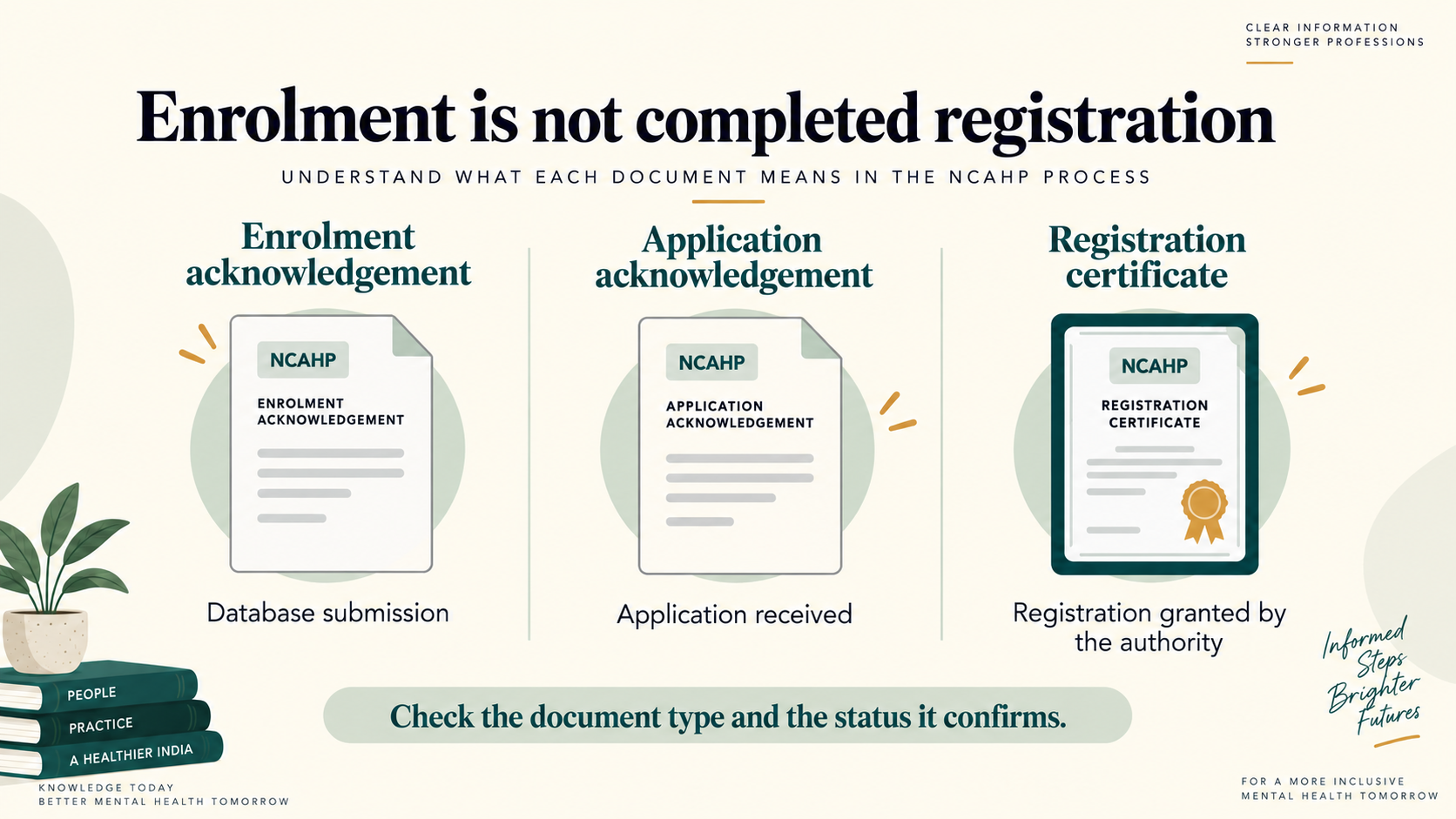
Submitting an AHPR enrolment form does not itself establish professional registration. The government’s Allied and Healthcare Professionals Enrolment Portal identifies its activity as data collection and distinguishes enrolment from registration. Check whether you have an enrolment acknowledgement, a registration application acknowledgement or an actual registration certificate; these are different documents.
The portal’s explanatory text may not update at the same time as the Gazette. Its older reference to regulations being under process does not undo the published 2026 instrument. What remains useful is the explicit distinction between database enrolment and statutory registration.
Until you have the relevant registration evidence, do not add “NCAHP registered” to a profile simply because the website generated an enrolment ID. Check the issuing authority, type of document and status recorded.
AHPR enrolment, application acknowledgement and professional registration are not the same document.
Step 2: Identify the Authority and Application Route
Regulation 4 describes submission of Form R-1 to the State Council, with the fee prescribed through the state process. Regulation 12 provides for a direct Central Register application until a functional State Council has been established and specifies a ₹2,000 registration fee for that route. That is not a universal fee for every application in every state.
Identify the authority for your state or Union territory and obtain its current submission instructions. A State Council is not a separate council for each city. Do not assume that a form circulating in a messaging group identifies the correct submission address or payment channel.
Step 3: Prepare Form R-1 and Supporting Records
Read Form R-1 in Schedule II, beginning on page 110, and the current application checklist. Organise identity and residence evidence, academic records, curriculum details, internship certificates and experience documents as applicable. Retain the submitted application and acknowledgement.
Before submitting, compare names, dates and qualification titles across your records. Explain discrepancies through the official process and retain a copy of everything you send. If an experience letter is vague, request an accurate description of the duties and period of work rather than trying to make an unsupported claim yourself.
Step 4: Await Verification and the Registration Decision
Regulation 4 provides thirty working days for acceptance or rejection by the State Council. This is not a guarantee of approval within thirty calendar days. The authority must verify eligibility, and the available submission process must also be checked. Regulation 5 provides for correction of defects and a reasoned rejection with an appeal mechanism.
Once a decision is issued, check the status, profession, certificate details and UID rather than assuming that a payment receipt confirms approval. Keep the authority’s correspondence with your professional records so you can answer future verification queries accurately.
NCAHP and RCI Registration Are Distinct Professional Routes
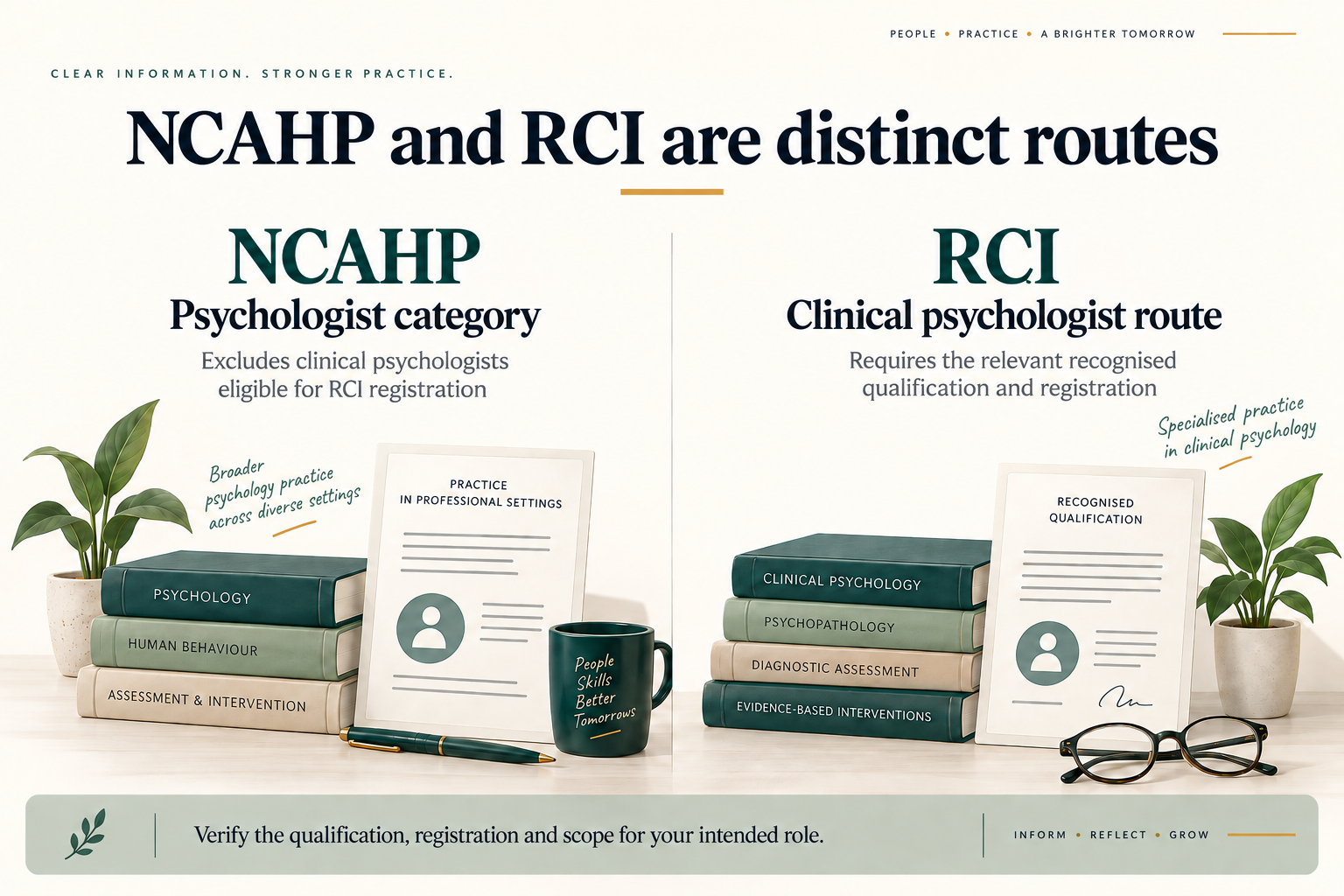
The notification’s psychologist category excludes clinical psychologists covered under RCI for PWD. Its notes also state that clinical psychologists eligible to register under RCI are not to be considered for NCAHP registration. These are distinct regulatory routes.
The presence of a non-RCI Clinical Psychology degree in the NCAHP schedule does not make it an RCI qualification. Before choosing a programme, identify the professional role you want and the registration that role requires. Do not assume that the words “clinical psychology” on a degree certificate resolve that question.
PsyQuench’s overview of RCI and non-RCI psychology courses introduces the distinction. Check the current regulator-issued requirements for your intended programme and admission year before making a commitment. A comparison article is background reading, not proof of a course’s current approval.
NCAHP and RCI are separate regulatory routes. Choose the route that matches the professional role you intend to hold.
What Changes for Foreign-Qualified Applicants?
Foreign-qualified applicants are not limited to one universal temporary route. The regulations address both registration and temporary registration for foreign-qualified professionals. Regulations 18 and 19 deal with eligibility and registration, including recognised foreign qualifications or equivalency evaluation and the relevant examination requirements. Temporary registration is addressed separately for specified purposes and periods.
If you completed a master’s abroad and plan to return to India, identify the qualification, country, recognition status and intended work. Ask which route applies rather than assuming that every foreign graduate receives the same temporary certificate. Read the provisions for the route relevant to your qualification and intended purpose.
Exit Examination, CPD and Five-Year Renewal
Regulation 4 includes an exit examination requirement. It also says that until the Commission specifies the examination, the recognised institution’s final examination for the recognised qualification is treated as the exit examination. Do not assume that a separate new psychology test has already been announced for everyone.
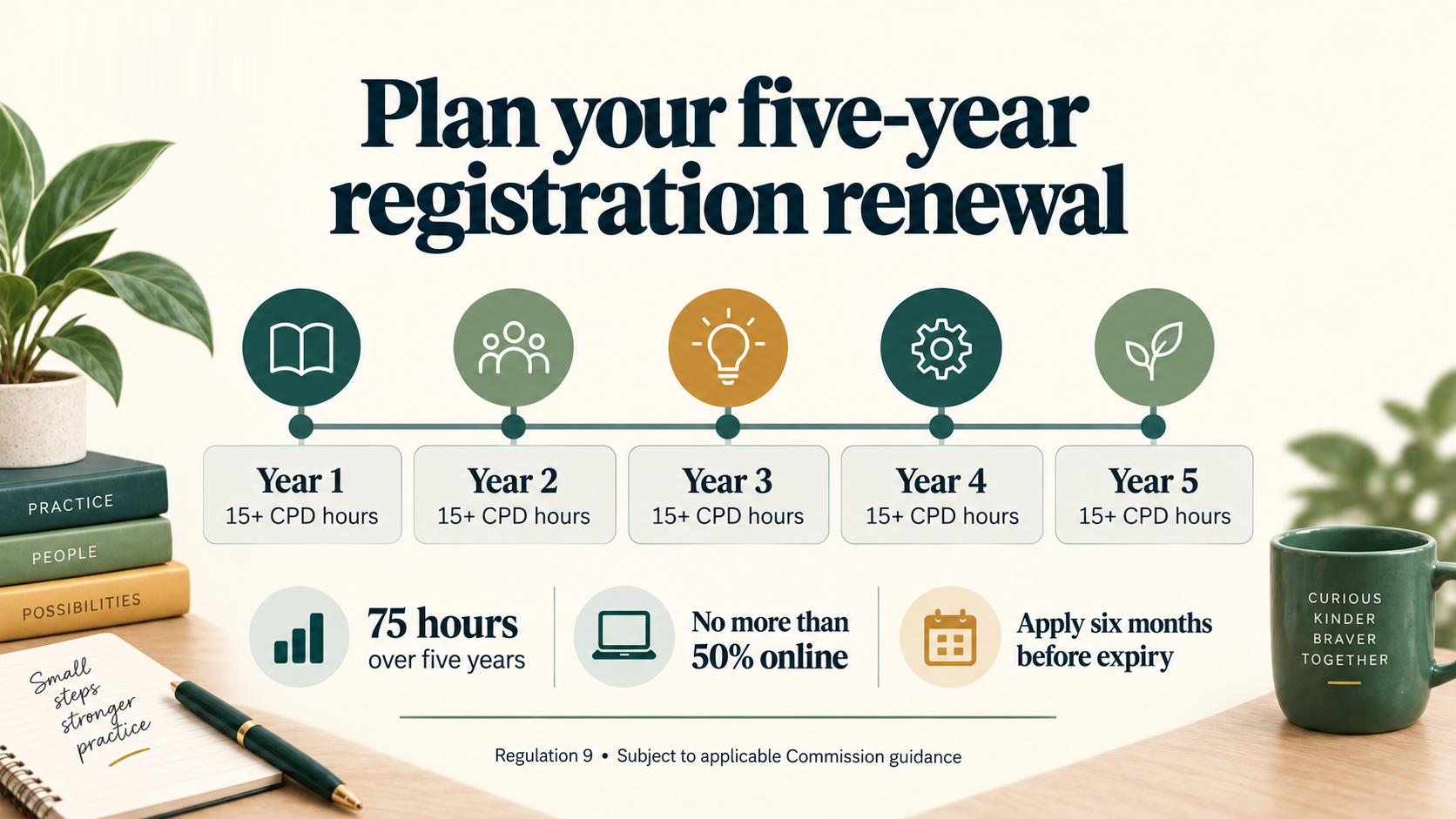
For renewal, Regulation 9 specifies five-year validity, at least fifteen hours of continuing professional development education each year and seventy-five hours across five years. These are hours, not an interchangeable points total. Online CPD must not exceed fifty per cent; this does not require an exact fifty-fifty split.
Keep attendance certificates and comply with further Commission guidance about accepted CPD. A webinar can be educationally useful without being approved for renewal purposes. Ask about acceptance before paying specifically to obtain CPD credit.
The renewal application is to be made six months before expiry. The regulations address inactive status when no renewal application is received before expiry and state that practice is not permitted during inactive status. Put the application date in your calendar instead of waiting for the certificate to expire.
Registration renewal planning begins long before expiry: track CPD hours and apply within the required timeline.
Where PsyQuench Training Fits Into Your Professional Development
Choosing additional training is easier when you separate the skill you want to learn from the registration condition you need to meet. You might want more practice with interviewing or case formulation, while your application requires clarification about recognised experience. One programme should not be assumed to resolve both needs. A course certificate or experience letter does not guarantee acceptance by NCAHP or a State Council.
In the webinar, Pragati discusses training and experience letters but also acknowledges uncertainty about recognition and describes current offerings as skill development. The responsible takeaway is to ask what a programme documents and what regulatory recognition, if any, has actually been confirmed. Do not treat a three-month course as automatically supplying three months of accepted statutory experience.
If your aim is to improve interviewing, reflection or case conceptualisation, review the Counselling and Psychotherapy course against that learning need. If your focus is CBT and REBT-related skills, review the Cognitive Therapies course. Neither course link should be understood as a promise of registration, an experience exemption or approved CPD credit.
Before enrolling, ask for the curriculum, learning mode, supervision arrangements and the exact wording of the completion documents. The guide to short-term psychology courses and career development can help you consider supplementary learning alongside your formal qualifications.
Your Next Steps Before Applying or Choosing Another Course
If you are a student, ask your institution about the recognised qualification route and the arrangements for required training. If you are a recent graduate, compare your education with the complete Schedule I entry and request guidance on acceptable experience. If you are already practising, document when you started, what qualifications you held and which registration provision applies.
For an unresolved case, send one focused query: “My qualification is [exact title], awarded by [institution], completed in [mode and dates]. My relevant experience is [setting, duties, dates and hours]. Please confirm the applicable registration route and whether this experience is acceptable.” This gives the authority concrete facts to assess.
You can consult the 2026 Gazette notification, available here as a public PDF mirror. Start with Regulations 3–4 for registration, Regulation 17 for interim registration, Regulation 9 for renewal, and Schedule I pages 82–88 for psychology qualifications. The document is dated 31 August 2026, the Gazette issue is dated 9 September 2026, and the electronic identifier is CG-DL-E-15092026-276186.
Visual Reference & Infographic Guide Gallery
Swipe or click through the gallery below to review the key infographics covering degree vs. registration, distance learning records, supervised practice requirements, AHPR enrolment differences, RCI comparisons, and 5-year CPD renewal timelines:
Conclusion
Understanding NCAHP psychologist registration starts with the details of your own education and work. For a student, the immediate question may be how the institution is arranging required training. For a graduate, it may be which experience will be accepted. For an existing practitioner, it may be the correct registration provision and the evidence needed to support it.
Before changing your degree plans or buying another course, find out which specific gap you are trying to address. It might be a qualification requirement, an experience question or simply missing documentation. Each calls for a different response. Getting that distinction right is more useful than collecting certificates in the hope that one of them will settle the registration question.
Once the regulatory question is clear, choose further learning around the skills you want to strengthen. PsyQuench’s course pages can help you explore those learning options, while eligibility and registration decisions remain with the relevant authority.
Frequently Asked Questions About NCAHP Psychologist Registration
Is NCAHP registration the same as AHPR enrolment?
No. AHPR enrolment contributes information to a professional database. Statutory registration involves the applicable authority’s process, verification and registration evidence. An enrolment ID alone is not proof of registration.
Can I register with an MA or MSc in Psychology?
Listed MA and MSc qualifications are part of the schedule, but the degree alone does not establish eligibility. Check the accompanying undergraduate requirements, two-year postgraduate duration, regular mode and applicable health-setting experience conditions.
Can IGNOU or other distance psychology graduates register?
Do not assume automatic eligibility or automatic rejection from the university name alone. The listed psychology degree rows specify regular learning. Distance graduates should request an assessment of their exact programme, dates and any applicable transitional or other recognised route.
What if my bachelor’s degree is not in psychology?
The ordinary UG-plus-PG remarks specify undergraduate Psychology or Applied Psychology. A master’s admission offer does not settle professional registration eligibility. Seek written clarification about your complete qualification combination before choosing another programme.
Does an internship count towards NCAHP experience?
Acceptance depends on the applicable requirements and assessment of the actual work. Keep evidence of the setting, duties, dates, hours and supervision. Do not assume that all internships, observerships or online training programmes count equally.
Who arranges interim registration for students?
Under Regulation 17, the recognised institution initiates the process with the State Council for training required for the recognised qualification. Students should contact their institution about the covered placement and necessary documentation.
Does every practising psychologist qualify for provisional registration?
No. The provision is tied to specified circumstances, including offering services on or before commencement of the Act without the recognised qualification. Current employment alone does not establish entitlement to that route.
How much does NCAHP psychologist registration cost?
State application fees depend on the relevant state process. Regulation 12 specifies ₹2,000 for the direct Central Register route until a functional State Council is established. Confirm the route and official payment instructions that apply to you.
Can a PsyQuench certificate guarantee NCAHP registration?
No. Supplementary training can support professional learning, but it does not automatically replace recognised qualifications or guarantee accepted experience, registration or CPD credit. The competent authority determines acceptance.
How many CPD hours are needed to renew registration?
Regulation 9 specifies at least fifteen hours each year and seventy-five hours over the five-year period. Online CPD must not exceed fifty per cent, and further Commission guidance must be followed. Apply for renewal six months before expiry.
Does NCAHP registration make me an RCI clinical psychologist?
No. NCAHP and RCI are distinct routes. The notification excludes clinical psychologists eligible for RCI registration from consideration for NCAHP registration. Check the qualification and registration required for your intended role.
Hi, Please Go Through Our
Courses And Counselling
Services.






















![*📢 NCAHP NEW GUIDELINES FOR PSYCHOLOGISTS — PART 1*
Missed yesterday’s FREE webinar? You can now watch Part 1 on YouTube! 🎥
Ms. Pragati Prasad, RCI Certified Clinical Psychologist, conducted this session to help psychology students and psychologists understand the new NCAHP guidelines and get clarity on what they mean for the profession.
▶️ *Watch Part 1 here:*
Comment HI to get the details
If you’re serious about upgrading your psychology skills and becoming a more confident, skilled professional, explore our practical training programs at:
🌐 [www.psyquench.com]
Do share this video with your psychology peers who may find it useful. 🧠](https://psyquench.com/wp-content/plugins/instagram-feed/img/placeholder.png)